

New Zealand needs a ‘traffic light’ system to stop COVID-19 creeping in at the border
- Written by Nick Wilson, Professor of Public Health, University of Otago
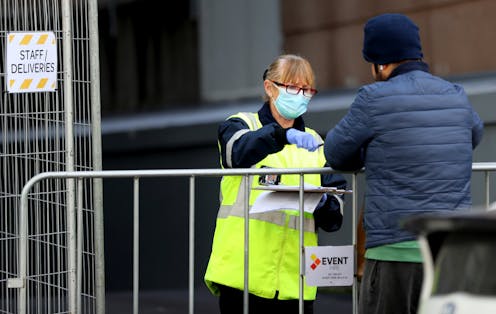
Following the sixth COVID-19 incursion in three months, New Zealand needs to shift from a one-size-fits-all strategy to a risk-based approach to border management.
Two staff have recently tested positive after coming into contact with international seafarers in the course of their duties at a managed isolation facility in Christchurch, where 31 mariners with COVID-19 remain in quarantine.
Mandatory testing of international mariners, who may be only briefly in the country to join their vessels, is being introduced from this week.
This latest incursion follows five earlier border failures since early August. One of these led to the recent outbreak in Auckland.
We propose an urgent shift to a traffic-light approach to border control. This system would facilitate travel to New Zealand from places that are free of COVID-19 (some Australian states and Pacific islands), while reducing the risk associated with travellers from jurisdictions with uncontrolled spread.
Keeping COVID-19 at the border
One of the recent border failures led to the relatively serious outbreak in Auckland, with 179 cases, three deaths and major social and economic impacts.
Two other outbreaks, including one from a returnee infected in a quarantine facility and the latest from port workers infected by incoming seafarers, were controlled at an early stage.
The others involved infections of border facility workers: health workers on two occasions and a maintenance worker.
These six events represent system failures — the goal should be to have complete containment of infection at the border and no cases in the community.
Read more: COVID-19 and small island nations: what we can learn from New Zealand and Iceland
Contributing factors include the use of hotels for quarantine (for which they are not designed) and poor system design, including the lack of testing of seafarers flying into the country to join their ships.
Such failures could increase if the proportion of infected travellers coming to New Zealand increases as many parts of the world experience resurgences and rising infection rates. Given the marked difference in the intensity of the COVID-19 pandemic in different regions and countries, we propose a traffic-light system of risk stratification for jurisdictions from which travellers arrive in New Zealand.
New Zealand has much of the infrastructure already in place to support this shift, including a booking system that could help to manage it. We would also get very rapid data on whether it is working, based on the rate of positive cases detected at the border.
Green: quarantine-free travel with precautions
A growing number of countries in the Asia-Pacific region have eliminated COVID-19, notably most states of Australia. Some Pacific island jurisdictions have never had cases.
Quarantine-free travel should be possible from these jurisdictions, provided an assurance program is in place to ensure elimination requirements are being met, including adequate levels of testing. Since there is always a small risk of outbreaks from border control failures (Australia also uses hotels for quarantine, which failed in Victoria), we would need to consider retaining aome controls, such as:
rapid testing (using PCR methods) on arrival in New Zealand, or rapid antigen tests once these are considered reliable enough and are available in New Zealand
digital tracking for the first three weeks in New Zealand (via a traveller’s smartphone and with government-provided phones for those who don’t have their own)
paying a bond (eg NZ$1000) to be returned after three weeks if the traveller has adhered to the digital tracking system.
Read more: How to use COVID-19 testing and quarantining to safely travel for the holidays
Amber: current border quarantine and testing
These could be states with evidence of ongoing pandemic spread, but where it is relatively well controlled (for example, in Japan, South Korea, Singapore). For this zone, the current measures (facility-based quarantine for 14 days and testing twice during that period) could apply, albeit with some refinements.
Facility-based quarantine periods could be shorter and replaced with home quarantine. The isolation period at home could be combined with the usual PCR testing, digital tracking, mask use and heavy fines for any breaches.
Various East Asian jurisdictions, including Taiwan, have successfully used home quarantine.
As above, a bond could be used to encourage adherence to the conditions.
Red: additional measures or no travel
Jurisdictions with uncontrolled pandemic spread (including US, UK, Russia and India) would fall into this category. For New Zealanders returning from these places, the government could require pre-travel measures in addition to the current quarantine.
The form of these measures needs careful development, but could include evidence of both pre-travel home quarantine (for three days or more) and negative pre-travel test results.
New Zealand should evaluate the experience in countries already using pre-travel COVID-19 testing to determine the most feasible approach. Currently, Cyprus, Bahamas, Bermuda, Hawaii, Hong Kong and Italy require proof of a negative result on arrival.
Such measures add to the burden these travellers face, but can be justified. They reduce the risk of outbreaks on incoming aircraft as well as the load on the isolation/quarantine facilities.
Quarantine facilities for these travellers could be restricted to those outside of Auckland, for example at the Ōhakea air base, ideally in purpose-built facilities with properly designed ventilation and no shared spaces.
If all these measures still resulted in high numbers of infected travellers arriving in New Zealand, we would need to consider suspending travel from these red-zone jurisdictions. New legislation could empower the government to allow for such constraint on the right of citizens to return to New Zealand from high-risk countries during a global pandemic.
Authors: Nick Wilson, Professor of Public Health, University of Otago

















