

This tiny amphibian that outlived the dinosaurs provides the earliest example of a rapid-fire tongue
- Written by Joseph Bevitt, Senior Instrument Scientist, Australian Nuclear Science and Technology Organisation
Albanerpetontids, or “albies” for short, are the cute little salamander-like amphibians you’ve likely never heard of.
Now extinct, Albies had a dream run. They’d been around since the Middle Jurassic around 165 million years ago, and probably even earlier. They lived through the age of dinosaurs (and saw out their extinction), then lived through the rise of the great apes, before quietly disappearing about 2.5 million years ago.
Albie fossils are scattered across continents, including in Japan, Morocco, England, North America, Europe and Myanmar. But until recently, we knew relatively little about what they looked like or how they lived.
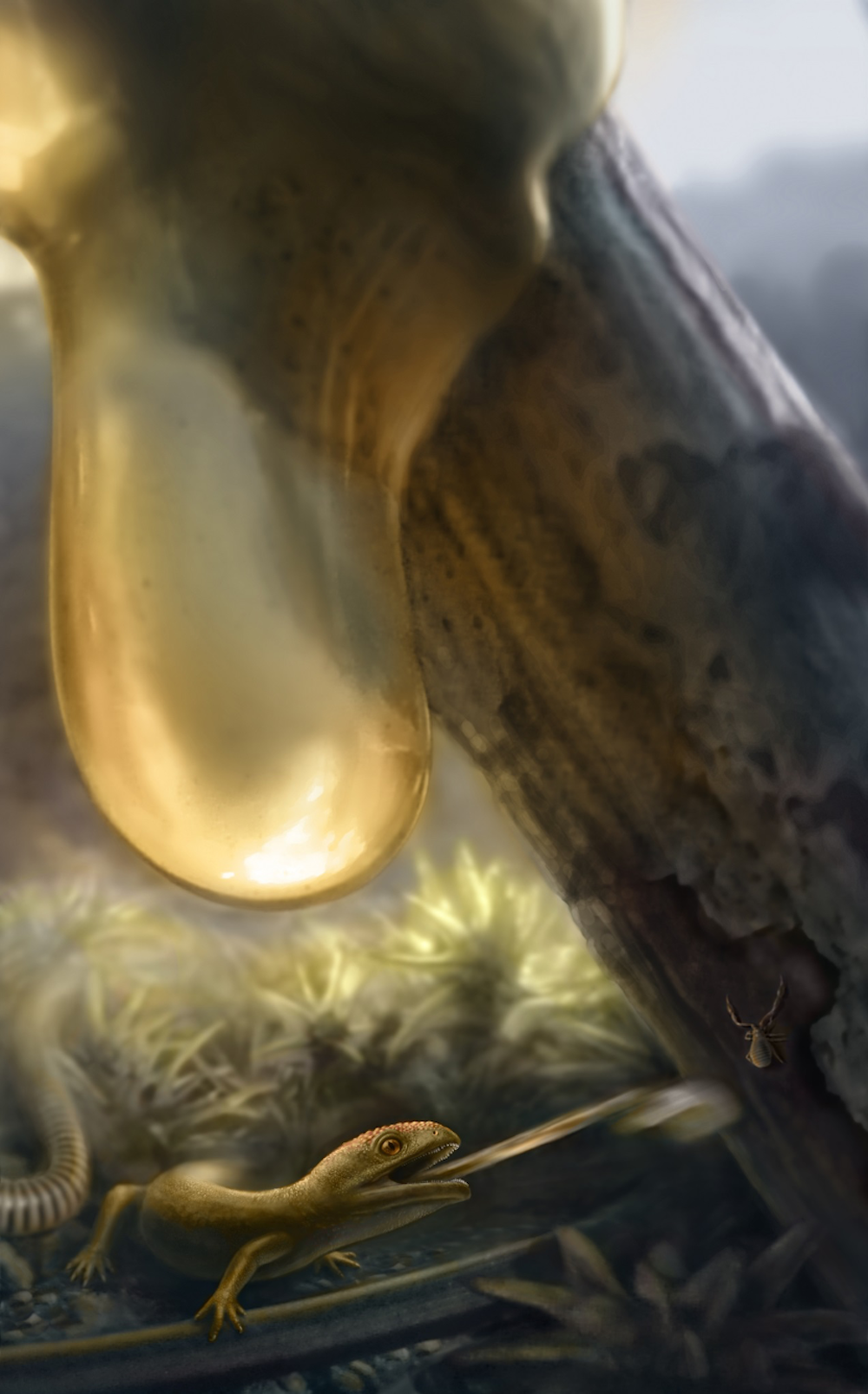
New research by my colleagues and I, published today in Science, reveals these amphibians were the earliest known creatures to have rapid-fire tongues. This also helps explain why albies were once misidentified as chameleons.
A miniature marvel uncovered
The reason albies remained largely elusive until recently is because they were tiny. Their slight, fragile bones are usually found as isolated jaw and skull fragments, making them hard to study.
 Peretti Museum Foundation/Stephanie Abramowicz, Author provided (No reuse)
The first almost complete albie specimen was found in the wetland environment deposits of Las Hoyas, Spain, and reported in 1995. Even though it was squashed flat, it was enough for palaeontologists to conclude albies were unlike any living salamander or any other amphibian.
They were completely covered in scales like reptiles, had highly flexible necks like mammals, an unusual jaw joint and large eye sockets suggesting good vision. Why were albies so unique?
Read more:
Meet the super salamander that nearly ate your ancestors for breakfast
Mistakes do happen
The answer partly came to light in 2016, when a group of researchers published a paper demonstrating the diversity of lizards found in the Cretaceous forests of what is now Myanmar.
They presented a dozen tiny 99-million-year-old “lizards”, all preserved in amber. Some were even found with soft tissue remains such as skin, claws and muscles, still attached within the fossilised tree resin.
The researchers used “micro-CT” technology to digitally excavate and study the specimens in detail. This involved using 3D imaging to digitally remove the fossil from the amber and study it on a computer — a technique that avoids the risk of physically damaging the fossil.
They noticed one small, juvenile specimen had a long rod-shaped tongue bone. It was identified as the earliest known chameleon: a remarkable discovery! Or was it?
See a chameleon’s rapid-fire tongue in attack mode. (BBC Earth)Alas, mistakes do happen in science. As lizard experts, the researchers had interpreted their results through this lens. It took the keen eye of Susan Evans, a professor of vertebrate morphology and palaeontology at University College London, to recognise this particular “lizard” was actually a misidentified albie.
A tongue-tying revelation
Some time later, Sam Houston State University assistant professor Juan Daza spotted another unbelievable specimen among a collection of fossils preserved in Burmite amber, ethically sourced from Myanmar’s Kachin state.
It was an adult version of the juvenile albie Evans identified. Needing higher-resolution 3D images, the sample was sent to me to study at the Australian Nuclear Science and Technology Organisation’s Australian Synchrotron in Melbourne.
Named after a class of mythical spirits responsible for guarding natural treasures, Yaksha, and the person who discovered the fossil, Adolf Peretti (founder of the non-profit Peretti Museum Foundation) — the Yaksha perettii specimen was an entire skull trapped in golden amber.
Peretti Museum Foundation/Stephanie Abramowicz, Author provided (No reuse)
The first almost complete albie specimen was found in the wetland environment deposits of Las Hoyas, Spain, and reported in 1995. Even though it was squashed flat, it was enough for palaeontologists to conclude albies were unlike any living salamander or any other amphibian.
They were completely covered in scales like reptiles, had highly flexible necks like mammals, an unusual jaw joint and large eye sockets suggesting good vision. Why were albies so unique?
Read more:
Meet the super salamander that nearly ate your ancestors for breakfast
Mistakes do happen
The answer partly came to light in 2016, when a group of researchers published a paper demonstrating the diversity of lizards found in the Cretaceous forests of what is now Myanmar.
They presented a dozen tiny 99-million-year-old “lizards”, all preserved in amber. Some were even found with soft tissue remains such as skin, claws and muscles, still attached within the fossilised tree resin.
The researchers used “micro-CT” technology to digitally excavate and study the specimens in detail. This involved using 3D imaging to digitally remove the fossil from the amber and study it on a computer — a technique that avoids the risk of physically damaging the fossil.
They noticed one small, juvenile specimen had a long rod-shaped tongue bone. It was identified as the earliest known chameleon: a remarkable discovery! Or was it?
See a chameleon’s rapid-fire tongue in attack mode. (BBC Earth)Alas, mistakes do happen in science. As lizard experts, the researchers had interpreted their results through this lens. It took the keen eye of Susan Evans, a professor of vertebrate morphology and palaeontology at University College London, to recognise this particular “lizard” was actually a misidentified albie.
A tongue-tying revelation
Some time later, Sam Houston State University assistant professor Juan Daza spotted another unbelievable specimen among a collection of fossils preserved in Burmite amber, ethically sourced from Myanmar’s Kachin state.
It was an adult version of the juvenile albie Evans identified. Needing higher-resolution 3D images, the sample was sent to me to study at the Australian Nuclear Science and Technology Organisation’s Australian Synchrotron in Melbourne.
Named after a class of mythical spirits responsible for guarding natural treasures, Yaksha, and the person who discovered the fossil, Adolf Peretti (founder of the non-profit Peretti Museum Foundation) — the Yaksha perettii specimen was an entire skull trapped in golden amber.
 The Yaksha perettii specimen is preserved in amber. The fossil was studied without being removed.
Author provided
Quick hits to unsuspecting prey
Its features that stood out were a long bone projecting back out of the mouth and soft tissue remains, including part of the tongue, jaw muscles and eyelids. By sheer luck, the soft tissue remains proved the long bone in the mouth was directly attached to the tongue.
The Yaksha perettii specimen is preserved in amber. The fossil was studied without being removed.
Author provided
Quick hits to unsuspecting prey
Its features that stood out were a long bone projecting back out of the mouth and soft tissue remains, including part of the tongue, jaw muscles and eyelids. By sheer luck, the soft tissue remains proved the long bone in the mouth was directly attached to the tongue.
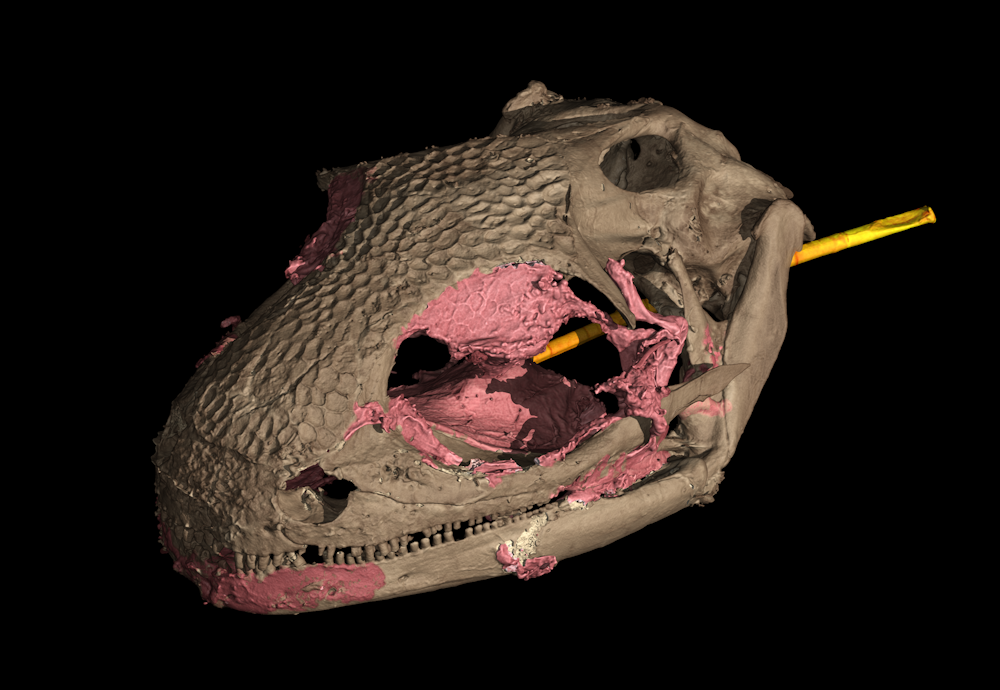 This rendering of the Yaksha perettii skull shows the extinct amphibian’s soft tissue and projectile tongue apparatus (in orange).
Edward Stanley/Florida Museum of Natural History, Author provided
In other words, Y. perettii was a predator armed with an incredible weapon: a specialised ballistic tongue that fired at lightning speed to capture prey — just as chameleons do today. It’s no wonder the original juvenile, only 1.5 centimetres long, was initially mistaken for a chameleon.
Modern chameleons have accelerator muscles in their tongues that lock in stored energy. This lets them fire their tongues at speeds of up to 100 kilometres per hour in just a fraction of a second.
We believe albies’ projectile tongues were just as fast, used to great effect while sitting motionless in trees or on the ground. If so, this also explains why albies had unusual jaw joints, flexible necks and large, forward-facing eyes. All these traits would have made up their predator toolkit.
Tree sap turned to iridescent amber
Despite these remarkable new insights, however, many mysteries of albanerpetontids remain. For instance, how exactly are they related to other amphibians? How did they survive for so long, only to die out relatively recently?
We’ll need more intact specimens to answer these questions. And most of these specimens will probably come from the Hukawng Valley in Kachin, Myanmar.
It’s expected about 100 million years ago this region was an island covered in vast forests. Global temperatures back then would have exceeded today’s, with trees producing vast amounts of resin (which later turned into amber) as a result of damage by insects and fire.
Amber studied from this region will not only increase our knowledge of its expired ecosystems, it could also provide insight into how certain organisms today might evolve in response to a warming climate.
Read more:
Fossil footprints give glimpse of how ancient climate change drove the rise of reptiles
This rendering of the Yaksha perettii skull shows the extinct amphibian’s soft tissue and projectile tongue apparatus (in orange).
Edward Stanley/Florida Museum of Natural History, Author provided
In other words, Y. perettii was a predator armed with an incredible weapon: a specialised ballistic tongue that fired at lightning speed to capture prey — just as chameleons do today. It’s no wonder the original juvenile, only 1.5 centimetres long, was initially mistaken for a chameleon.
Modern chameleons have accelerator muscles in their tongues that lock in stored energy. This lets them fire their tongues at speeds of up to 100 kilometres per hour in just a fraction of a second.
We believe albies’ projectile tongues were just as fast, used to great effect while sitting motionless in trees or on the ground. If so, this also explains why albies had unusual jaw joints, flexible necks and large, forward-facing eyes. All these traits would have made up their predator toolkit.
Tree sap turned to iridescent amber
Despite these remarkable new insights, however, many mysteries of albanerpetontids remain. For instance, how exactly are they related to other amphibians? How did they survive for so long, only to die out relatively recently?
We’ll need more intact specimens to answer these questions. And most of these specimens will probably come from the Hukawng Valley in Kachin, Myanmar.
It’s expected about 100 million years ago this region was an island covered in vast forests. Global temperatures back then would have exceeded today’s, with trees producing vast amounts of resin (which later turned into amber) as a result of damage by insects and fire.
Amber studied from this region will not only increase our knowledge of its expired ecosystems, it could also provide insight into how certain organisms today might evolve in response to a warming climate.
Read more:
Fossil footprints give glimpse of how ancient climate change drove the rise of reptiles
Authors: Joseph Bevitt, Senior Instrument Scientist, Australian Nuclear Science and Technology Organisation

















