

why rural Australians' mental health is taking a battering
- Written by: David Perkins, Director, Centre for Rural and Remote Mental Health and Professor of Rural Health Research, University of Newcastle
Among the Bushfire Royal Commission’s 80 recommendations, released last week, was a call to prioritise mental health support during and after natural disasters.
The Australian Medical Association this week called on the federal government to implement the recommendations to lessen the health impacts of future disasters, noting the ongoing mental health fallout from the 2019-20 Black Summer bushfires.
The Royal Commission’s report comes as Australia heads into a bushfire season during a pandemic. Some farmers have this year lost their crops due to unseasonal rain and hail, as many rural communities anticipate further “big weather” events. Certain local economies, which are reliant on exports like wine and barley, are concerned about strained trade relations with China.
The combined effects of these adverse events is taking a toll on the health and well-being of rural people.
A year of cumulative stress
Australian Bureau of Statistics figures released last month showed rural suicide rates are much higher than those in the big cities.
The causes of psychological stress for rural people are many and varied, depending on who you are and where you live. Many are facing environmental and weather events at increasing frequency and intensity. Some of these events happen rapidly, such as fire and floods, whereas others are long-lasting and uncertain, like drought.
The effects of these events include direct losses such as injury and death, as well as loss of livestock and buildings. Indirect losses include declines in businesses and employment, and the disruption of social fabric when friends or family leave town.
Recovery or adaptation can take many years.
Read more: Distress, depression and drug use: young people fear for their future after the bushfires
These stresses of course come in addition to life’s normal challenges likes illness, bereavement and relationship breakdown.
For rural people, COVID has likely compounded these cumulative stresses and contributed to higher levels of trauma, mental ill-health and in some cases, suicidal behaviour.
Band-aid policies
In most rural communities, access to mental health services is relatively poor.
There’s longstanding evidence Medicare Benefits Scheme expenditure for mental health services is skewed towards metropolitan services.
State expenditure is focused on hospital services and care for those with high and complex needs. Consequently, many rural people with mild to moderate needs are under-served.
 Among the bushfire royal commission’s 80 recommendations was a call to strengthen mental health services for people impacted by disasters.
Lukas Coch/AAP
Among the bushfire royal commission’s 80 recommendations was a call to strengthen mental health services for people impacted by disasters.
Lukas Coch/AAP
Traditionally, governments respond to crises reactively and by treating these events as short-term and disconnected. But this isn’t the experience of rural people.
Each adverse event is accompanied by (usually short-term) funding announcements by governments and agencies for new Headspace centres, expanded telephone helplines, websites, counsellors, or coordinators in the most affected areas.
Sometimes there’s overlap of effort across different government departments, federal and state jurisdictions or from different disaster responses, potentially wasting resources.
For example, in NSW, the longstanding drought has recently broken. But the social and economic recovery will take longer — possibly up to five years with consistent rain as it did following the Millennium drought.
Counsellors were funded to support rural residents during the drought in 2018, with more counsellors funded in response to the bushfires. And now additional services are being offered due to COVID.
While the extra support is welcome, the fragmentation and temporary nature of the funding means rural people may not know what services are available, and accessing services becomes confusing.
What’s more, with short-term contracts, it may be the same staff moving between roles and agencies, therefore not actually adding new staff to support local rural communities. This funding instability makes it difficult to retain a stable rural mental health workforce.
Read more: Budget funding for Beyond Blue and Headspace is welcome. But it may not help those who need it most
What can be done?
In the first instance, policymakers need to ask people living in rural areas what they need and involve them in the process of developing appropriate and accessible services.
Second, we need to adopt a systemic approach that examines the full range of adverse events that affect the mental health and well-being of individuals, families and communities. This means going beyond treating illness, to addressing environmental, economic, social and personal factors.
As part of this, we need people on the ground to support communities through preparedness activities such as educating people about mental health and how to access services, while stepping into disaster response and recovery as needed. Continuity and building on what already exists locally is key.
The Rural Fire Service is a good example of such a structure. It has a clear role in disaster response, but also works to prepare communities between disasters (for example, by conducting back-burning and educating about bushfire plans).
Localised support is important because preparedness and response look very different depending on where you live in rural Australia. For example, Lismore on the northern NSW coast experiences regular flooding, whereas Broken Hill in the state’s far west contends with more frequent drought, and fierce dust storms.
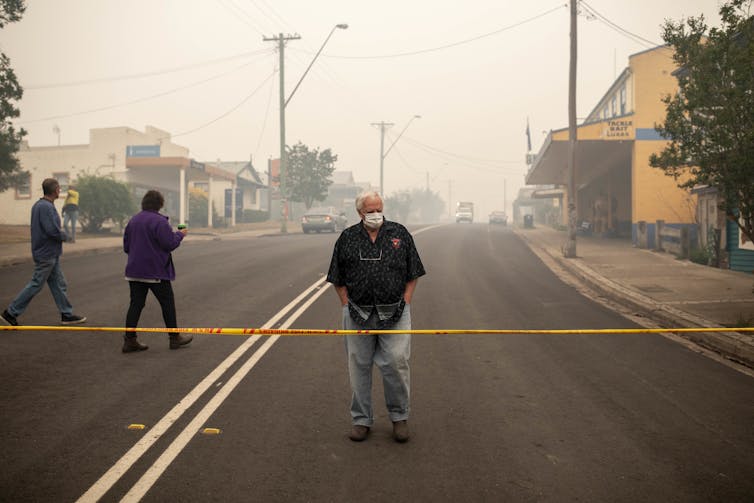 Accessing mental health support during and after disasters can be confusing and bureaucratic.
Sean Davey/AAP
Accessing mental health support during and after disasters can be confusing and bureaucratic.
Sean Davey/AAP
Third, to fully understand and plan for the diversity of rural communities, we need sophisticated data planning, collection and analysis systems. Beyond health data, we need to look at the social, economic, environmental factors which all contribute to mental health and the way people access care.
If we can do this well, local planning will become easier, more transparent and tailored to need.
Finally, rural communities need support to develop local leadership, so they’re empowered to lead local responses. This is unlikely to succeed with short-term band-aid solutions, but rather with long-term investment and strategic policy to build and sustain capacity to cope with adversity.
Read more: Collective trauma is real, and could hamper Australian communities' bushfire recovery
Authors: David Perkins, Director, Centre for Rural and Remote Mental Health and Professor of Rural Health Research, University of Newcastle


















