

Hotel quarantine interim report recommends changes but accountability questions remain
- Written by: Kristen Rundle, Professor of Law, University of Melbourne
The division of the findings of the Victorian COVID-19 Hotel Quarantine Inquiry into two – the interim report published today, with a final report due December 21 – is aimed at making a timely contribution to the redesign of the quarantine systems that will remain key to Australia’s management of the COVID-19 pandemic for some time to come.
With a view to the expected influx of returnees at Christmas, the national cabinet is due to discuss necessary changes later this month. Justice Jennifer Coate’s clear recommendations for how to devise and operate a quarantine system will surely be pivotal to its deliberations.
Key recommendations
Coate’s primary message is that quarantine – in whatever form it might take – is a public health operation. So any future quarantine system needs to be designed in a manner that ensures the centrality of this public health imperative.
We must wait until the final report to find out what Coate has to say on the larger governance and accountability questions surrounding “the decision” to contract out the front line of Victoria’s hotel quarantine operation to private security provision. However, her interim report already tells us a lot – if indirectly.
The report states it “is clear from the evidence to date” that the majority of those involved in the hotel quarantine program who contracted the virus were:
private security personnel engaged by way of contracting arrangements that carried with them a range of complexities.
It is therefore unsurprising that the issue of the appropriateness of contracting-out is the elephant in the room across a number of its key recommendations.
In particular, the recommendations record that the expertise of those involved in future quarantine operations will be crucial. Moreover, every effort should be made to ensure people working at quarantine facilities are “salaried employees” who are “not working in other forms of employment”.
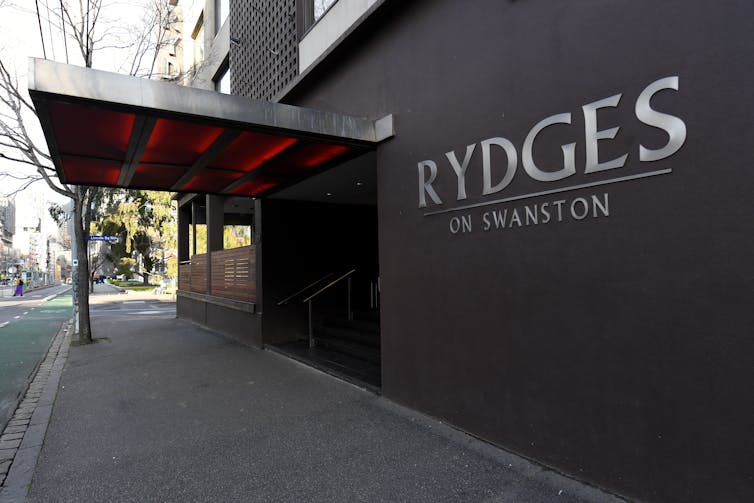 Rydges on Swanston was one of the quarantine hotels where coronavirus outbreaks occurred.
James Ross/AAP
Rydges on Swanston was one of the quarantine hotels where coronavirus outbreaks occurred.
James Ross/AAP
It takes little effort to surmise that contracted-out service delivery is unlikely to meet any of these demands.
As I have explained elsewhere, to contract out a statutory function in whole or in part requires that it be translated into a “service” that private sector providers are capable of delivering.
In the Victorian case, this meant the front line of the hotel quarantine operation was performed pursuant to an “observe and report” security services contract. It was carried out by an entirely casualised workforce with little infection-control training and no lawful powers of enforcement. Many or most of them worked in other jobs at the same time.
Coate also recommended that, alongside the “embedded” presence of expert infection-control personnel, a 24/7 police presence be established at every facility-based quarantine operation. This clearly points to the failure of contracting-out from an enforcement perspective as well.
So, by implication or otherwise, the interim report confirms that too little thought was given to whether the contracted service could meet the dual public health and detention demands of the function at issue.
Coate’s conclusions on how a facility-based quarantine program should work make the multiple dimensions of this mismatch plain.
Where to from here?
The final report of the inquiry may well prove to be the most sustained critique of contracting-out, from the perspective of public expectations of government action, that Australia has yet seen. This would be a welcome shift from what has prevailed so far, with much more effort dedicated to refining and expanding the practice than to challenging it.
As for where the interim report fits with the “whodunnit” exercise that has dominated so much of the interest in the inquiry’s work so far, Coate makes clear we must wait until the final report to find out more. Whether Victoria ended up with private security at the front line of its hotel quarantine program as a result of a “decision” by one or more individuals, or (as counsel assisting Rachel Ellyard described it) a “creeping assumption that became a reality”, is something that ultimately might never be clear.
Either way, the question of accountability will remain. Providing a clear answer to it stands to be every bit as complicated as it has been so far.
The inquiry, which found the bungled scheme cost the state $195 million, has shown the relationship between contracting-out and political accountability is incoherent. Substantial reform in both directions is needed to make it otherwise. Coate’s final report will hopefully guide that much-needed conversation.
But, again, we can already take a lot from the interim report about where – minimally – we need to be. Any future Victorian quarantine program must be operated “by one cabinet-approved department”, in accordance with a “clear line of command vesting ultimate responsibility in the approved department and Minister”.
That department must in turn be “the sole agency responsible for any necessary contracts”. Among other things, its responsible minister must also ensure senior members of its governance structure “maintain records […] of all decisions reached”.
Such is the vision for the future. But it also highlights why it is so important not to lose sight of the “why” questions when the issue of accountability for what actually happened in Victoria’s disastrous hotel quarantine program is again upon us.
If the front line of the hotel quarantine system was simply too important a responsibility to be outsourced, it is time to get to the bottom of why this was the case, and why it might also be the case for other high-stakes government functions that carry serious consequences for public health or safety.
Providing sensible answers to those questions needs to be the goal. But what matters above all else is that we actually start asking them.
Read more: Grattan on Friday: Premiers facing elections play hardball with hard borders
This piece was co-published with the University of Melbourne’s Pursuit.
Authors: Kristen Rundle, Professor of Law, University of Melbourne


















