

As Victoria's COVID-free streak continues, it's probably time to consider changing the rules around masks
- Written by: Lara Herrero, Research Leader in Virology and Infectious Disease, Griffith University
After a devastating second wave, Victoria yesterday recorded its twelfth straight day of zero new COVID cases.
In light of the state’s progress, Premier Daniel Andrews announced the easing of several COVID restrictions on Sunday, including removing travel limits within Victoria, reopening gyms and cinemas, and allowing greater numbers in hospitality venues. Restrictions are set to ease further on November 23.
But one of the notable measures to remain is face masks. Every Victorian must still wear a mask in public — whether indoors or outdoors — and they risk a A$200 fine if they don’t.
Is it time this rule was relaxed? After all, Victoria’s COVID situation is beginning to look more and more like other Australian states and territories, which have seen prolonged stretches of zero community transmission. Yet it remains the only state where mask-wearing is compulsory.
What does a mask do anyway?
A highly contagious virus called SARS-CoV-2 causes COVID-19. We believe the virus most commonly spreads when we breathe in tiny contaminated droplets which a person infected with SARS-CoV-2 has released into the air when coughing, sneezing, or talking.
The virus may also spread when we touch our eyes, nose or mouth after coming into contact with surfaces viral droplets have settled onto.
Face masks primarily target that first route of transmission, appreciating many people with COVID-19 won’t display symptoms. By preventing both inward and outward flow of virus-carrying droplets, masks can protect both the wearer and other people.
It’s also possible that if our hands become contaminated with the virus, wearing a mask may stop us touching our face and becoming infected that way.
Read more: Which mask works best? We filmed people coughing and sneezing to find out
The effectiveness of any mask depends not just on its type, but also on wearing it correctly — so it covers your mouth and nose — and handling it carefully to avoid cross-contamination.
Widespread use of masks, together with sticking to other COVID-safe strategies, very likely helped Victoria to control its second wave. The use of similar approaches has been effective in other parts of the world, such as China, Italy and the United States, where the burden of COVID has been high.
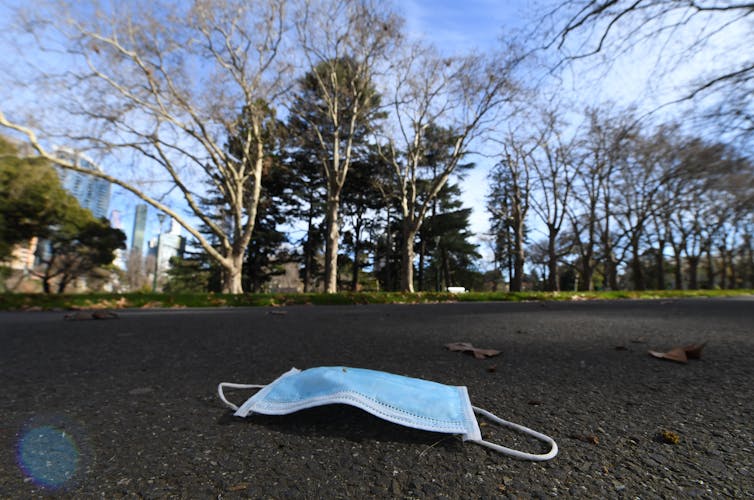 Masks remain compulsory in Victoria.
James Ross/AAP
Masks remain compulsory in Victoria.
James Ross/AAP
Are masks as important outside as they are inside?
Wearing masks inside, or outside where physical distancing is difficult, helps to slow the spread of SARS-CoV-2. It’s especially important in areas where many people congregate including in shops, elevators, public transport, or at outdoor sporting venues.
There are a couple of factors that make wearing masks less important outdoors, particularly when we’re not near other people. First, the high airflow outside means any virus-carrying droplets are more readily dispersed, and so we’re less likely to breathe them in, compared with poorly ventilated indoor environments.
Second, evidence suggests outdoor environmental conditions such as higher heat or humidity can reduce the survival of SARS-CoV-2.
Taken together, the risk of transmission outdoors where physical distancing is in place remains low.
Read more: How to talk to someone who doesn't wear a mask, and actually change their mind
Is it time to change the rules?
Victoria is one of numerous states and jurisdictions around the world that have mandated masks during the pandemic. Of course, many of these places are experiencing significant community transmission, which Victoria isn’t.
Other Australian states recommend masks — particularly where it’s difficult to maintain physical distancing — but don’t mandate them.
While the continuation of the mask rule may be confusing and disappointing for many Victorians, the rationale is to keep the population safe and to safeguard the state’s strong progress.
 It’s more important to wear a mask indoors than outdoors.
Shutterstock
It’s more important to wear a mask indoors than outdoors.
Shutterstock
That said, if Victoria’s zero community transmission streak continues for more than 14 days altogether (which is enough time for most people to develop symptoms if infected) the state should start considering transition to an “indoors only” mask strategy.
This approach would require masks to be worn indoors, particularly in crowded and possibly poorly ventilated environments like shops and restaurants, and in transit, such as on public transport or in taxis.
Wearing masks outdoors would be recommended if physical distancing is difficult or if a person is more vulnerable to COVID. But the decision would be up to the individual.
Hopefully in time for summer
Masks become less tolerable as the weather gets warmer. There’s little doubt Victorians would be glad to be free from masks when going out walking, or for a picnic, or to the beach.
If Victoria remains on the path of no new cases — or at least none with an unknown source — we would think, and hope, that the current mask rules will be eased in time for the summer holiday period.
The challenge for Victoria’s health department will be to ensure the transition occurs safely. Venues need to maintain strong COVID-safe plans, including hand hygiene, distancing, regular sanitising, and “check ins” for easy contact tracing.
The success of an “indoors only” strategy or any relaxing of mask rules would likely depend on both residents and visitors to Victoria strictly adhering to remaining COVID restrictions. It would be important for people to use their judgement, and if they’re in a crowded place where it’s difficult to maintain physical distancing, to put on a mask.
Authors: Lara Herrero, Research Leader in Virology and Infectious Disease, Griffith University


















