

From COVID anxiety to harassment, more needs to be done on safety in taxis and rideshare services
- Written by: Bianca Fileborn, Senior Lecturer in Criminology, University of Melbourne
The introduction of ridesharing services has transformed the way many of us travel. Alongside traditional taxis, app-based ridesharing services have made it easier than ever to travel privately for those who can afford it.
But how safe are taxi and rideshare services? Anecdotally, experiences of harassment and violence appear to be common for passengers.
Last year, media reports drew attention to attempts by individuals posing as Uber drivers to lure women into their vehicles in Melbourne. Incidents of drivers sexually assaulting passengers periodically occur. Perhaps the most notorious is the case of the UK’s “Black Cab Rapist”, John Worboys, who drugged and raped at least 90 women.
Although concerns about safety and harassment have been well documented in relation to public transport, limited data are available on experiences of harassment among both drivers and passengers of taxi and rideshare services.
In 2019, rideshare service Uber released a safety report for the first time. It revealed the company had received more than 3,000 reports of sexual assault perpetrated by drivers or other passengers in the United States between 2017 and 2018.
While there is no evidence harassment and assault occur more frequently in taxis and rideshares compared to the wider community, the specific contexts of these services are important to investigate. For instance, passengers can be isolated while using these services, and some use them to travel after consuming drugs and alcohol – factors that can increase the risk of harm.
Our research – which is currently under way – aims to shed light on these issues by exploring Victorians’ perceptions and experiences of safety and harassment when using taxi and rideshare services.
Read more: The same but different: what passengers like about Uber
Perceptions of safety pre- and post-COVID
As we began our research, the COVID-19 pandemic emerged, fundamentally changing how, where and when people travelled.
Lockdown and working from home led to reduced use of taxi and rideshare services for some. For others, anxiety about COVID transmission on public transport likely made taxi and rideshare services a more appealing option.
As Melbourne and the rest of the country come out of lockdown, people are going out again and having to consider how they travel. There might be a dilemma for some people in terms of whether they feel safe using taxi and rideshare services due to the perceived risk of COVID transmission.
Early findings from our survey of 94 Victorians suggest participants felt safer using rideshare services compared to taxi services before COVID-19. While participants reported factors that potentially reduced feelings of safety when using taxis – such as travelling alone or being intoxicated – they tended to report factors that promoted feelings of safety when using rideshare services. For example, the ability to track drivers and send tracking on to friends or loved ones, the rating system, automatic payment, and information about drivers, passengers and the ride being held by the app were all reported to improve perceptions of safety.
Since the pandemic, about half of participants report they feel equally safe using taxi and rideshare services compared to before the pandemic. Small numbers report feeling safer. However, many of our participants report feeling less safe about using taxi (38%) and rideshare (43%) services.
Based on written comments from participants, it appears that, in addition to physical safety concerns, people are experiencing concerns about health safety. These concerns include being in an enclosed space with the driver or other passengers, whether the car has been cleaned between each passenger, and the risk of acquiring COVID-19 from the driver or previous passengers.
Although rideshare services have introduced a range of measures to prevent COVID-19 transmission, drivers have similarly reported concerns about their health.
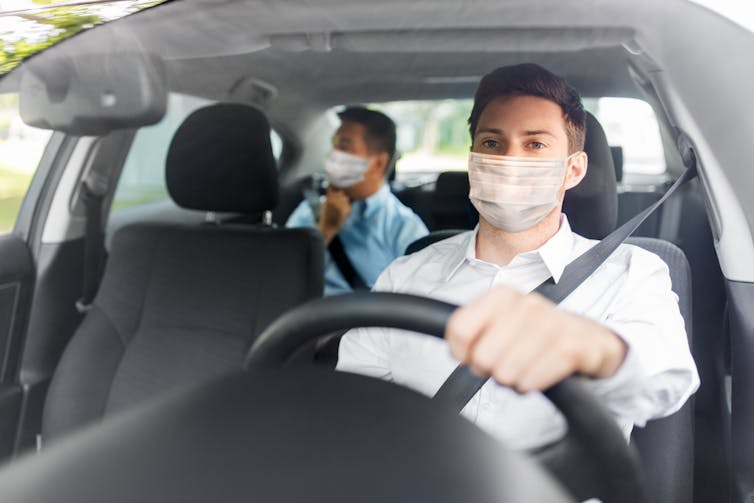 Health safety concerns have risen since the COVID-19 pandemic.
Shutterstock
Health safety concerns have risen since the COVID-19 pandemic.
Shutterstock
Experiences of harassment in taxis and rideshares
We also asked participants about experiences of harassment when using taxi and rideshare services.
Uber’s 2019 safety report indicated 99.9% of rides in the United States in 2017-18 had been completed without incident.
Similarly, our preliminary findings suggest experiences of harassment are not common. Nonetheless, a minority of participants have reported verbal harassment relating to gender (35.6%), sexuality (19.8%), race (10%) and disability (13.5%).
Sexual harassment is by far the most common form of harassment experienced by participants so far. Half of survey respondents had experienced unwanted flirting, while 46% experienced unwanted comments about their physical appearance. Participants have described their experiences of harassment as including:
several experiences where taxi drivers have either tried to flirt, made aggressively sexual statements, or touched me, and one specific one where the driver made several comments about knowing where I lived and how he’d date me.
Honestly there are too many to recount. In one instance, a taxi driver […] kept telling me how lonely he was and parked far away from home and would not let me leave the cab, forcing kisses on me and unwanted groping […] I was terrified. It wasn’t the first time I’ve been terrified of cab drivers either.
Participants also discussed feeling unsafe because of factors related to race, sexuality and disability. One participant with a disability, for example, shared experiences of being:
left in scary situations by drivers not wanting to pick up my guide dog.
Harassment occurred more commonly in taxis, with drivers responsible for these behaviours in the vast majority (84%) of incidents. However, there is no evidence drivers are more likely to perpetrate harassment and violence than other members of society.
Drivers are themselves often subject to high levels of abuse, harassment and violence.
It is also difficult to know if harassment is actually more common in taxis, or if this finding reflects the fact taxi services have been in use longer than rideshare services.
Read more: FactCheck: are ridesharing services like Uber no safer than hitchhiking?
The impacts of these experiences have been varied, including emotional distress, anxiety, anger, embarrassment and fear for personal safety. While some participants have reported no impacts, others have said they now avoid using taxis or rideshare services, or are hypervigilant when using them.
They also report safety strategies such as minimising alcohol consumption, not using a taxi or rideshare alone, giving the driver a fake address, and sharing registration or journey details with a friend. A small number of women said they only used women-only ridesharing services such as Shebah.
Getting there safely
Experiences of harassment do not only occur in taxi and rideshare contexts. However, the harassment that does occur in these contexts requires a tailored response working alongside broader prevention efforts.
Our participants valued app-based features such as GPS tracking and the ability to rate drivers. Taxi companies could consider introducing similar measures to improve perceptions of safety.
Although rideshare services have introduced several features that can promote feelings of safety among drivers and riders, further measures are needed. These would include greater transparency from taxi and rideshare companies about reports of harassment by drivers and riders, and how they are responding to these reports.
Our emerging findings make it clear much more work is required to prevent and better respond to reports of harassment.
We are still recruiting people to take part in our study. We are interested in a wide range of experiences of harassment – including sexist/sexual, gender-based, racist, ableist, homophobic and transphobic harassment – without any particular legal definition in mind. You do not need to have used a taxi or rideshare service during COVID-19 to take part. You can participate in the anonymous online survey here or you can also contact Elena at elena.cama@unimelb.edu.au if you would prefer to participate in a confidential interview.
For help with any of the issues mentioned in this piece, contact the National Sexual Assault, Family & Domestic Violence Counselling Line – 1800 RESPECT (1800 737 732).
Authors: Bianca Fileborn, Senior Lecturer in Criminology, University of Melbourne


















