what we know so far, and what needs to happen next
- Written by Adrian Esterman, Professor of Biostatistics and Epidemiology, University of South Australia
A COVID cluster linked to a quarantine hotel in Adelaide has today grown to 17 cases.
As a result, the South Australian government has reintroduced certain restrictions, including closing gyms, capping patrons in hospitality venues, and limiting visitors to private homes.
Meanwhile, other states have reimposed border restrictions for South Australians.
After months without any community transmission in the state, this is a big blow for South Australia. But with an effective public health response and cooperation from the community, the hope is we will be able to quickly get this under control.
Seeded in hotel quarantine
The first, or index case, to come to the attention of the health authorities was an 80-year-old woman who attended the emergency department of Lyell McEwin Hospital in Adelaide’s northeast. She comes from an extended family based in the city’s northern suburbs, 15 of whom have now been diagnosed with COVID-19.
Members of this extended family work in aged care, health care and the prison system — all high-risk settings for the spread of COVID-19. It’s possible some of these people worked while infectious, but this information hasn’t been released yet.
It’s been reported the origin of this cluster was one of Adelaide’s quarantine hotels (which in South Australia we call medi-hotels) where one member of the family worked.
It’s likely there’s been some kind of breach in the medi-hotel. We don’t know the exact role this person was working in, but it’s important we find out how they picked up the infection so we can address what went wrong.
From now on, staff working at medi-hotels will be tested for COVID-19 weekly. Before this outbreak, they were only asked to be tested if they had symptoms. In hindsight, regular testing should have been in place months ago.
Read more: 7 ways to better design quarantine, based on what we know about human behaviour
Déjà vu?
We know Victoria’s second wave began with someone working in the hotel quarantine system who passed it to their large family, who then spread it in the community.
While there are similarities between what happened in Victoria and what’s unfolding in Adelaide, there are also some notable differences. The first is that South Australia has a very strong public health system, whereas Victoria’s has had many problems.
Second, South Australia doesn’t have the high-density population Victoria does. The population is smaller and more dispersed, making the virus easier to control.
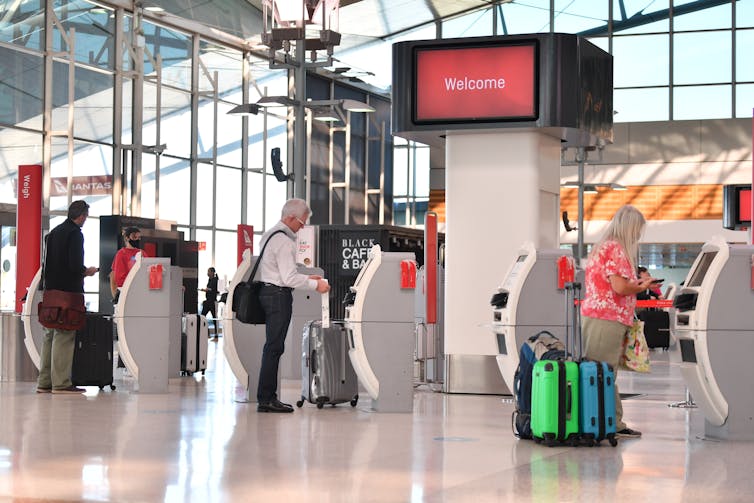 South Australians will now have to self-quarantine when entering some other Australian states and territories.
Dean Lewins/AAP
South Australians will now have to self-quarantine when entering some other Australian states and territories.
Dean Lewins/AAP
Although both Victoria’s second wave and South Australia’s current cluster were seeded in hotel quarantine, the road out for Adelaide should be more akin to what we’ve seen in New South Wales.
Over recent months, several clusters have emerged in NSW, but they have been stamped out before transmission got out of control. We stand a good chance of doing the same in Adelaide, and indeed must avoid a situation in which this cluster grows exponentially.
Read more: Hotel quarantine interim report recommends changes but accountability questions remain
What needs to happen now?
Testing will be crucial to getting a handle on this outbreak, and is already a focal point. Pop-up testing sites have already been established, and public health messaging is encouraging people with symptoms to get tested.
South Australia has a well established contact-tracing team which should manage the daily case load, as long as we don’t see exponential growth. The conventional wisdom in my field is that each case has on average ten or so close contacts. If close contacts of close contacts are investigated too (the “second ring” approach), 100 people need to be investigated for each case. With 17 cases, that’s already 1,700 contacts to deal with. So you can see how easily an outbreak can become too big to track.
It may be possible to avoid any kind of lockdown. If the cluster does get much bigger from here, the government might think about mandating masks. Restricting social gatherings and asking people to work from home where possible are also worthwhile measures. These measures could reduce transmission but won’t deal a major blow to South Australia’s economy.
Border questions…
The approach from other states to consider South Australia a “hotspot” and restrict entry, while no doubt disappointing for many, is a sensible move.
Western Australia, Tasmania and the Northern Territory are now asking people arriving from South Australia to self-quarantine. Queensland will require all arrivals to go into hotel quarantine.
Now may be the time to seriously consider rapid antigen testing at all borders. These tests are not as accurate as the traditional COVID tests, but deliver results much more quickly, in as little as 15 minutes. Victoria is considering this tool.
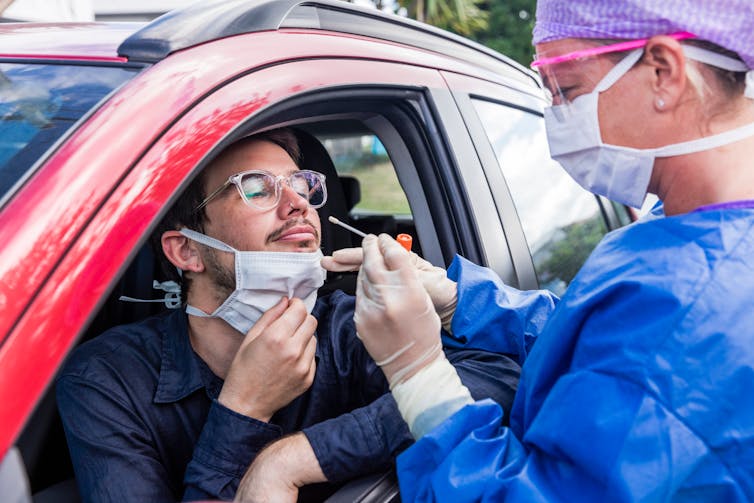 Testing and tracing will be crucial to control South Australia’s outbreak.
Shutterstock
Testing and tracing will be crucial to control South Australia’s outbreak.
Shutterstock
…and broader questions
In a situation like this, we should ask why we continue to operate high-risk quarantine hotels in the middle of a city. It would be much safer to quarantine people away from communities, like we did on Christmas Island earlier in the pandemic.
I also believe we should establish a national centre to oversee contact tracing, hotel quarantine, and other important aspects of the pandemic’s management, ensuring all systems and training are uniform across Australia.
As domestic travel increases, this centre could host a national database with information gathered through QR codes, flight data, and so on. Local hubs in each state and territory would continue to be important.
South Australia’s current outbreak shows us this can happen anywhere — even in a place where COVID-19 is well under control. It’s likely this will be our COVID-normal, at least until we have a vaccine.
Read more: Where did Victoria go so wrong with contact tracing and have they fixed it?
Authors: Adrian Esterman, Professor of Biostatistics and Epidemiology, University of South Australia