

Exponential growth in COVID cases would overwhelm any state's contact tracing. Australia needs an automated system
- Written by: C Raina MacIntyre, Professor of Global Biosecurity, NHMRC Principal Research Fellow, Head, Biosecurity Program, Kirby Institute, UNSW
The people at highest risk of getting infected with SARS-CoV-2, the virus that causes COVID-19, are close contacts of infected cases. So tracking these close contacts, and quarantining them so they can’t infect others, is key to efficient epidemic control. Sometimes we also have to track contacts who attend venues where super-spreading occurs.
Victoria’s second wave prompted the National Cabinet to order a review into contact tracing, which became a flashpoint during the crisis.
The report, by Australian Chief Scientist Alan Finkel and released on Friday, broadly makes the following recommendations:
establish performance metrics on the speed of testing and contact tracing
states and territories should pursue their own contact tracing systems, but have a national digital data exchange mechanism
invest in technology, automation and digital systems for outbreak management
strengthen the public health workforce, training and career tracks, as well as surge capacity for outbreaks
go hard, go early and never fall behind
maintain other public health measures such as social distancing, personal hygiene and early testing; and use waste-water surveillance for early warning of community transmission
engage and communicate with communities, including those in higher risk groups and those with with diverse cultural or language needs.
We must invest in the public health workforce
The report recognises the efforts of all jurisdictions in continually improving mechanisms for control of COVID. It also recognises some of the challenges posed by confusing and inconsistent terminology, and also in differing testing protocols between jurisdictions.
It also reviews various digital technologies used to help with outbreak management across Australia, some of which are linked to pathology testing, and others to attendance at public venues, schools or workplaces. In Western Australia, for example, the G2G app enables facial recognition and mobile phone location data to help police to enforce quarantine.
 Chief Scientist Alan Finkel’s report recommended Australia have a national data exchange mechanism for contact tracing, beyond states’ internal systems.
Mick Tsikas/AAP
Chief Scientist Alan Finkel’s report recommended Australia have a national data exchange mechanism for contact tracing, beyond states’ internal systems.
Mick Tsikas/AAP
Another strength of the report is the recognition of the public health workforce as a distinct and equally important part of the pandemic response as the clinical workforce.
Early in the pandemic, we did well to expand ICU beds and ventilator capacity. However, the requirements for public health capacity during pandemics has long been neglected. Victoria was under-resourced compared to other states and had fewer trained personnel for contact tracing and outbreak response, so when clusters began occurring in June, authorities were unable to stamp them out as NSW had done.
The report recommends surge capacity but no specific strategies. One strategy could involve harnessing the thousands of Bachelors or Masters of Public Health students and graduates around Australia. A course on contact tracing and surveillance within these degrees could create a large surge capacity of people with more baseline public health knowledge, compared with other options used in Victoria.
Read more: Where did Victoria go so wrong with contact tracing and have they fixed it?
Manual contact tracing can’t keep up with exponential growth
However, while Victoria was compared to NSW unfavourably, NSW has not yet been stressed with substantial daily community case numbers, and may also be unable to keep up without digital tracing.
This is actually the crux of the problem. If an epidemic grows too large, no city or state — no matter how well-resourced — will be able to keep up with contact tracing using manual methods such as whiteboards, phone calls or SMS.
What the report doesn’t make clear is the enormous human resources requirement for contact tracing, how rapidly it increases and becomes unfeasible, and the critical importance of digital contact tracing methods which will automate the identification of contacts.
Every person with COVID will have 10-20 contacts to trace, which means if you have 100 cases a day, you need to trace 1,000-2,000 contacts within 24-48 hours. If you don’t trace them rapidly, you will miss the window of opportunity to prevent them infecting others. If you don’t trace them all, you will face a growing backlog and lose control of the epidemic.
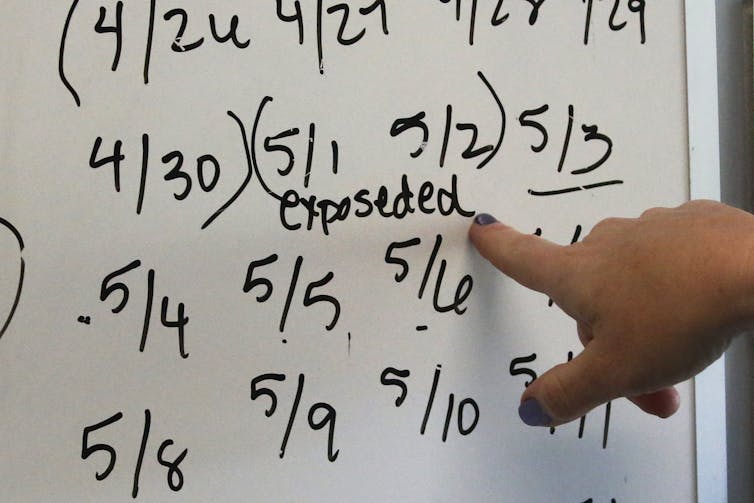 Contact tracing in Australia has traditionally been done on whiteboards. It’s imperative we invest in digital systems.
Rick Bowmer/AP/AAP
Contact tracing in Australia has traditionally been done on whiteboards. It’s imperative we invest in digital systems.
Rick Bowmer/AP/AAP
Compounding this is the exponential growth of epidemics. New cases per day can grow from 20 to 700 in a matter of weeks, as we saw in Victoria, so the task of keeping up with contact tracing becomes more and more difficult as an epidemic grows.
Even in Wuhan, the human resource capacity for contact tracing was exceeded when the outbreak reached thousands of new cases a day - equating to tens of thousands of contacts to be traced every day, and hundreds of thousands being monitored in quarantine at any one time. So authorities used digital contact tracing to keep up.
Australia should expand public health workforce and implement automated contact tracing
Of the different digital tools discussed in the report, automated contact tracing is only mentioned fleetingly, but is essential.
This could be done with QR codes and a colour-coded alert system, as was used in China. With their QR code, people receive a colour code - if they are green, they are free to move about; if orange or red, they must quarantine.
We’ve heard many stories of restaurants and entertainment venues breaching requirements for recording patron details, so that when an outbreak occurs, we have no information to enable contact tracing.
To use QR codes successfully, there has to be enforcement and substantial disincentives to noncompliance.
 Many Australian businesses are using QR codes, but there’s currently no centralised method for quickly sharing contact tracing data between states.
James Ross/AAP
Many Australian businesses are using QR codes, but there’s currently no centralised method for quickly sharing contact tracing data between states.
James Ross/AAP
Australia’s COVIDSafe App, in contrast, was an opt-in app that users had to download themselves, and has had low uptake and some technical issues. Other automated methods that do not require people to actively opt in include harnessing location data from mobile phones, credit card use and other digital footprints. However, many of these raise privacy issues, which is likely why they have been used less in Western countries than in Asia.
The bottom line is that finding all cases and tracing their contacts are the most important strategies to mitigate epidemic growth. We need to have methods to scale up vastly and rapidly with both manual and digital tracing in the event of an epidemic blowout.
Read more: South Australia's COVID outbreak: what we know so far, and what needs to happen next
Authors: C Raina MacIntyre, Professor of Global Biosecurity, NHMRC Principal Research Fellow, Head, Biosecurity Program, Kirby Institute, UNSW


















