As Australia's chief scientist, Alan Finkel brought more science into government. His successor Cathy Foley will continue the job
- Written by Misha Schubert, Visiting Fellow at the National Centre for the Public Awareness of Science at the Australian National University, Australian National University
Australia’s chief scientist, Alan Finkel, will bring his five-year stint in the role to a close at the end of 2020. His successor will be Cathy Foley, a physicist and current chief scientist at the Commonwealth Scientific and Industrial Research Organisation (CSIRO), the national government research agency.
What legacy will Finkel leave behind? If there’s a defining theme to his time as chief scientist, it must surely be how he has drawn science and evidence more deeply into government policy-making. Among his many achievements in this vein, two key examples leap out.
Bringing scientists to public service
The first is the Australian Science Policy Fellowship pilot program. Based on a hugely successful US scheme run by the American Association for the Advancement of Science, this program recruits brilliant professionals from scientific, technical, engineering and mathematical (STEM) fields and places them in the federal public service. Now in its third successful year, the scheme has been embraced by 10 Commonwealth government departments.
The embedded scientists, technology experts, engineers and mathematicians not only bring their specific expertise into public service careers. They also bring the broad analytical skill set that is a hallmark of a high-quality STEM education. In STEM, you’re taught to question timeworn assumptions, pull things apart to understand how they really work, look at problems from fresh angles, and strive to innovate and improve things.
The program is a defining legacy for Finkel, who is himself an engineer by training, an entrepreneur by instinct, and a cross-disciplinary STEM leader by evolution.
Connecting government with research and expertise
The second example hails from the onset of the COVID-19 pandemic. As chief scientist, Finkel found himself fielding requests from government ministers for the latest expert scientific evidence about the coronavirus and the effects of the outbreak.
With a huge volume of research being undertaken at record speed, this was no small task. Finkel looked to leverage the collective brains trust of our nation’s learned academies and peak bodies, such as Science & Technology Australia (STA), to reach deep into our nation’s STEM workforce. (Disclosure: we are the president and CEO of STA, respectively.)
Read more: Bees, pesticides and ... what are chief scientists for?
He created the Rapid Research Information Forum. It handled questions from ministers, swiftly crowd-sourcing leading experts to produce clear and concise guides to the emerging evidence. It is a model for future policy-making, and should be resourced as an ongoing vehicle for expert advice to complement the in-house work of the public service.
A complex balancing act
Finkel’s legacy also includes a vast amount of work on energy and education policy, and myriad reports, reviews and roadmaps to help the government navigate complex challenges by leveraging Australia’s STEM strengths.
He also created the STARportal, a digital treasure trove of STEM resources for parents and teachers to engage kids in STEM – especially girls. And his office has run campaigns such as Summertime Science, Science Superheroes, the Storytime Pledge, and STEMEverywhere to get the public more involved in STEM.
The chief scientist’s role is a complex balancing act. It demands great intellect, mastery of policy and political engagement, strong management of relationships with the STEM sector, expert media skills and the ability to communicate clearly to the Australian public.
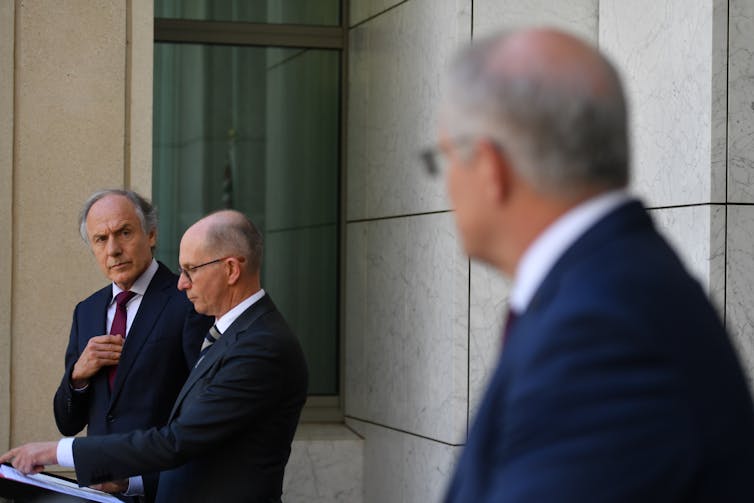 As chief scientist, Alan Finkel has benefited from a strong relationship with Prime Minister Scott Morrison.
Mick Tsikas / AAP
As chief scientist, Alan Finkel has benefited from a strong relationship with Prime Minister Scott Morrison.
Mick Tsikas / AAP
Behind the scenes, the chief scientist is an advocate for science-informed policy, and an independent source of wise counsel to the prime minister and other ministers on science, technology and innovation. But they are also drawn into media and public debates about the role of science in any number of issues, requiring dexterous skill and a strong command of detail, nuance and politics.
Supported by his top-notch staff, Finkel racked up a catalogue of luminous speeches in the finest tradition of using formal speechcraft to stake out an agenda. He proposed many big and bold ideas, elegantly articulated with warmth, wit and historical anecdotes aplenty.
Read more: Chief Scientist's address to the National Press Club: The voyage of science and innovation
A strong relationship with the prime minister has been one of Finkel’s greatest assets. Scott Morrison’s speech at the award ceremony for the Prime Minister’s Prizes for Science this year carried a special note of personal connection.
As well as thanking the thousands of scientists who kept us safe this year working on everything from vaccines to epidemiological modelling to ventilators and virus transmission, Morrison paid tribute to Finkel, noting his public service was far from over.
Stronger collaboration, more inspiration
Finkel’s successor will be physicist Cathy Foley. She is currently chief scientist for Australia’s national science agency, the CSIRO, where she has spent 36 years of her impressive career.
We can expect Foley to combine Finkel’s instincts for strong public engagement with the mastery of public service machinery that Finkel’s predecessor Ian Chubb displayed deftly in the role.
Foley is also impeccably connected across the STEM sector. She’s a former president and policy committee chair of STA, a fellow of two learned academies – the Academy of Technology and Engineering and the Australian Academy of Science – and a generous mentor to many young scientists and women in STEM through STA’s Superstars of STEM program.
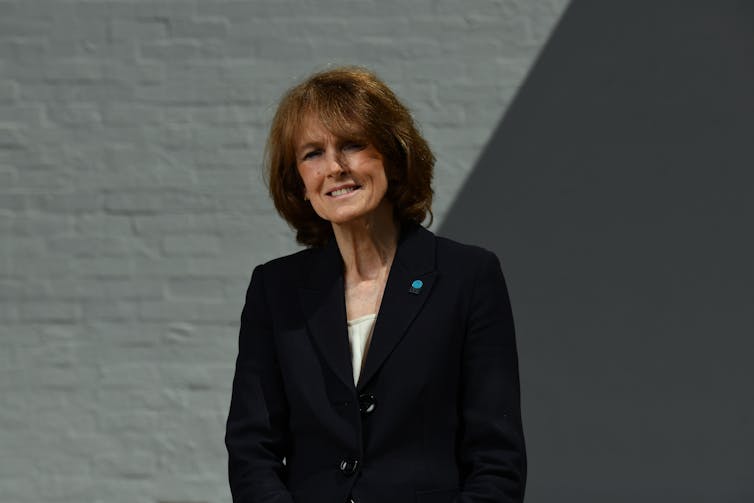 Cathy Foley brings a wealth of expertise and experience to the role of chief scientist.
Mick Tsikas / AAP
Cathy Foley brings a wealth of expertise and experience to the role of chief scientist.
Mick Tsikas / AAP
What will her priorities be? Morrison has noted he would like her to drive stronger collaboration between industry and the science and research community to create jobs for the COVID-19 recovery and beyond.
Federal Science Minister Karen Andrews proposed Foley for the job and is herself a longstanding champion of women in STEM. Andrews said the new chief scientist would help Australia’s manufacturing sector leverage science and technology to strengthen our sovereign capabilities.
For her part, Foley has stated a strong desire to help the government draw on expert scientific advice, serve the nation, and inspire more young people – especially girls – into STEM.
She’s already off to an astute start – turning up at the media call to announce her appointment with gifts for Morrison’s two daughters to inspire in them an even deeper love of science.
Read more: We can’t let STEM skills become a casualty of COVID-19
Authors: Misha Schubert, Visiting Fellow at the National Centre for the Public Awareness of Science at the Australian National University, Australian National University