

Bad reactions to the COVID vaccine will be rare, but Australians deserve a proper compensation scheme
- Written by: Katie Attwell, Senior Lecturer, University of Western Australia
This week brings more good news on the vaccination front, with reports that yet another COVID-19 vaccine trial has produced encouraging results.
According to the federal government, Australia is “on track” to administer the Oxford University AstraZeneca vaccine as early as March next year.
Read more: Why the Oxford AstraZeneca vaccine is now a global game changer
This means we need to be thinking more carefully about how the roll-out will work. This includes looking at a no-fault compensation scheme in the rare and unlikely event someone is harmed by a COVID-19 vaccine.
Most Australians would get vaccinated … but not all
Many Australians will be eager to be vaccinated against COVID-19 as soon as possible. Research in April found nearly 86% of Australian adults surveyed would have a vaccine.
But a significant proportion of people are either unsure about the COVID-19 vaccine, or say they would not have one. This could affect the uptake rates needed for community protection.
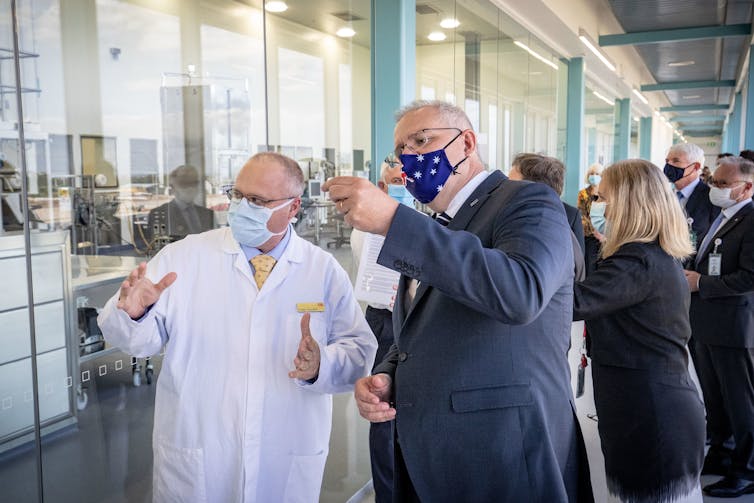 CSL in Melbourne has already begun manufacturing the AstraZeneca vaccine.
Darrian Traynor/AAP
CSL in Melbourne has already begun manufacturing the AstraZeneca vaccine.
Darrian Traynor/AAP
In October, a survey done for the ABC also found only 70% of respondents thought a vaccine would be “safe” or “mostly safe”.
Vaccines are rigorously tested and monitored for safety prior to, during, and after administration. But most of us have not given these background processes much thought until recently.
Adverse reactions to vaccination are typically minor, such as brief soreness at the injection site. Sometimes a reaction will need medical attention and cause a short or long-term health impairment. A serious adverse reaction following vaccination is extraordinarily rare.
For Australians who would not automatically get a COVID vaccine, their trust and confidence in both the vaccine and the system could be bolstered if they knew they would be taken care of in the extremely unlikely event of a serious adverse reaction.
Existing protections are not good enough
In the recent federal budget, the government promised to indemnify vaccine manufacturers if members of the public were to sue following an adverse reaction.
This would make the companies feel safe about operating in the country. However, it is a missed opportunity to also make the public feel safe about what would happen following an adverse event.
Usually, an injured victim must bring a case to court in order to receive compensation. To win, the victim must demonstrate they suffered a harm, the defendant was at fault, and there is a causal connection between the defendant’s fault and the harm. This is more complex than it sounds.
For example, victims of the recent pelvic mesh implant scandal had to initiate a class action, which has been going since 2012. Victims are still waiting for compensation.
A further problem is that when it comes to vaccinations, extremely rare adverse reactions often occur without negligence. This means there is no one to sue.
Why a no-fault scheme makes sense
A no-fault compensation scheme removes both the adversarial nature of litigation and the onerous requirement of establishing fault.
An injured party is only required to demonstrate they suffered a harm and some form of causal link between the harm and the vaccine.
These schemes already exist in most high-income countries — including the United Kingdom, United States and New Zealand — for non-COVID vaccines.
However, to date, Australia has not had a no-fault compensation scheme for vaccine injury, despite policies that compel Australians to vaccinate their children.
Other countries are leading the way
The lack of no-fault scheme in Australia is problematic in general. In the current pandemic, this policy gap is even more of a concern.
The COVID-19 vaccine will need to meet rigorous safety and efficacy criteria to be approved in Australia. However, the truncated timeframe for its development means governments need to be prepared for any unknowns.
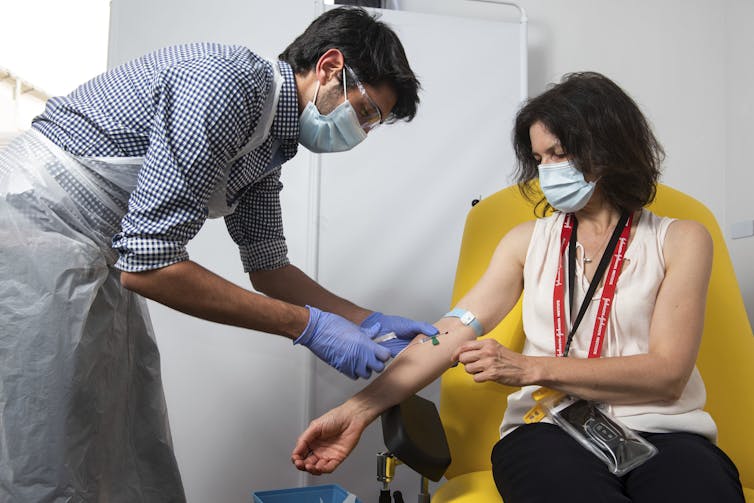 Experts in the UK are also looking at a specific compensation scheme for a COVID vaccine.
John Cairns/AP/AAP
Experts in the UK are also looking at a specific compensation scheme for a COVID vaccine.
John Cairns/AP/AAP
Some might conclude the National Disability Insurance Scheme could take care of anybody who suffered an adverse event following vaccination. However, the NDIS follows fundamentally different logic, in that it provides services for people living with disability, rather than compensating for an injury.
Other countries with existing no-fault compensation schemes are on the front foot to deal with this issue. So far, some experts in the UK have called for a “bespoke” scheme just for a COVID vaccine rather than using existing systems. This is because the rare adverse events that may follow COVID-19 vaccination are as yet unknown.
So, how should Australia design one?
The roll-out of a COVID-19 vaccine provides a unique opportunity for Australia to implement either a standalone scheme for COVID-19 in the first instance, or move straight to a more comprehensive scheme to cover all vaccines.
There are numerous funding options available. We believe this should be funded out of general government revenue — through the tax system — as this can be targeted towards different incomes and reflects the fact it is a common good.
Read more: How to read results from COVID vaccine trials like a pro
There are risks in implementing a no-fault compensation scheme, either for routine vaccination or COVID-19. In the US and the UK, such schemes have not necessarily reassured people about vaccine safety, and in some cases have created narratives for anti-vax activists (that certain vaccines are “dangerous”).
However, the absence of such a scheme leaves our country open to scare campaigns about unforeseen injuries. This could place our entire vaccination program in jeopardy.
Aside from the damage of a “bad news” story, we also need to make sure people are properly compensated if they are the rare victims of a vaccine that benefits everybody.
The time of thinking about vaccination as an individual matter is over. Similarly, it is time to stop leaving the rare risk of vaccine injury as a burden on individuals.
Authors: Katie Attwell, Senior Lecturer, University of Western Australia


















