Why there's a lot more to love about jacarandas than just their purple flowers
- Written by Gregory Moore, Doctor of Botany, University of Melbourne
Every spring, streets across Australia turn purple with the delicate, falling flowers of jacarandas. This year, they’ll likely be flowering over Christmas.
The colour of the flowers is often debated – is it indigo, blue or purple? Well, it’s all of them and more as the colour ranges from deeper to lighter shades depending on the specimen, soils and season.
Read more: Spring is here and wattles are out in bloom: a love letter to our iconic flowers
Jacaranda is so well known to Australians and so well loved, that many of us think of them as a native. But the genus Jacaranda is actually native to South America, and the most common variety in Australia, Jacaranda mimosifolia, may be from an Argentine source.
For this reason, and others, there are many who don’t share the jacaranda love.
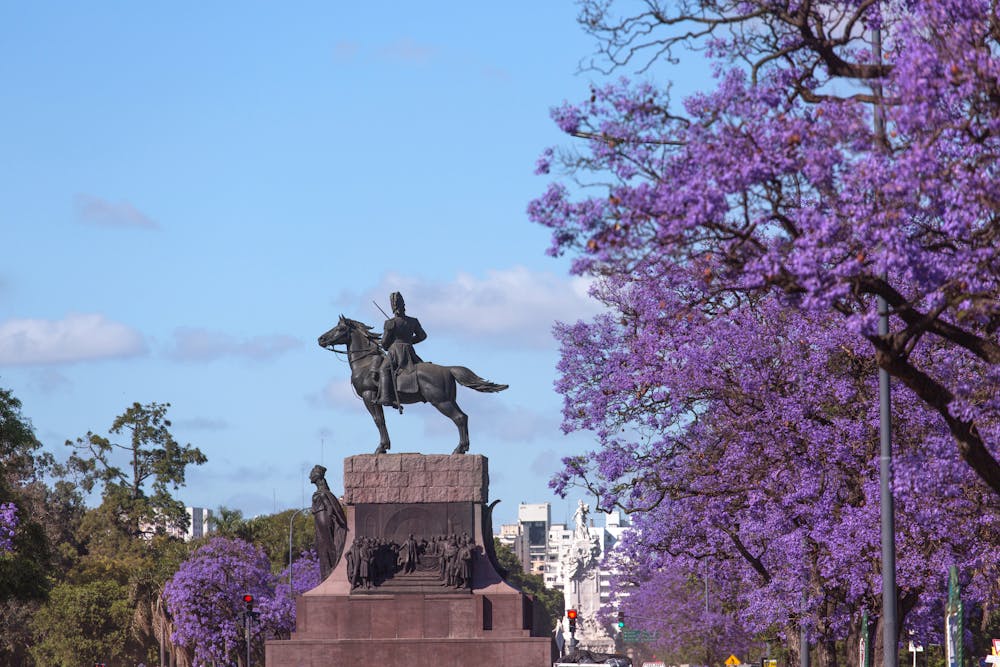 Jacarandas are native to South America, but are celebrated all over the world for their stunning flowers.
Shutterstock
Jacarandas are native to South America, but are celebrated all over the world for their stunning flowers.
Shutterstock
Festivals and local lore
Jacaranda festivals are a highlight of the year in many towns across Australia, including in Grafton, Applecross, Goodna, Camden, Woodville and Ipswich, to name a few.
The trees are even part of local lore at the University of Queensland, with students knowing of “purple panic” as they associate end of year exams with flowering.
California, Texas, Florida, southern Italy, Malta, Portugal, Spain and India boast stunning populations of jacaranda, too. I have seen them in Pretoria, South Africa’s capital, which is renowned for them, and in Gaborone, the capital of marvellous Botswana.
This is testament to how widely Jacaranda mimosifolia has been planted around the world. This is because, despite being a little frost sensitive, the tree is quite hardy when it’s young and copes with a wide range of soil and climatic conditions. And in hot climates, the trees provide an appealing, dappled shade — the flowers are a bonus.
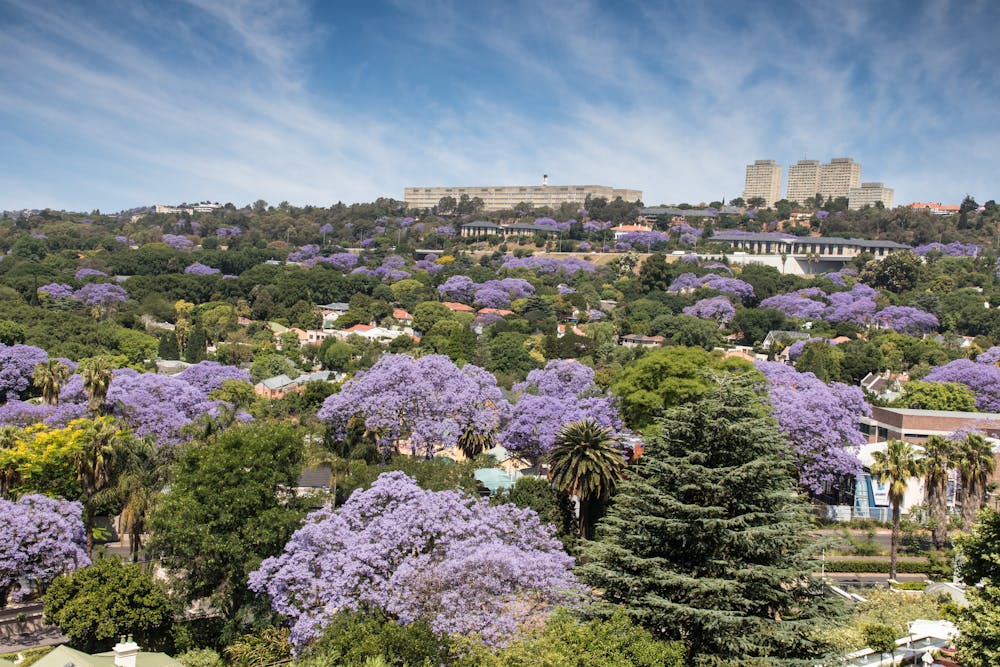 Jacarandas grow across Pretoria and Johannesburg, and have been declared an invasive weed.
Shutterstock
Jacarandas grow across Pretoria and Johannesburg, and have been declared an invasive weed.
Shutterstock
And yet, jacaranda is classified as threatened or vulnerable in its natural habitat. This is because the land it once and still occupies in South America is being rapidly converted for agricultural use.
It’s not all about the flowers
Jacaranda mimosifolia is known to attract some birds and insects such as the African honey bee and local and native honey-eaters. The species belongs to the family Bignoniaceae, and its members are largely distributed in tropical regions.
The Bignoniaceae family contains woody species alongside jacaranda, but many other members are “lianes”, the climbers you might associate with Tarzan swinging through the jungle.
Read more: Tree ferns are older than dinosaurs. And that's not even the most interesting thing about them
Jacarandas also have both soft and brittle wood and large, pod-like fruits which turn brown as they dry out.
These pods become almost woody and can rattle in the wind. This can be a bit disconcerting at first, but in mild wind it makes a soothing sound – a bit like a natural wind chime. And as Christmas approaches, some people gather the pods, decorate them and use them as ornaments.
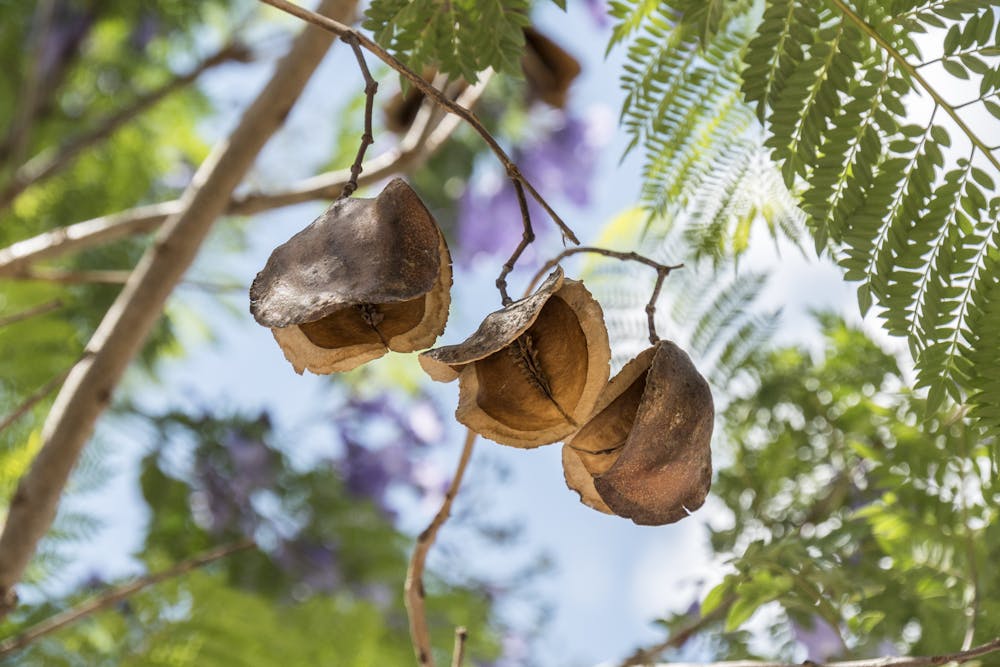 When dry, you can decorate jacaranda pods and turn them into Christmas ornaments.
Shutterstock
When dry, you can decorate jacaranda pods and turn them into Christmas ornaments.
Shutterstock
While the twigs and branches of the jacaranda break easily with an almost explosive crack, large pieces of wood can be used for wood turning, especially for bowls and handles. The brittleness of the wood also leaves jacaranda vulnerable to damage during strong winds, but usually only smaller branches and twigs are affected.
So what’s not to love? A lot, actually
Jacaranda has been declared an invasive weed in South Africa and parts of Australia, with the fine seeds within the woody fruits very easy to germinate. In Africa, it has proved very difficult to eradicate and can only be planted with official permission.
Its roots can be quite extensive and, depending on soil type, may damage paths and fences. This strong root system is one of the reasons jacaranda outcompetes local species, such as native grasses and wattles, and why very few other species can grow under it. In such situations, it can form dense seedling thickets.
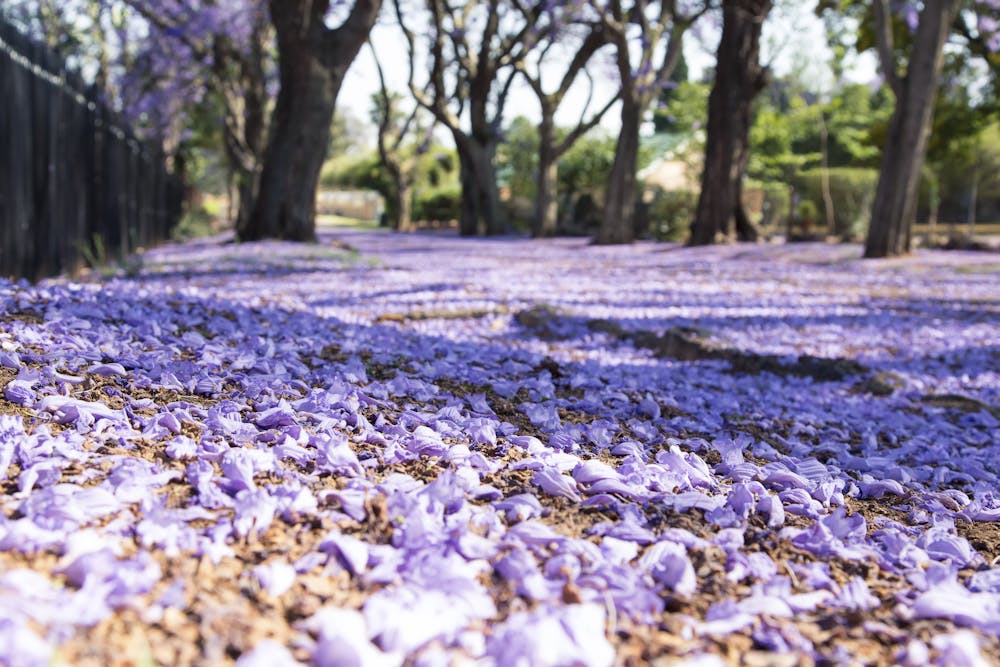 When it rains, jacaranda flowers that have fallen to the ground can become slippery and dangerous.
Shutterstock
When it rains, jacaranda flowers that have fallen to the ground can become slippery and dangerous.
Shutterstock
When it sheds its fine, feathery leaves, they have an amazing capacity to get into every nook and cranny, under roofs and into ceilings. While the living tree is fire retardant, I have seen how the leaves can form thick, tinder-dry mats which can be a fire hazard, and can completely fill or block gutters and drains, causing major damage to homes after heavy rain.
What’s more, their beautiful flowers are almost filmy when they shed, and if you add a little rain they can become very slippery.
What does the future hold?
Whether you love them or hate them, the future for Jacaranda mimosifolia in urban Australia is bright, as it’s one of the species likely to do well under climate change as it grows well in warmer and drier places.
But in rural and regional Australia, greater care must be taken in places where it has the potential to become weedy.
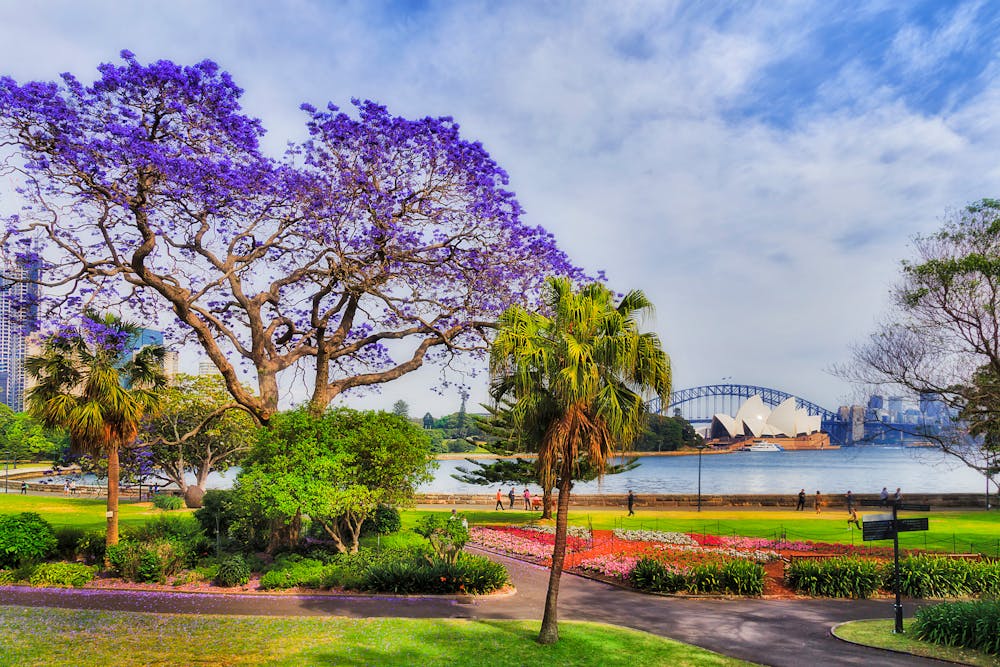 Jacarandas are sure to be part of urban Australian for decades to come.
Shutterstock
Jacarandas are sure to be part of urban Australian for decades to come.
Shutterstock
Perhaps the nursery industry will come up with fruitless or seedless varieties to resolve the problem, as it has with white cedar (Melia azedarach), whose fruits are so hard they represented a tripping hazard in cities.
Fruitless or seedless varieties of jacaranda would eliminate its potential weediness, ensuring it grows only where desired.
Regardless, we are likely to see the purple haze of jacarandas in flower over the Australian summer heat for many decades to come.
Read more: White cedar is a rare bird: a winter deciduous Australian tree
Authors: Gregory Moore, Doctor of Botany, University of Melbourne