ancient deep sea monsters called radiodonts had incredible vision that likely drove an evolutionary arms race
- Written by John Paterson, Professor of Earth Sciences, University of New England
Deep sea animals can be the stuff of nightmares.
Many inhabit the ocean’s twilight zone (down to 1,000 metres depth), where sunlight has virtually disappeared, and have adapted their vision to this dark alien world. Evolution gave them large, complex eyes to see in dim light — examples include the Vampire Squid, Sloane’s Viperfish, and various predatory crustaceans.
But how far back in prehistoric time do these scary, sharp-eyed creatures go?
Our study, published today in Science Advances looked at radiodonts (meaning “radiating teeth”) — a type of ancient arthropod (animals with jointed legs but no backbone).
We found they developed sophisticated eyes more than 500 million years ago, and some were adapted to the dim light of deep water.
Our study provides new information about the evolution of the earliest marine animal ecosystems.
In particular, it supports the idea that vision played a crucial role during the Cambrian Explosion, a pivotal phase in history when most major animal groups (including the oldest fish) first appeared during a rapid burst of evolution.
Once complex visual systems arose, animals could better sense their surroundings. That may have fuelled an evolutionary arms race between predators and prey. Once established, vision became a driving force in evolution and helped shape the biodiversity and ecological interactions we see today.
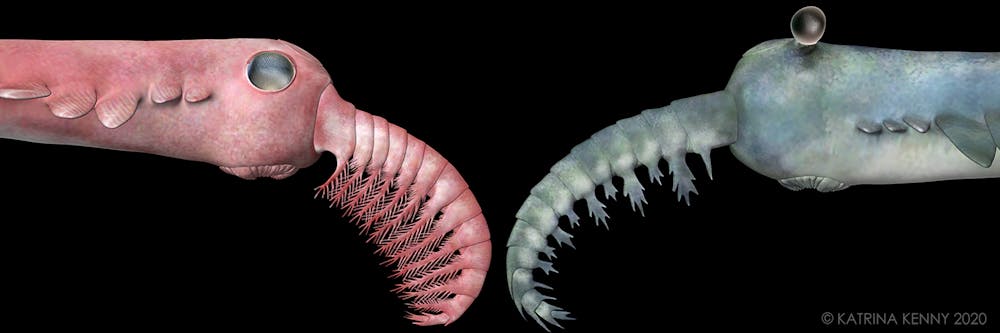 Radiodonts face off. These bizarre animals from the Cambrian Period (over 500 million years ago) have some of the largest and most lens-rich compound eyes to have ever existed.
Katrina Kenny, Author provided
Radiodonts face off. These bizarre animals from the Cambrian Period (over 500 million years ago) have some of the largest and most lens-rich compound eyes to have ever existed.
Katrina Kenny, Author provided
Read more: Life quickly finds a way: the surprisingly swift end to evolution's big bang
A brief guide to radiodonts
Radiodonts are weird animals. Now extinct, they once dominated the oceans, especially during the Cambrian Period (541 million to 485 million years ago).
Some of the first radiodont fossils discovered more than a century ago were isolated body parts, and initial attempts at reconstructions resulted in some “Frankenstein’s monsters”.
But over the past few decades many new discoveries — including whole radiodont bodies — have given a clearer picture of their anatomy, diversity and possible lifestyles. Nevertheless, complete radiodonts still look like something from science fiction!
There are many species of radiodonts and they share a similar body layout.
The head has a pair of large, segmented appendages for capturing prey, a circular mouth with serrated teeth, and a pair of eyes. The rest of the body looks rather like that of a squid.
It might sound like a chimera of different animal parts, but the jointed appendages and compound eyes allow us to classify radiodonts as arthropods, which include insects, spiders and crabs.
 An isolated head appendage of Anomalocaris canadensis from the Burgess Shale of Canada.
John Paterson
An isolated head appendage of Anomalocaris canadensis from the Burgess Shale of Canada.
John Paterson
Over the past decade, new radiodont fossils have revealed a surprising variety of forms and enhanced our understanding of how they lived and especially how they fed.
One genus of radiodont, Anomalocaris, has long been considered an apex predator, akin to the modern great white shark. It had a large body, more than 50 centimetres long, and very strong, spiny head appendages it used for catching prey. It swam by undulating flaps on the sides of its body.
However, other radiodonts were gentle giants, such as the two-metre-long genus Aegirocassis, which used its appendages for filtering plankton.
All the better to see you with
Despite the recent surge in knowledge about these awesome arthropods, little was known about the optics of radiodont eyes. In 2011, we published two papers in the journal Nature on fossil compound eyes from the 513-million-year-old Emu Bay Shale on Kangaroo Island, South Australia.
The first paper documented isolated eye specimens (up to 1 cm in diameter) that could not then be assigned to a known arthropod species. The second paper reported the stalked eyes of Anomalocaris in spectacular detail.
Since then, we have amassed a much larger collection of eyes from the Emu Bay Shale, shedding new light on radiodont vision.
Importantly, our new study identifies the owner of the eyes from our first 2011 paper: ‘Anomalocaris’ briggsi — the inverted commas indicate that it represents a new genus yet to be formally named.
We discovered much larger specimens of these eyes (up to 4 cm in diameter). They possess a distinctive “acute zone” — enlarged lenses in the centre of the eye’s surface that enhance light capture and resolution.
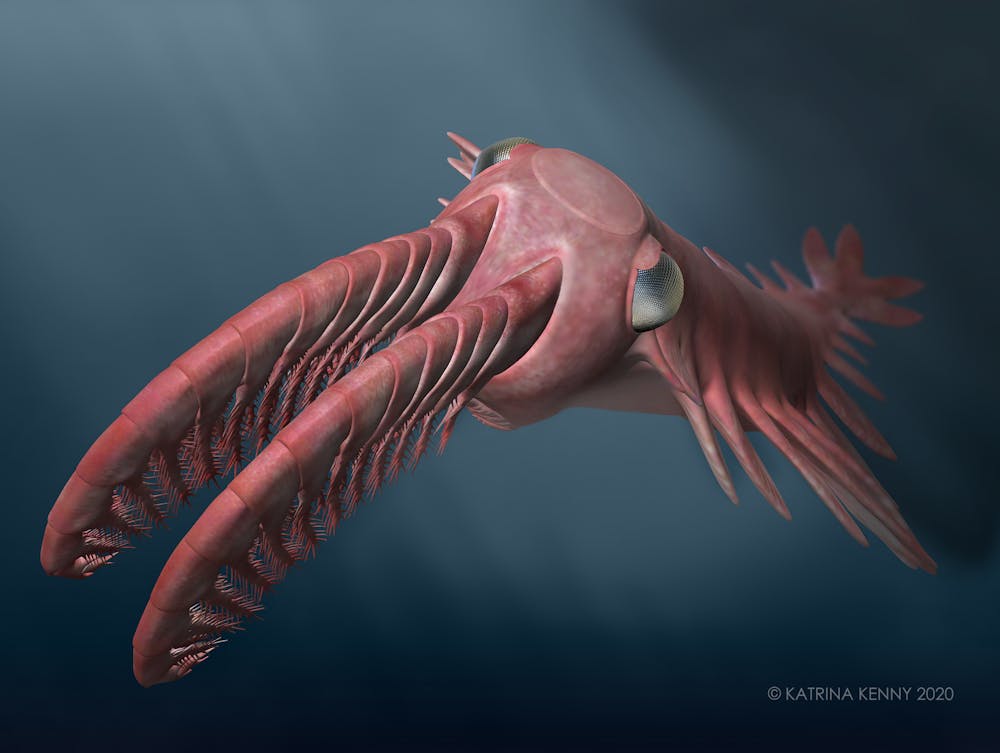 An artist’s reconstruction of ‘Anomalocaris’ briggsi swimming within the twilight zone.
Katrina Kenny, Author provided
An artist’s reconstruction of ‘Anomalocaris’ briggsi swimming within the twilight zone.
Katrina Kenny, Author provided
Radiodont eyes are also extremely sensitive. A single eye of Anomalocaris aff. canadensis — “aff.” meaning “affinity”, as it is closely related to this Canadian species — with more than 24,000 lenses, is rivalled only by certain insects such as dragonflies. These make it a highly visual, shallow-water predator, capturing prey with appendages bearing barbed spines.
The large lenses of ‘Anomalocaris’ briggsi suggest it could see in very dim light at depth, similar to amphipod crustaceans, a type of prawn-like creature that exists today. The frilly spines on its appendages filtered plankton that it detected by looking upwards.
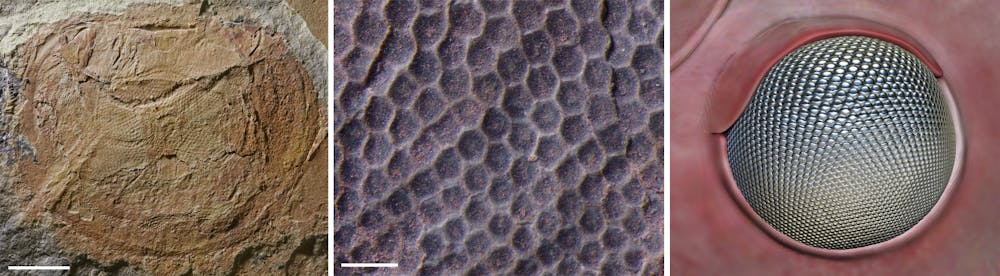 The eye of ‘Anomalocaris’ briggsi. Left: complete fossil eye (scale bar is 5 mm); middle: close-up of lenses (scale bar is 0.5 mm); right: artist’s reconstruction showing the ‘acute zone’ of enlarged lenses, allowing it to see in dim light.
John Paterson
The eye of ‘Anomalocaris’ briggsi. Left: complete fossil eye (scale bar is 5 mm); middle: close-up of lenses (scale bar is 0.5 mm); right: artist’s reconstruction showing the ‘acute zone’ of enlarged lenses, allowing it to see in dim light.
John Paterson
The compound eyes of the two radiodonts from the Emu Bay Shale are outliers among arthropods, living or extinct. Their sheer size places them among the largest arthropod eyes ever.
Read more: Final frontiers: the deep sea
Authors: John Paterson, Professor of Earth Sciences, University of New England