how 20th century settler writers foreshadowed the Anthropocene
- Written by Philip Steer, Senior Lecturer in English, Massey University
Just as writers and artists today are responding to the Anthropocene through climate fiction and eco art, earlier generations chronicled an environmental crisis that presaged humanity’s global impact.
The Anthropocene is a proposed geological epoch that powerfully expresses the planetary scale of the environmental changes wrought by human activity.
Yet almost a century ago, New Zealand and Australia were at the forefront of an environmental crisis that was also profoundly geological in nature: erosion. And it, too, left its mark on culture.
A forgotten global problem
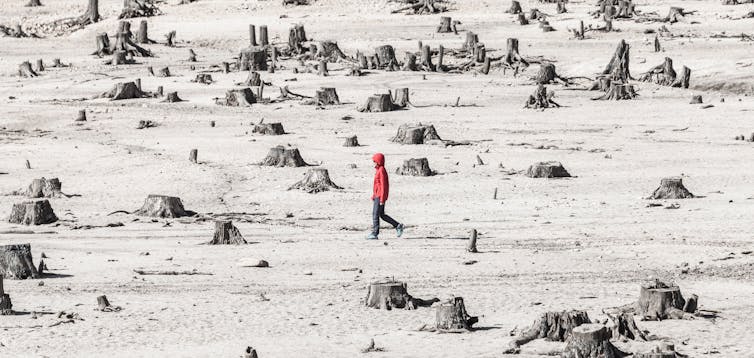
Erosion was first brought to the attention of the western world in the 19th century by the American diplomat and polymath George Perkins Marsh. In Man and Nature: Or, Physical Geography as Modified by Human Action (1869), he argued that much of the “Old World” of the Mediterranean had been transformed into desert by deforestation.
 Shutterstock/Marc Henauer
He warned that European colonisation threatened a similar fate for other parts of the world. These concerns came back with a vengeance in the 1930s, when the Dust Bowl in the United States began to raise alarm about the long-term security of global food supply.
In the 1930s, south-eastern Australia was also plagued by dust storms. The biologist Francis Ratcliffe, in Flying Fox and Drifting Sand: The Adventures of a Biologist in Australia (1939), described the situation in South Australia as a fight for survival.
Nothing less than a battlefield, on which man is engaged in a struggle with the remorseless forces of drought, erosion and drift.
In New Zealand’s different climate and topography, another version of the erosion crisis was also becoming evident. Geographer Kenneth Cumberland described the growing desolation of the North Island’s hill-country pasture.
Miles upon miles of the Hawkes Bay, Poverty Bay, Wanganui and Taranaki- Whangamomona inlands have slip-scarred slopes […] The recent history of these regions is one of abandonment, of decreasing population, of a succession of serious floods, and of slip-severed communications.
Cumberland argued in 1944 that New Zealand’s soil erosion problems “attain the extreme national significance […] of those of the United States.”
Similarly, in 1946, the geographer J. M. Holmes claimed:
No greater peace-time issue faces Australia than the conquest of soil erosion.
Shutterstock/Marc Henauer
He warned that European colonisation threatened a similar fate for other parts of the world. These concerns came back with a vengeance in the 1930s, when the Dust Bowl in the United States began to raise alarm about the long-term security of global food supply.
In the 1930s, south-eastern Australia was also plagued by dust storms. The biologist Francis Ratcliffe, in Flying Fox and Drifting Sand: The Adventures of a Biologist in Australia (1939), described the situation in South Australia as a fight for survival.
Nothing less than a battlefield, on which man is engaged in a struggle with the remorseless forces of drought, erosion and drift.
In New Zealand’s different climate and topography, another version of the erosion crisis was also becoming evident. Geographer Kenneth Cumberland described the growing desolation of the North Island’s hill-country pasture.
Miles upon miles of the Hawkes Bay, Poverty Bay, Wanganui and Taranaki- Whangamomona inlands have slip-scarred slopes […] The recent history of these regions is one of abandonment, of decreasing population, of a succession of serious floods, and of slip-severed communications.
Cumberland argued in 1944 that New Zealand’s soil erosion problems “attain the extreme national significance […] of those of the United States.”
Similarly, in 1946, the geographer J. M. Holmes claimed:
No greater peace-time issue faces Australia than the conquest of soil erosion.
 Shutterstock/photolike
Cultural crisis
Because agriculture is so central to western ideas of civilisation, commentators found that cultural and environmental questions were inextricable. This overlapping of science and ideology is evident in G. V. Jacks and R. O. Whyte’s The Rape of the Earth: A World Survey of Soil Erosion (1939), written by two scientists at Oxford’s Imperial Bureau of Soil Science.
The organisation of civilised societies is founded upon the measures taken to wrest control of the soil from wild Nature, and not until complete control has passed into human hands can a stable superstructure of what we call civilisation be erected on the land.
The belief that nature must be subdued and remade was especially potent among the settler populations of Australia and New Zealand. There colonial identity and economic survival were both inextricably bound up with the success of agricultural and pastoral production.
Elyne Mitchell, now best known as the author of the Silver Brumby children’s books, wrote extensively in the 1940s about how cultural norms of white Australians were directly impacting the soil.
To fit Australia into the pattern of Western civilisation, economically and socially, we have upset the natural balance and turned ourselves into destroyers instead of creators.
The cultural commentator Monte Holcroft used even stronger language to express a similar thought in Creative Problems in New Zealand (1948).
But we see also the bare hillsides, the remnants of forest, the flooding rivers, and in some districts the impoverished soil. The balance of nature has changed. Are we to assume that a people which possessed the land in this manner — raping it in the name of progress — can remain untroubled and secure in occupation?
As the title says, erosion was now a “creative problem”. Even as they were committed to colonial forms of society, settler writers were increasingly aware that their environmental foundations were not as stable as had previously been assumed.
Shutterstock/photolike
Cultural crisis
Because agriculture is so central to western ideas of civilisation, commentators found that cultural and environmental questions were inextricable. This overlapping of science and ideology is evident in G. V. Jacks and R. O. Whyte’s The Rape of the Earth: A World Survey of Soil Erosion (1939), written by two scientists at Oxford’s Imperial Bureau of Soil Science.
The organisation of civilised societies is founded upon the measures taken to wrest control of the soil from wild Nature, and not until complete control has passed into human hands can a stable superstructure of what we call civilisation be erected on the land.
The belief that nature must be subdued and remade was especially potent among the settler populations of Australia and New Zealand. There colonial identity and economic survival were both inextricably bound up with the success of agricultural and pastoral production.
Elyne Mitchell, now best known as the author of the Silver Brumby children’s books, wrote extensively in the 1940s about how cultural norms of white Australians were directly impacting the soil.
To fit Australia into the pattern of Western civilisation, economically and socially, we have upset the natural balance and turned ourselves into destroyers instead of creators.
The cultural commentator Monte Holcroft used even stronger language to express a similar thought in Creative Problems in New Zealand (1948).
But we see also the bare hillsides, the remnants of forest, the flooding rivers, and in some districts the impoverished soil. The balance of nature has changed. Are we to assume that a people which possessed the land in this manner — raping it in the name of progress — can remain untroubled and secure in occupation?
As the title says, erosion was now a “creative problem”. Even as they were committed to colonial forms of society, settler writers were increasingly aware that their environmental foundations were not as stable as had previously been assumed.
 Shutterstock/brackish_nz
Soil mysticism
In New Zealand literature, the landscape wasn’t simply a backdrop: writers often depicted Pākehā identity as being produced through a direct confrontation with geology. The poet and critic Allen Curnow described the sense “that we are interlopers on an indifferent or hostile scene” as a “common problem of the imagination”. As Curnow wrote in his poem, The Scene, in 1941:
Here among the shaggy mountains cast away
Man’s shape must be recast
Settlement was also described as an encounter between “man” and the landscape in an influential poem by Charles Brasch, The Silent Land, in 1945:
Man must lie with the gaunt hills like a lover,
Earning their intimacy in the calm sigh
Of a century of quiet and assiduity.
Critic Francis Pound has described this nationalist preoccupation as a “soil mysticism”. In focusing so closely on the soil, Pākehā writers were also able to overlook its occupancy by Māori and their own deep knowledge of the land.
Awareness of erosion
Yet Brasch’s appeal is to “gaunt hills”: the landscape of literature was more often than not eroded rather than untouched.
Frank Sargeson’s 1943 short story, Gods Live in Woods, drew on the experience of his uncle, who had felled the forest to establish a hill country farm in Te Rohe Pōtae/the King Country.
And places where the grass still held were scarred by slips that showed up the clay and papa. One of these had come down from above the track, and piled up on it before going down into the creek. A chain or so of fence had been in its way and it had gone too. You could see some posts and wires sticking out of the clay.
Erosion also spread into the common stock of literary imagery. In a short poem by Colin Newbury, In My Country (1955), it appears as a metaphor for disappointed love.
He stands close to the earth,
My obdurate countryman,
Drawing from the wind’s breath,
The arid sweetness of flower and mountain;
Knows no green herb for the heart’s erosion.
Such texts demonstrate the ecological concept of “shifting baseline syndrome”, as described by Anna Lowenhaupt Tsing and her collaborators, whereby “newly shaped and ruined landscapes become the new reality”.
Shutterstock/brackish_nz
Soil mysticism
In New Zealand literature, the landscape wasn’t simply a backdrop: writers often depicted Pākehā identity as being produced through a direct confrontation with geology. The poet and critic Allen Curnow described the sense “that we are interlopers on an indifferent or hostile scene” as a “common problem of the imagination”. As Curnow wrote in his poem, The Scene, in 1941:
Here among the shaggy mountains cast away
Man’s shape must be recast
Settlement was also described as an encounter between “man” and the landscape in an influential poem by Charles Brasch, The Silent Land, in 1945:
Man must lie with the gaunt hills like a lover,
Earning their intimacy in the calm sigh
Of a century of quiet and assiduity.
Critic Francis Pound has described this nationalist preoccupation as a “soil mysticism”. In focusing so closely on the soil, Pākehā writers were also able to overlook its occupancy by Māori and their own deep knowledge of the land.
Awareness of erosion
Yet Brasch’s appeal is to “gaunt hills”: the landscape of literature was more often than not eroded rather than untouched.
Frank Sargeson’s 1943 short story, Gods Live in Woods, drew on the experience of his uncle, who had felled the forest to establish a hill country farm in Te Rohe Pōtae/the King Country.
And places where the grass still held were scarred by slips that showed up the clay and papa. One of these had come down from above the track, and piled up on it before going down into the creek. A chain or so of fence had been in its way and it had gone too. You could see some posts and wires sticking out of the clay.
Erosion also spread into the common stock of literary imagery. In a short poem by Colin Newbury, In My Country (1955), it appears as a metaphor for disappointed love.
He stands close to the earth,
My obdurate countryman,
Drawing from the wind’s breath,
The arid sweetness of flower and mountain;
Knows no green herb for the heart’s erosion.
Such texts demonstrate the ecological concept of “shifting baseline syndrome”, as described by Anna Lowenhaupt Tsing and her collaborators, whereby “newly shaped and ruined landscapes become the new reality”.
 Shutterstock/Filip Fuxa
Alternative possibilities
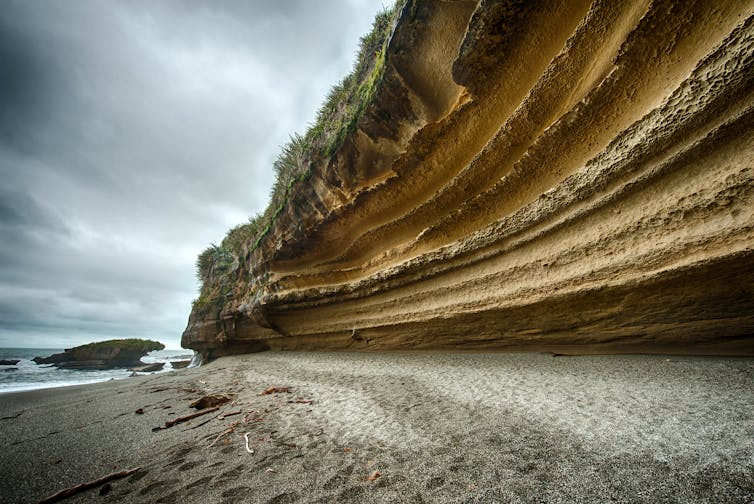
Although so much of Pākehā writing about geology from this time imagines the relationship between humanity and nature as hostile and irreversibly damaged, some offered glimpses of alternative possibilities. One was Ursula Bethell, whose poem Weathered Rocks (1936) stretched her Christian beliefs to find common ground with geology. Through this she imagined a less antagonistic relationship with nature.
And we are kin, compounded of the same elements,
Alike proceeding to an unknown goal.
Another approach is offered by Herbert Guthrie-Smith in Tutira: The Story of a New Zealand Sheep Station (1921). Through the local histories he gleaned from Ngāti Kurumōkihi elders, Guthrie-Smith came to reject a Pākehā view of the Earth as simply a resource to be exploited.
When a block of land passes, as it may do through the hands of ten holders in half a century, how can long views be taken of its rights? Who under these conditions can give his acres their due?
Auē, taukari e, anō te kūware o te Pākehā kāhore nei i whakaaro ki te mauri o te whenua. Alas! Alas! that the Pākehā should so neglect the rights of the land, so forget the traditions of the Māori race, a people who recognised in it something more than the ability to grow meat and wool.
This view of the land as a political partner, endowed with independence and rights, appears to offer a new environmental perspective that in fact draws on the long-standing Indigenous legal principles of tikanga Māori.
Read more:
Dead as the moa: oral traditions show that early Māori recognised extinction
Anticipating the Anthropocene
Mid-20th century settler writing about erosion holds renewed interest today because it conveys a strikingly literal, visible sense of the Anthropocene: the geological impact of colonisation was plainly evident in sand drift, dust storms and scarred hillsides.
Writers were not blind to environmental damage, but in the main their responses are reminiscent of what critic Greg Garrard has called the present-day “gloomy trio of Anthropocenic futures — business-as-usual, mitigation and geo-engineering”.
But writers such as Bethell and Guthrie-Smith demonstrate the ongoing importance of creative work for questioning the values that created and sustain the Anthropocene we now all inhabit.
Shutterstock/Filip Fuxa
Alternative possibilities
Although so much of Pākehā writing about geology from this time imagines the relationship between humanity and nature as hostile and irreversibly damaged, some offered glimpses of alternative possibilities. One was Ursula Bethell, whose poem Weathered Rocks (1936) stretched her Christian beliefs to find common ground with geology. Through this she imagined a less antagonistic relationship with nature.
And we are kin, compounded of the same elements,
Alike proceeding to an unknown goal.
Another approach is offered by Herbert Guthrie-Smith in Tutira: The Story of a New Zealand Sheep Station (1921). Through the local histories he gleaned from Ngāti Kurumōkihi elders, Guthrie-Smith came to reject a Pākehā view of the Earth as simply a resource to be exploited.
When a block of land passes, as it may do through the hands of ten holders in half a century, how can long views be taken of its rights? Who under these conditions can give his acres their due?
Auē, taukari e, anō te kūware o te Pākehā kāhore nei i whakaaro ki te mauri o te whenua. Alas! Alas! that the Pākehā should so neglect the rights of the land, so forget the traditions of the Māori race, a people who recognised in it something more than the ability to grow meat and wool.
This view of the land as a political partner, endowed with independence and rights, appears to offer a new environmental perspective that in fact draws on the long-standing Indigenous legal principles of tikanga Māori.
Read more:
Dead as the moa: oral traditions show that early Māori recognised extinction
Anticipating the Anthropocene
Mid-20th century settler writing about erosion holds renewed interest today because it conveys a strikingly literal, visible sense of the Anthropocene: the geological impact of colonisation was plainly evident in sand drift, dust storms and scarred hillsides.
Writers were not blind to environmental damage, but in the main their responses are reminiscent of what critic Greg Garrard has called the present-day “gloomy trio of Anthropocenic futures — business-as-usual, mitigation and geo-engineering”.
But writers such as Bethell and Guthrie-Smith demonstrate the ongoing importance of creative work for questioning the values that created and sustain the Anthropocene we now all inhabit.
Authors: Philip Steer, Senior Lecturer in English, Massey University