

How universities and professions are preparing to meet the climate challenge
- Written by: Shamit Saggar, Professor and Director, Public Policy institute, University of Western Australia
Getting ahead of climate change challenges is now a pressing need across our economy and society. Last month the bosses of 22 of Australia’s largest firms, including BHP, Rio Tinto, Wesfarmers and Commonwealth Bank, put their names to the Climate Leaders Coalition. It signalled their collective wish to push down emissions and push up their international obligations under the Paris Agreement.
Australia’s politicians are increasingly on the back foot — something universities and professions cannot risk. The cockpit of the knowledge economy must remain fit for purpose in the face of global challenges.
The biggest of these of late has been marshalling expertise to tackle a global pandemic. Climate change is an even bigger challenge.
Read more: Climate change is the most important mission for universities of the 21st century
Universities as knowledge communities take pride in leading discovery and understanding. The pressures to update and reform can come from beyond the academy, sometimes in response to perceived failure (think of economics and the GFC) or in meeting demand for new skills (the rapid expansion of business education in the past two decades).
 UWA Public Policy Institute, Author provided
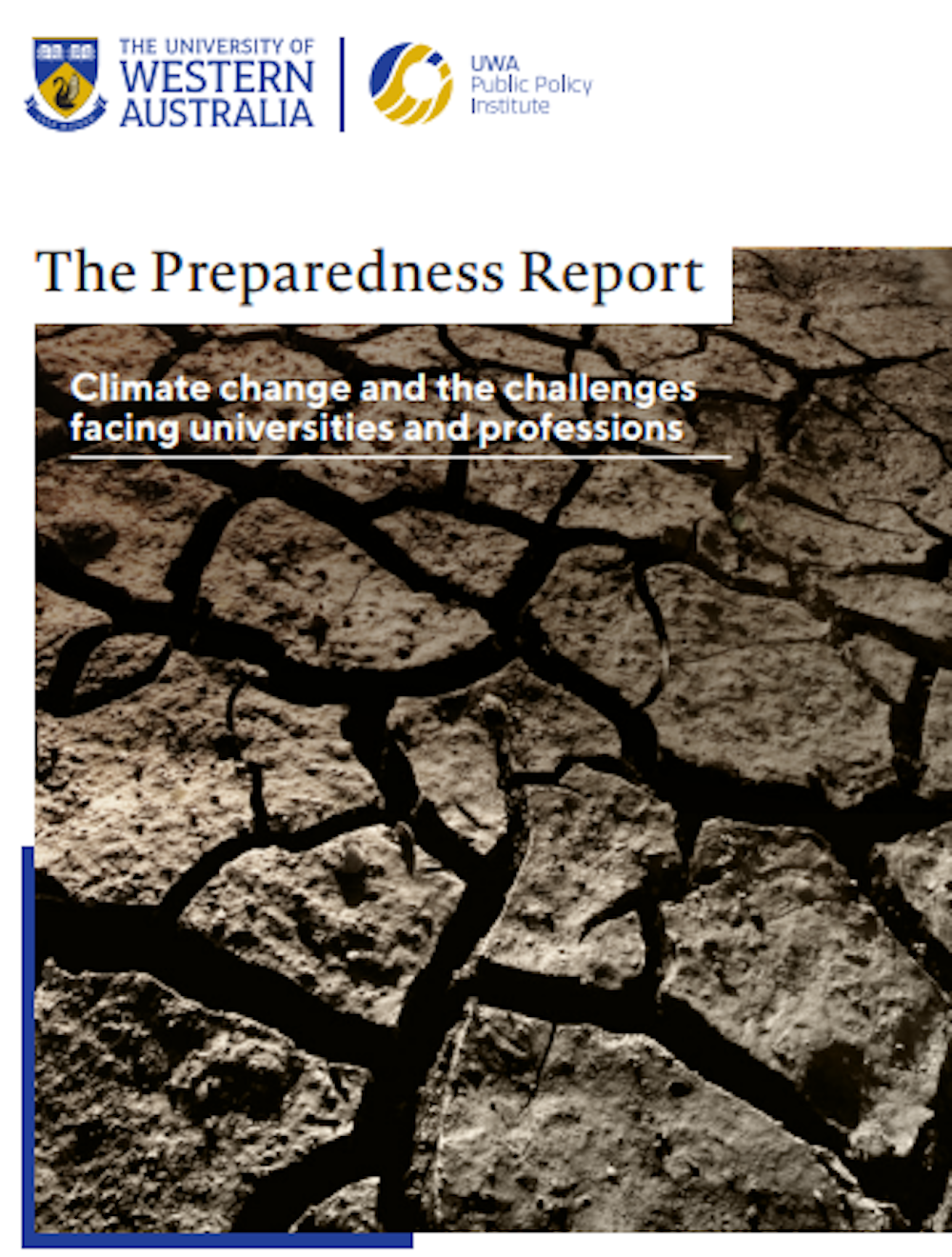
The Preparedness Report, launched today by the UWA Public Policy Institute, argues disciplines, and the practitioners they educate and train, are already changing fast in response to climate change.
The report highlights the nature and extent of retooling in six fields: engineering, architecture, law, economics, healthcare and oceanography (the same is true for around 20 more disciplines).
Key questions for all professions
All professions need to find timely answers to some core questions:
What will be the practical impacts of climate change on the feasibility, processes, sustainability and operations of their professions?
How will future members of the professions need to be educated, trained and accredited?
How will the underlying disciplines change?
Which new fields of research and education will emerge?
How will different disciplines develop new cross-overs and synergies?
Many new skills and competencies will have to be taught. Think, for example, of the need to engineer heat-tolerant public transport systems and plan water-sensitive cities.
Fresh mechanisms are also needed to ensure the value of current expertise, such as actuaries’ capacity to model commercial and household risk for insurance purposes.
UWA Public Policy Institute, Author provided
The Preparedness Report, launched today by the UWA Public Policy Institute, argues disciplines, and the practitioners they educate and train, are already changing fast in response to climate change.
The report highlights the nature and extent of retooling in six fields: engineering, architecture, law, economics, healthcare and oceanography (the same is true for around 20 more disciplines).
Key questions for all professions
All professions need to find timely answers to some core questions:
What will be the practical impacts of climate change on the feasibility, processes, sustainability and operations of their professions?
How will future members of the professions need to be educated, trained and accredited?
How will the underlying disciplines change?
Which new fields of research and education will emerge?
How will different disciplines develop new cross-overs and synergies?
Many new skills and competencies will have to be taught. Think, for example, of the need to engineer heat-tolerant public transport systems and plan water-sensitive cities.
Fresh mechanisms are also needed to ensure the value of current expertise, such as actuaries’ capacity to model commercial and household risk for insurance purposes.
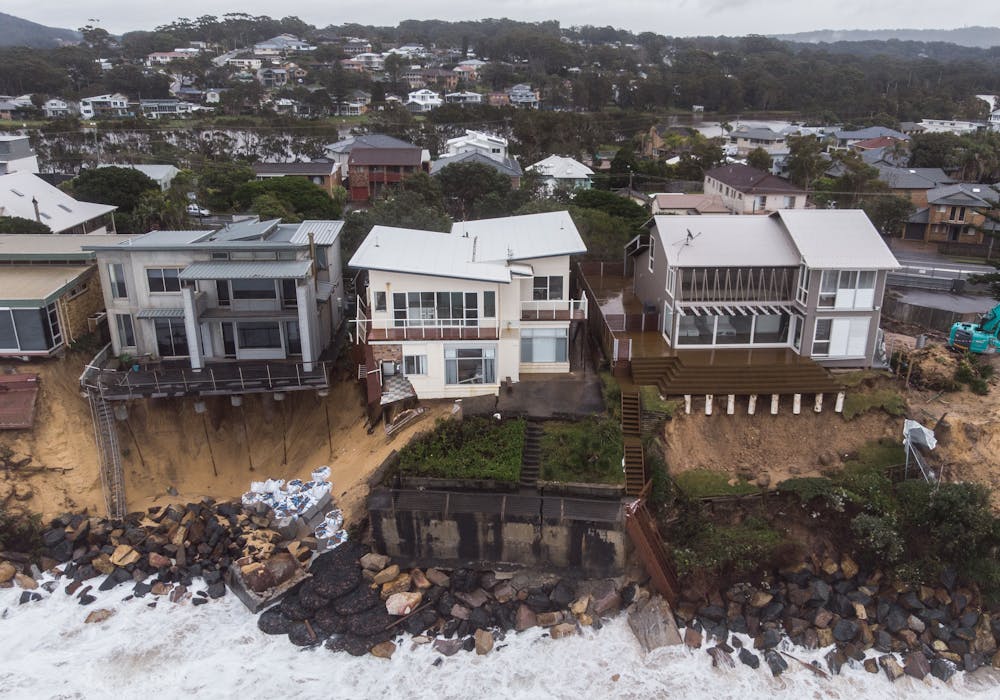 Climate change is forcing insurance risks to be reassessed, including for coastal properties.
James Gourley/AAP
Read more:
Water may soon lap at the door, but still some homeowners don't want to rock the boat
Greater use of cross-disciplinary collaboration will be needed too — for example, in building design and construction.
How 6 disciplines are responding
Engineering is synonymous with industrial society so has much to reflect on in terms of repurposing. Engineers will have to recalibrate their earlier assumptions. As UWA environmental engineer Anas Ghadouani notes:
Consider the fact that the sectors at the top of the emissions pyramid, including transport, electricity production and manufacturing, contributed over 75% of emissions. These top emitting sectors have been flush with engineers and engineering companies.
For architects to be credible in this new environment, they must grasp that “our modern experience of globalisation is predicated on three phenomena with spatial and environmental consequences: mobility, dispersion and density”, says UWA’s School of Design dean, Kate Hislop. Thus:
Lowering CO₂ emissions involves regenerative design, adaptive reuse, life-cycle costing, carbon modelling, post-occupancy evaluation, waste minimisation and adoption of low embodied carbon materials and systems.
Academic law is heavily exposed, and its challenges, reports David Hodgkinson from UWA’s School of Law, boil down to the laws and regulations that can be introduced to reduce emissions and assist people, species and ecosystems vulnerable to climate change. It is a question of intergenerational justice. He concludes:
The main issue at stake is that if we agree to reduce emissions now, people living in the future will benefit, not those living today. But we will, today, bear the costs of reducing such emissions.
For economists, whose counsel has become embedded in part thanks to the landmark Stern Report, the greatest contribution has been in evaluating policy options that could reduce greenhouse gas emissions. Their very strong consensus is that the key policy response is to place a price on greenhouse gas emissions. David Pannell, who leads UWA’s Centre for Environmental Economics and Policy, states:
There are differences of opinion about whether a tax or a market in permits would be superior [in reducing emissions], but there is almost no dissent among economists that one or the other of these is needed.
In the field of health care, the emphasis is on training health-care professionals. For Sajni Gudka, from UWA’s School of Population and Global Health, climate change amounts to a public health emergency:
Real capacity shortfalls are close by in responding to growing infectious diseases, heat stress, food insecurity, poor water quality and nutrition.
Finally, for oceanography the urgency lies in mitigating the effects of climate change in coastal zones. Julian Partridge and Charitha Pattiaratchi, of UWA’s Oceans Institute, say a breakthrough depends on a grand alliance of disciplinary perspectives:
Climate change challenges cannot be solved by engineers and scientists alone. They need alliances with social scientists, cultural heritage specialists and others to join this collective endeavour.
Read more:
This is how universities can lead climate action
Climate change is forcing insurance risks to be reassessed, including for coastal properties.
James Gourley/AAP
Read more:
Water may soon lap at the door, but still some homeowners don't want to rock the boat
Greater use of cross-disciplinary collaboration will be needed too — for example, in building design and construction.
How 6 disciplines are responding
Engineering is synonymous with industrial society so has much to reflect on in terms of repurposing. Engineers will have to recalibrate their earlier assumptions. As UWA environmental engineer Anas Ghadouani notes:
Consider the fact that the sectors at the top of the emissions pyramid, including transport, electricity production and manufacturing, contributed over 75% of emissions. These top emitting sectors have been flush with engineers and engineering companies.
For architects to be credible in this new environment, they must grasp that “our modern experience of globalisation is predicated on three phenomena with spatial and environmental consequences: mobility, dispersion and density”, says UWA’s School of Design dean, Kate Hislop. Thus:
Lowering CO₂ emissions involves regenerative design, adaptive reuse, life-cycle costing, carbon modelling, post-occupancy evaluation, waste minimisation and adoption of low embodied carbon materials and systems.
Academic law is heavily exposed, and its challenges, reports David Hodgkinson from UWA’s School of Law, boil down to the laws and regulations that can be introduced to reduce emissions and assist people, species and ecosystems vulnerable to climate change. It is a question of intergenerational justice. He concludes:
The main issue at stake is that if we agree to reduce emissions now, people living in the future will benefit, not those living today. But we will, today, bear the costs of reducing such emissions.
For economists, whose counsel has become embedded in part thanks to the landmark Stern Report, the greatest contribution has been in evaluating policy options that could reduce greenhouse gas emissions. Their very strong consensus is that the key policy response is to place a price on greenhouse gas emissions. David Pannell, who leads UWA’s Centre for Environmental Economics and Policy, states:
There are differences of opinion about whether a tax or a market in permits would be superior [in reducing emissions], but there is almost no dissent among economists that one or the other of these is needed.
In the field of health care, the emphasis is on training health-care professionals. For Sajni Gudka, from UWA’s School of Population and Global Health, climate change amounts to a public health emergency:
Real capacity shortfalls are close by in responding to growing infectious diseases, heat stress, food insecurity, poor water quality and nutrition.
Finally, for oceanography the urgency lies in mitigating the effects of climate change in coastal zones. Julian Partridge and Charitha Pattiaratchi, of UWA’s Oceans Institute, say a breakthrough depends on a grand alliance of disciplinary perspectives:
Climate change challenges cannot be solved by engineers and scientists alone. They need alliances with social scientists, cultural heritage specialists and others to join this collective endeavour.
Read more:
This is how universities can lead climate action
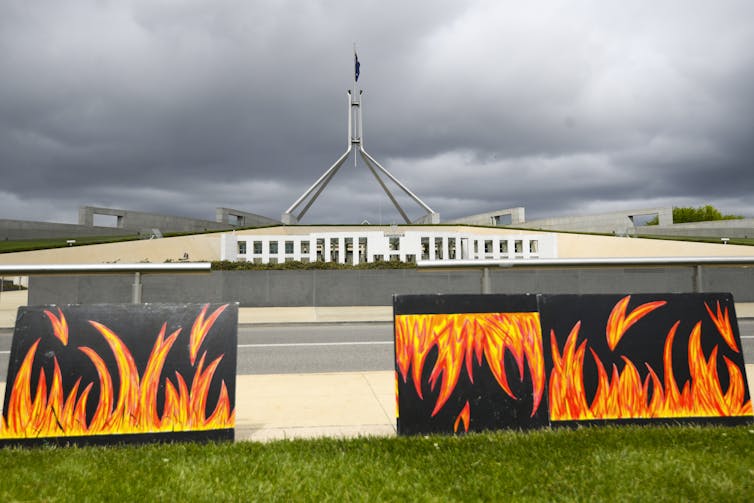 The Australian Parliament is seen behind posters depicting flames during a gathering of bushfire survivors in Canberra in October.
Lukas Coch/AAP
Waiting for political action
The focus of the report is on the academic sector, related professions and the knowledge economy. But the preparedness question is also being asked of the political class and specific governments. As public attitudes become accustomed to environmental stewardship, heightened by the bushfire crisis last summer, voters are beginning to choose a direction of travel that was until recently dismissed.
In Western Australia, the government has just released its new Climate Change Policy, following several other states. Doctors for the Environment Australia is one of many campaigns that question the sagacity of short-term economic priorities.
How prepared is the country’s political class to use the advances made by universities and professions to address climate change?
The Australian Parliament is seen behind posters depicting flames during a gathering of bushfire survivors in Canberra in October.
Lukas Coch/AAP
Waiting for political action
The focus of the report is on the academic sector, related professions and the knowledge economy. But the preparedness question is also being asked of the political class and specific governments. As public attitudes become accustomed to environmental stewardship, heightened by the bushfire crisis last summer, voters are beginning to choose a direction of travel that was until recently dismissed.
In Western Australia, the government has just released its new Climate Change Policy, following several other states. Doctors for the Environment Australia is one of many campaigns that question the sagacity of short-term economic priorities.
How prepared is the country’s political class to use the advances made by universities and professions to address climate change?
Authors: Shamit Saggar, Professor and Director, Public Policy institute, University of Western Australia


















