

Report shows New Zealand's 'fragmented' environmental research funding doesn't match most urgent needs
- Written by: Troy Baisden, Professor (Environmental Sciences), University of Waikato
There’s a serious mismatch between what New Zealand’s government identified as the most pressing environmental issues, including climate change and freshwater quality, and the investments in environmental research it actually makes.
A report released today by the Parliamentary Commissioner for the Environment (PCE) shows New Zealand spends about NZ$500m on environmental research each year. But the commissioner, former MP Simon Upton, says finding out “what gets funded and its links with policy priorities proved more difficult than I expected”.
The commissioner’s main recommendations include ring-fencing the money, developing a funding strategy and distributing funds through a new agency, based on the success of the Health Research Council.
New Zealanders are entitled to know that the environmental research they fund is focused on addressing the most important challenges we face. But the way public funds are currently invested in environmental research is fragmented, making it hard to respond to problems such as climate change, freshwater quality and biodiversity loss.
The report presents an almost complete map of environmental research funding, updating the incomplete picture previously available.
Among the major failings of the current funding system is the lack of systematic investment in collections and monitoring programmes to track the changing environment.
Read more: Why long-term environmental observations are crucial for New Zealand's water security challenges
Lack of overview and strategy
The commissioner proposes the Ministry for the Environment (MfE) should lead the development of a strategy to identify environmental research priorities, even though its current investment is dwarfed by other government entities and regional councils.
Two of the four largest investors in environmental research deserve special mention. About $71m is funded by universities each year, but it is challenging to verify or break down into categories. The report also shows ratepayers contribute nearly as much as universities, through projects funded by regional councils.
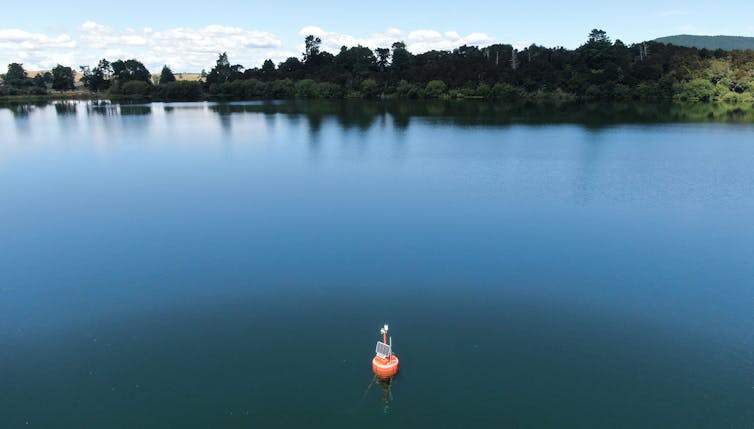 Monitoring buoys, like this one on Lake Okare in the Waikato region, are funded by regional councils rather than central government.
David Schmale/Virginia Polytechnic Institute and State University, CC BY-ND
Monitoring buoys, like this one on Lake Okare in the Waikato region, are funded by regional councils rather than central government.
David Schmale/Virginia Polytechnic Institute and State University, CC BY-ND
The best possible environmental research might develop win-win solutions to what is often seen as a trade-off between the economy and the environment. Regenerative agriculture is one example where more research investment is needed to assess its potential to reduce environmental impacts while delivering higher-value products.
Missed opportunities
The report doesn’t explore New Zealand’s approaches to environmental research funding over the last few decades. The recommendation that a policy agency should coordinate research resembles what some consider one of the worst historic funding mechanisms.
Investments in ecological research between 2005 and 2015 supported short-term policy needs well. But this may have come at the expense of long-term monitoring projects and environmental databases.
The relatively large investment by regional councils also raises the question of whether central government should support long-term environmental monitoring that is of national interest but beyond immediate benefit to local ratepayers.
The commissioner could also have highlighted the 2010 report of the Crown Research Institute task force, which concluded that stable science institutions should manage funding strategically and use international advisory boards to review their success. A similar review conducted this year recommended the development of integrated research strategies across the country’s seven institutes, particularly on environmental issues such as climate change.
Read more: 'Devastating': The Morrison government cuts uni funding for environment courses by almost 30%
A return to a simplified public-good model should be considered together with the recommendation for a dedicated funding agency. Simon Upton was the cabinet minister who reformed New Zealand’s research institutions and funding systems back in 1992, and has lamented subsequent decisions that destabilised funding and institutions.
Changing post-pandemic focus
The COVID-19 pandemic represents both an opportunity and challenge, according to advisors to an assessment of how the research sector could better contribute to economic transformation.
Success depends on the research workforce. There are major concerns about too few Māori researchers, particularly in roles leading research. Early career researchers also face difficulty finding permanent positions.
Many benefits would come from reformed institutions with flexible funding to respond to public-good needs for environmental and natural hazards research. Less contestability would also reduce the effort wasted on unsuccessful proposals.
New Zealand’s main source of contestable research funding, the Endeavour Fund, invested $187M in 17 research programmes this year, but turned down 128 (87%).
New Zealand voters want progress on water quality and climate change, but ministers and councils appear unwilling to use taxes and rates to fully support a solution.
Ideally, a future research funding system will support all New Zealanders, especially farmers, to implement changes to look after our environment.
Authors: Troy Baisden, Professor (Environmental Sciences), University of Waikato


















