

Tasmanian devils look set to conquer their own pandemic
- Written by: Hamish McCallum, Professor, Griffith School of Environment and Science, Griffith University
In the midst of a human pandemic, we have some good news about a wildlife one: our new research, published today in Science, shows Tasmanian devils are likely to survive despite the infectious cancer that has ravaged their populations.
Tasmanian devils have been devastated by a bizarre transmissible cancer. Devil facial tumour disease, or DFTD for short, was first detected in 1996 in northeast Tasmania. Transmitted via biting, DFTD has spread over almost the entire state, reaching the west coast in the past two or three years. It has led to a decline of at least 80% in the total devil population.
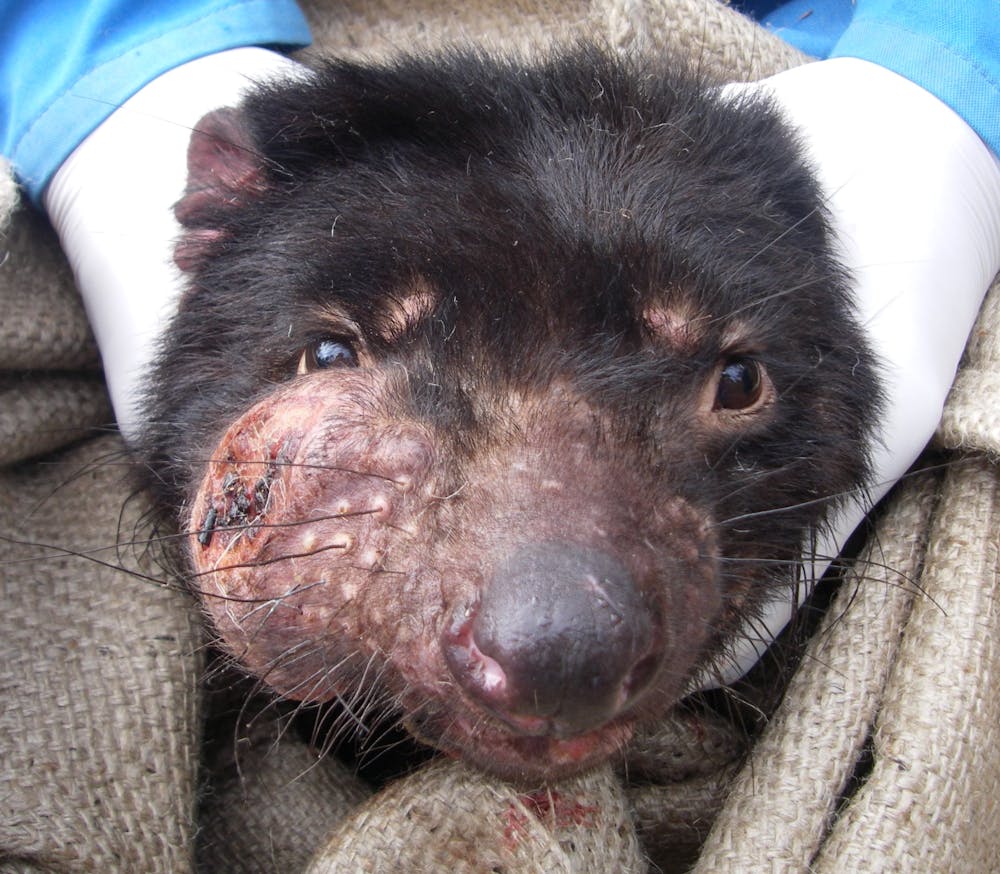 The infectious tumours are spread by biting.
CREDIT, Author provided
The infectious tumours are spread by biting.
CREDIT, Author provided
Ten years ago, we thought there was a real chance DFTD would drive the Tasmanian devil to extinction. Our concern arose not just because the cancer was almost inevitably lethal, but also because the transmission rate did not appear to slow down, even as devils became very rare.
Our new research has some good news: by pioneering application of genomic analysis typically used for viruses, we have discovered the curve has flattened and the rate of increase of infections has slowed. This means while the disease is probably not going away, neither are Tasmanian devils.
Genomics is a relatively new field of science that uses the vast amounts of data available from modern genetic sequencing techniques to answer some of the most difficult and important questions in biology.
Read more: We developed tools to study cancer in Tasmanian devils. They could help fight disease in humans
The genomic approach we used is called phylodynamics. It uses sophisticated mathematical analysis of small changes in DNA to reconstruct the evolution and spread of the tumour through devil populations. This is the same method used to track the COVID-19 pandemic, and it was first developed to study the influenza virus. Viruses have small genomes and evolve rapidly. This is the first time the method has been used for a pathogen with a much more complex and slowly evolving genome.
Screening more than 11,000 genes, we found the R number (the average number of secondary cases for each primary case, now familiar from COVID-19) has fallen from about 3.5 at the peak of the epidemic to about one now. This suggests some sort of steady state has been reached, and the disease and devils are now coexisting.
 Reproduction number RE of DFTD from 1990 to the present.
CREDIT, Author provided
Reproduction number RE of DFTD from 1990 to the present.
CREDIT, Author provided
This discovery backs up a paper we published last year, in which we reached a similar conclusion using mathematical models based on marking and recapturing Tasmanian devils at a single study site, without taking genetics into account.
Our new study is based on samples collected across Tasmania since the early 2000s. Given the very different nature of the two methods, the agreement between the results lends us increased confidence in our conclusions.
This paper, in addition to several we have published recently, shows there have been rapid evolutionary changes in Tasmanian devils and in the tumours themselves since the emergence of this transmissible cancer. Already, frequencies of gene variants known to be associated with immune function in humans have increased in Tasmanian devil populations, suggesting the devils are evolving and adapting to the threat.
We also now know a relatively small number of genes has a large influence on whether devils become infected, and whether they survive if they do.
Finally, and perhaps most encouragingly of all, we have now seen tumours shrink and disappear — something that was unheard of when the disease first emerged. What’s more, we also know this has a strong genetic basis, again suggesting the devils are genetically adapting to their foe.
Together, all of these discoveries show wild Tasmanian devils can evolve very rapidly — over just five generations or so — in response to this disease. This has profoundly encouraging implications for their likely future survival.
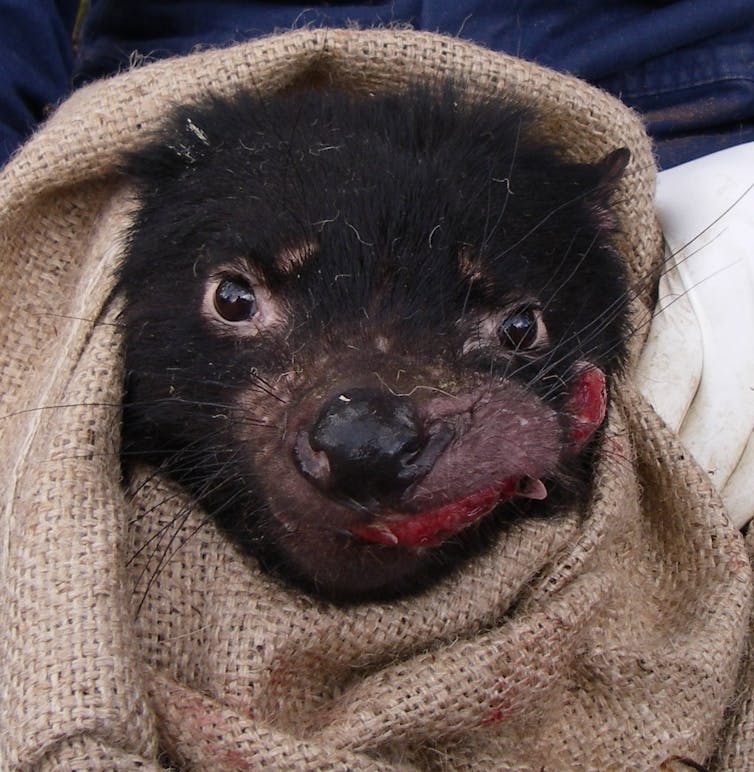 Tasmanian devils now have much better genetic defences against the disease.
Rodrigo Hamede, Author provided
Tasmanian devils now have much better genetic defences against the disease.
Rodrigo Hamede, Author provided
There is still much more to learn about the evolution of the devils and their tumours. But meanwhile, our results provide a warning that a strategy of reintroducing captive-reared animals to supplement diseased wild devil populations is likely to be counterproductive.
When devils from populations that have never been exposed to the disease interbreed with wild animals in diseased populations, the evolution we have seen in wild populations is likely to slow down or even reverse, endangering those populations.
What’s more, the slowing rate of disease transmission may be partly a consequence of reduced devil population densities, resulting in fewer bites. Artificially boosting population densities might accelerate disease transmission, the opposite of the intended effect.
Read more: Sexual aggression key to spread of deadly tumours in Tasmanian devils
With the growing body of evidence showing extinction of devils is quite unlikely even over the next 100 years, we have time for careful consideration of management strategies. Specifically, models can be developed to assess the evolutionary and epidemiological consequences of reintroductions or translocations.
One possibility would be to captively breed devils that have the right genes to boost their chance of surviving the disease. More broadly, our research underlines the vital importance of taking evolutionary considerations into account when managing endangered species. We now have the genomic tools to do so.
Many thanks to Andrew Storfer at Washington State University, Menna Jones and Rodrigo Hamede at the University of Tasmania, and Paul Hohenlohe at the University of Idaho for their contributions to this article and the research it describes.
Authors: Hamish McCallum, Professor, Griffith School of Environment and Science, Griffith University
Read more https://theconversation.com/tasmanian-devils-look-set-to-conquer-their-own-pandemic-151842


















