why unis must prepare students to secure both our food and our planet
- Written by Damien Field, Associate Professor, Institute of Agriculture, University of Sydney
Agriculture will soon be worth A$100 billion a year to Australia. The industry employs more than 250,000 people, stewards 80% of our land area and drives world-class agribusiness and food sectors. In an uncertain employment market, every new agriculture graduate has a choice of six job opportunities.
Read more: Don't panic: Australia has truly excellent food security
Agriculture today is fast-paced, global, diverse, reliant on high-end scientific discovery and increasingly responsive to consumers’ concerns about provenance, ethics and health. Despite all this, agriculture still fails to grip the imagination of many of our brightest students.
In Australia about 300 to 400 students graduate with some form of agriculture degree each year. With 17 universities offering significant agriculture studies, this would amount to only 23 students per university each year. And the numbers are declining.
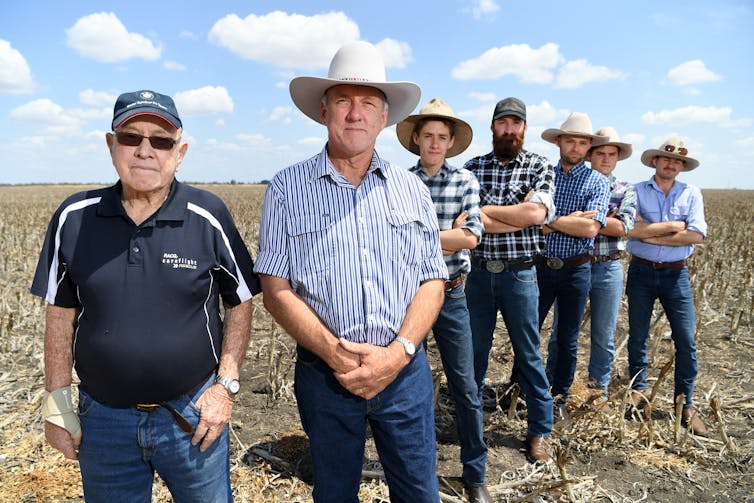 While some farms are being passed on through the generations, there is a shortage of agriculture graduates.
Dan Peled/AAP
While some farms are being passed on through the generations, there is a shortage of agriculture graduates.
Dan Peled/AAP
As a growth sector with many jobs on offer, why does it lack appeal for students? Do we have the right model to attract the school leavers agriculture needs?
Part of the problem is social: agriculture doesn’t attract much attention apart from when Australia is on fire, covered in dust, flooded by water or when crops are dying of thirst. Parents and students associate agriculture with rural parched landscapes and struggling farmers, not high-technology science and genetics to produce the best meat or crops.
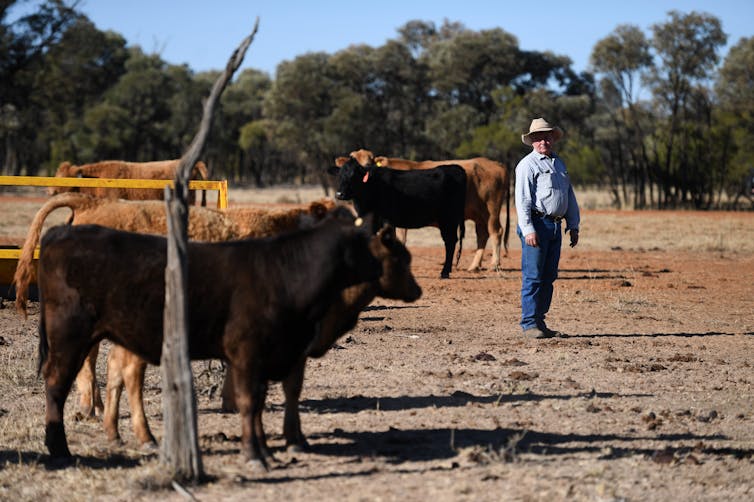 Media coverage of farms hit by droughts and floods presents a challenge for the image of agriculture.
Dan Peled/AAP
Media coverage of farms hit by droughts and floods presents a challenge for the image of agriculture.
Dan Peled/AAP
Read more: Technology is changing the face of northern Australian cattle farming
What do students need to know?
The world of agriculture may start in a rural town far from Sydney Harbour, but it ends up in the commodity markets of London, Paris and New York and underpins some of the world’s most successful companies. And it does this with the help of some of our most innovative scientists.
To attract the best school leavers, it is vital that what we offer students is as exciting, diverse and challenging as the sector is becoming. To borrow a federal government term, the job-ready (agriculture) graduate of tomorrow needs to experience and understand best-practice regional farming systems. This is agriculture that’s in sync with a diverse landscape and resilient to climate change.
Read more: New study: changes in climate since 2000 have cut Australian farm profits 22%
Students’ knowledge needs to be across the many ways to practise agriculture. These range from organic and regenerative agricultural practices, focused on replicating natural processes, through to technology-driven precision farming and the emerging trend of using locally sourced inputs in circular farming systems.
The days of simply shearing and shipping are over. The importance of provenance now goes right through the supply chain – we need to be able to trace food from paddock to plate.
Graduates will also need strong statistical and experimental design skills to manage the science and economics of agriculture. Since the emergence of precision agriculture the quantitative skills graduates need have been totally transformed. They’ll have to manage big data sets to make informed decisions and optimise farm production.
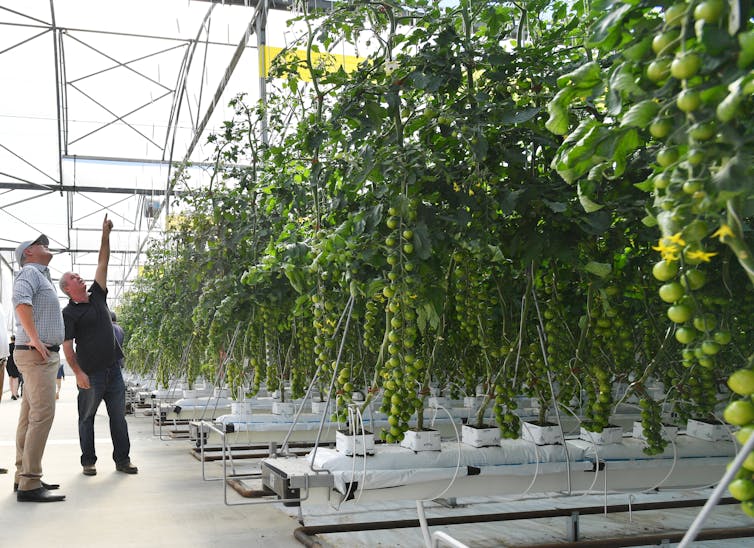 Agriculture demands ever-increasing technological skills.
David Mariuz/AAP
Agriculture demands ever-increasing technological skills.
David Mariuz/AAP
The curriculum has had to expand beyond its historical focus on experimental design to include teaching spatial and temporal data combined with ecological statistics. Farmers want data in real time and mapped across their farm to optimise management and make spatially mapped yield predictions.
A rising awareness of ethics
The impact of producing food is under increasing scrutiny, too, exemplified by recent films Kiss the Ground and David Attenborough’s A Life on Our Planet.
Consumers are demanding more of food producers. They are represented by groups concerned with better health and nutrition, more diverse diets, or advocates for differing ethical opinions.
Kiss the Ground trailer.The current student cohort is also the most socially aware we have had in decades. The new agriculture curriculum must give them the tools to address these diverse agendas.
Read more: Australia's farmers want more climate action – and they’re starting in their own (huge) backyards
The rise of digital agriculture will further increase use of technology and data for decision-making along the entire supply chain from farm to consumer. Graduates must be aware of how digital technologies can be used to decommoditise – presenting products as unique that are strongly linked to priorities such as sustainability – and add value to farm outputs. Complex value-added products will allow producers to take advantage of rapidly expanding world markets, particularly on our doorstep in Asia.
Farmers continue to strive to protect the land. This is being recognised with calls for payments for ecosystem services that support biodiversity.
Future graduates will be armed with greater understanding of what makes a resilient landscape. They will be able to draw on scientific evidence to support on-farm management decisions and ensure their ecosystem service payments. They will be able to tailor land-management strategies to each farm.
Read more: Climate explained: regenerative farming can help grow food with less impact
Wanted: a visionary curriculum
A renewed agriculture curriculum will open up tremendous opportunities for students. Data science, bioinformatics and genetics now form the basis of much of the activity in agriculture. This is dramatically extending the skill set of graduates.
While animal husbandry and crop cultivation remain central to our sector, the ag students of the future must strive to be the best geneticists, pathologists and ecologists. Sometimes all rolled into one.
A visionary new curriculum must also include a focus on entrepreneurship and market prospecting – leading to innovative start-ups – and ensure graduates have a global outlook.
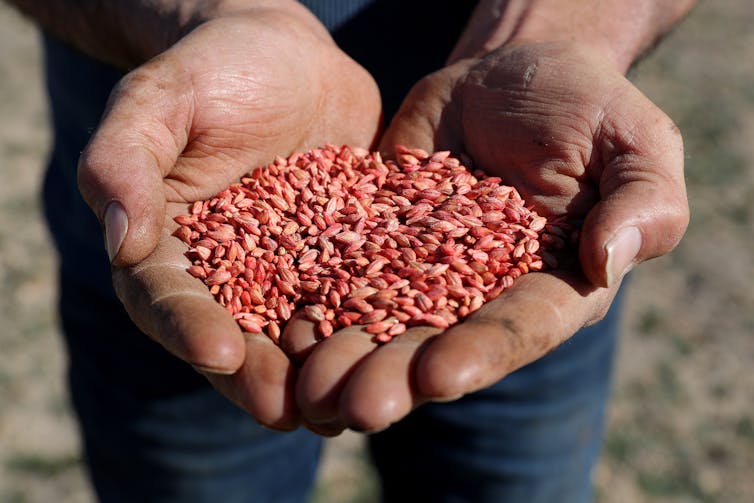 Agriculture graduates will need entrepreneurial skills to market their produce to the world.
Richard Wainwright/AAP
Agriculture graduates will need entrepreneurial skills to market their produce to the world.
Richard Wainwright/AAP
They should be able to build agribusinesses that are responsive to the increasing risks, such as climate change, and agile enough to respond to volatility or to restructure to take advantage of new markets. Entrepreneurial skills will be needed too, to meet consumers’ expectations.
Universities must continue to listen and work with industry and consumers and be responsive to global trends and concerns. Agriculture will remain a growth industry. Careful management and investment in preparing students for the future of agriculture will ensure they can be tomorrow’s leaders of positive change and opportunity for the planet.
Authors: Damien Field, Associate Professor, Institute of Agriculture, University of Sydney