

there is evidence inclusive schooling will help those left behind
- Written by: Linda J. Graham, Professor in the School of Early Childhood & Inclusive Education, Queensland University of Technology
The recently released Gonski 2.0 Review aimed to examine how school funding should be used to improve school performance and student outcomes. A particular area of focus was to improve outcomes across all student cohorts including disadvantaged and vulnerable students, and academically advanced (“gifted”) students.
The report sets out a radically different vision of Australian school education but does not fully explain how this vision can be achieved.
Read more: Gonski review reveals another grand plan to overhaul education: but do we really need it?
This omission has been rightly criticised. But there has been little acknowledgement of the positives in the report or the problems it seeks to address. These problems are real and are important to confront as they affect us all and will increase in the future.
By far the biggest problem is more than one quarter of Australian school students are “missing out” from their school education. This affects their ability to participate in an increasingly high skills economy, setting them up for a lifetime of precarious work or welfare dependency.
The presumption has always been that these students just aren’t “smart enough” to “keep up” and seldom is the need to do so questioned. Gonski 2.0 changes that by recognising and challenging deep fault lines in our education system that have extremely negative equity effects.
What’s the problem?
The report notes our current age/grade system leaves too many students behind. It acknowledges the huge range in the learning readiness of students the same age, stating the:
most advanced students in a year group can be five to six years ahead of the least advanced.
The presence of this gap does not mean students at the lower end are destined to remain there. These students can and do succeed, but it takes the right supports from expert teachers and the time to provide them.
Yet, our system is currently structured in such a way that those who fall behind get left behind. This is because the Australian curriculum is content heavy and the pressure to cover this content over the course of a year leaves teachers with little time to provide the individualised support needed by almost one in five Australian students.
“Summative assessment”, or benchmarking, is used as a blunt tool to determine what students have or have not learned. They are then graded A-E against the achievement standards. In some schools they’re also ranked against their peers.
By the end of their schooling, some 26% have still not achieved a Year 12 Certificate or its equivalent.
What is Gonski’s solution?
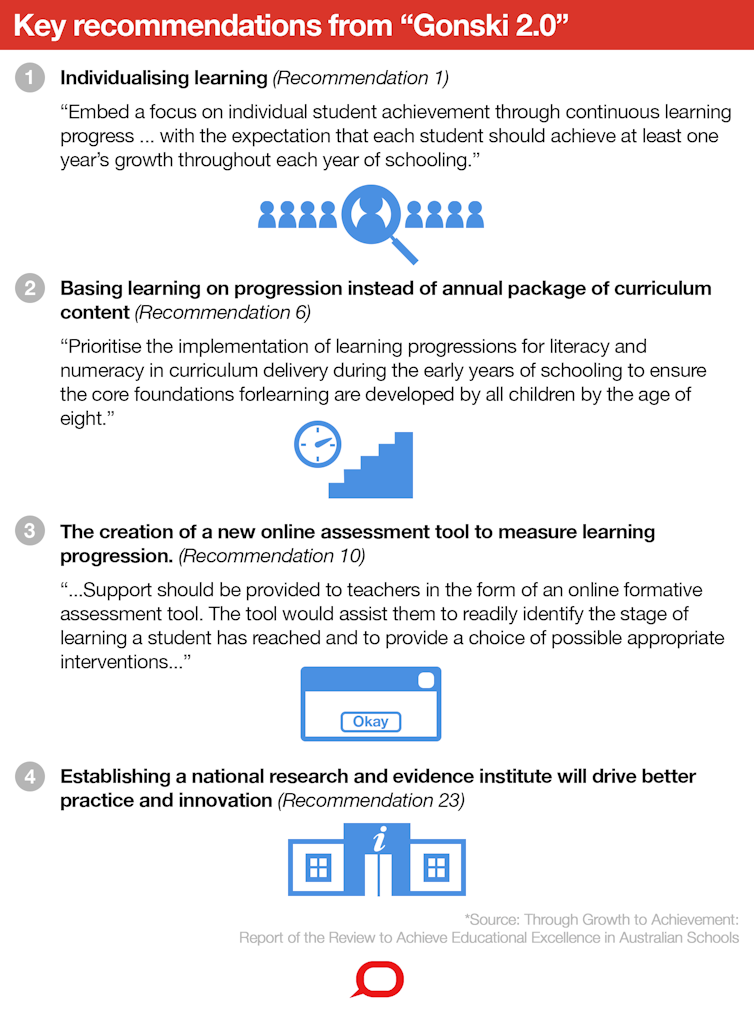
The report proposes a “radical” new approach based on:
all students being educated in mixed-ability classrooms
greater use of formative assessment to determine where students are in their learning
differentiated teaching to meet students at their respective point of need
a redirection in focus from comparative achievement against an age/grade standard to individual growth in achievement against a defined learning progression.
 The Conversation/Federal government, CC BY-ND
Some commentators have criticised the lack of supporting evidence and it’s true the report relies heavily on a select range of sources and does not make the grade in terms of academic rigour. This does not mean the ideas proposed or practices described are fanciful or have no evidence to support them.
Take, for example, the concept of teaching students in mixed-ability classrooms, the use of formative assessment, and differentiated teaching. While these might sound radical when combined into a new vision for school education, each has evidence to support them. They’re all elements of inclusive practice.
The evidence for inclusive education
The benefits of mixed-ability classes are shared by all. There are a range of important academic and social benefits for students with disabilities (including improved memory and stronger language and literacy and mathematics skills), as well as students without disability (such as social and emotional development).
Ability “streaming”, which involves assigning students of the same grade into ranked classes based on prior achievement or perceived ability levels, has a neglible effect on achievement and profoundly negative consequences for lower ranked students. Despite strong evidence against streaming, many schools still stream classes by ability and some education systems stream entire schools.
Read more:
The way schools cope with learning difficulties is doing more harm than good
Formative assessment is feedback given to students during the course of their learning, and can help students understand what progress they have made and what the next steps are. It has been highlighted as one of the most effective practices a school can adopt to individualise learning for all students with long-standing and consistent evidence to support its use. Teachers can also use the information to differentiate their teaching to ensure that they are truly teaching each student based on their needs.
Teachers differentiate when they provide appropriately challenging work for all students, using a variety of means to help them engage with the content and demonstrate their learning. There is evidence whole-school models of differentiation can improve academic outcomes and close achievement gaps including in high stakes tests. Teachers who have the opportunity to practice differentiated instruction and receive ongoing professional development develop competency and stronger belief in their own capability.
Inclusion is better for everyone
In offering a bold vision for the future, the Gonski 2.0 report has encouraged Australia to help more of our young people successfully navigate a precarious future.
More flesh is needed to make this vision a reality but the individual components that make up the vision are not radical and, if done well, can enhance students’ learning experiences and outcomes. And that is better for everyone.
The Conversation/Federal government, CC BY-ND
Some commentators have criticised the lack of supporting evidence and it’s true the report relies heavily on a select range of sources and does not make the grade in terms of academic rigour. This does not mean the ideas proposed or practices described are fanciful or have no evidence to support them.
Take, for example, the concept of teaching students in mixed-ability classrooms, the use of formative assessment, and differentiated teaching. While these might sound radical when combined into a new vision for school education, each has evidence to support them. They’re all elements of inclusive practice.
The evidence for inclusive education
The benefits of mixed-ability classes are shared by all. There are a range of important academic and social benefits for students with disabilities (including improved memory and stronger language and literacy and mathematics skills), as well as students without disability (such as social and emotional development).
Ability “streaming”, which involves assigning students of the same grade into ranked classes based on prior achievement or perceived ability levels, has a neglible effect on achievement and profoundly negative consequences for lower ranked students. Despite strong evidence against streaming, many schools still stream classes by ability and some education systems stream entire schools.
Read more:
The way schools cope with learning difficulties is doing more harm than good
Formative assessment is feedback given to students during the course of their learning, and can help students understand what progress they have made and what the next steps are. It has been highlighted as one of the most effective practices a school can adopt to individualise learning for all students with long-standing and consistent evidence to support its use. Teachers can also use the information to differentiate their teaching to ensure that they are truly teaching each student based on their needs.
Teachers differentiate when they provide appropriately challenging work for all students, using a variety of means to help them engage with the content and demonstrate their learning. There is evidence whole-school models of differentiation can improve academic outcomes and close achievement gaps including in high stakes tests. Teachers who have the opportunity to practice differentiated instruction and receive ongoing professional development develop competency and stronger belief in their own capability.
Inclusion is better for everyone
In offering a bold vision for the future, the Gonski 2.0 report has encouraged Australia to help more of our young people successfully navigate a precarious future.
More flesh is needed to make this vision a reality but the individual components that make up the vision are not radical and, if done well, can enhance students’ learning experiences and outcomes. And that is better for everyone.
Authors: Linda J. Graham, Professor in the School of Early Childhood & Inclusive Education, Queensland University of Technology


















