

how the arts in Australia suffered (but survived) in 2020
- Written by: Jo Caust, Associate Professor and Principal Fellow (Hon), School of Culture and Communication, University of Melbourne
The arts sector has been through a trial by fire this year. Most activities planned from March had to be cancelled, or modified to such an extent they were no longer recognisable.
The challenge for many is the sector is complex: not defined by one artform, one form of artistic expression or one mode of organisation. Those not familiar with this complexity find it hard to come to grips with or make sense of.
Read more: A litany of losses: a new project maps our abandoned arts events of 2020
The federal government, in particular, has been very slow in both recognising the damage to the sector with the sudden closures, and in taking any significant action to address it.
Coronavirus-specific funding didn’t start to be distributed by the government until November through its RISE program — eight months after the calamity hit. A very long time for artists and arts organisations to survive without assistance.
For some, state governments stepped up and provided support.
But the message to artists from the federal government was: you are not important to the national agenda, and therefore we can — and will — ignore you.
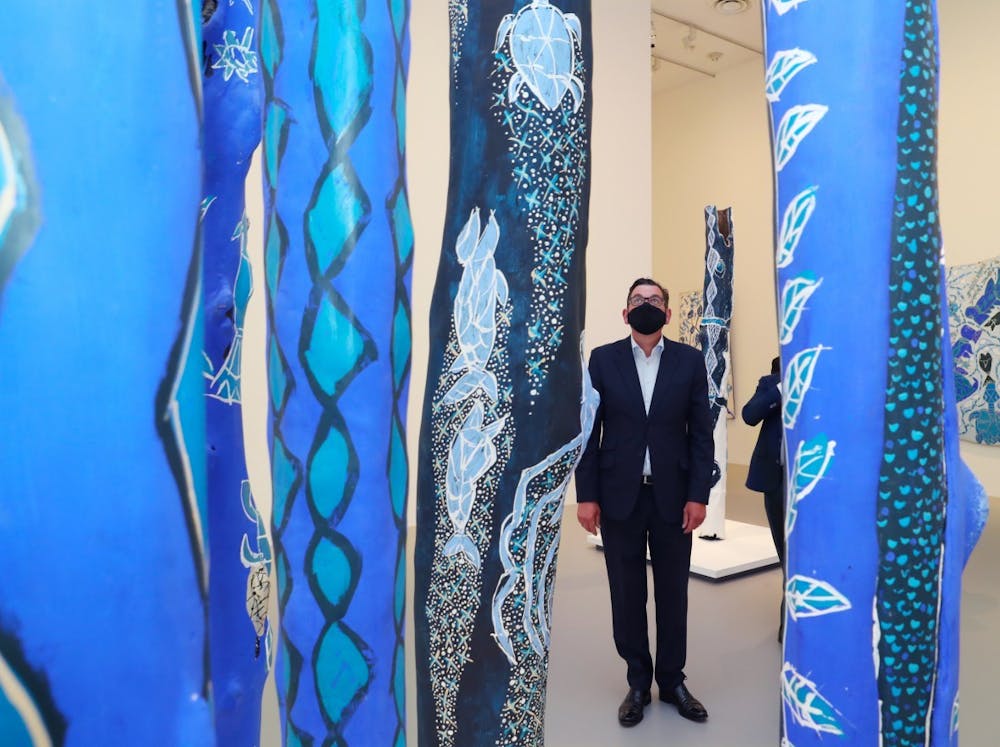 Victorian Premier Daniel Andrews tours the reopened National Gallery of Victoria on November 25.
David Crosling/AAP
Victorian Premier Daniel Andrews tours the reopened National Gallery of Victoria on November 25.
David Crosling/AAP
Read more: The government says artists should be able to access JobKeeper payments. It's not that simple
The collapse of arts degrees
Being ignored was one thing. But then the federal government decided it should ensure there was no future in the arts by decreeing an education in the arts and the humanities to be effectively an indulgence.
From 2021, arts and the humanities will become as expensive as law degrees. Rapidly and across the country, universities started to axe or modify their arts offerings.
We have Monash getting rid of its theatre studies and musicology programs; Newcastle and La Trobe getting rid of their drama departments; an Australian National University proposal to downgrade its arts school; Griffith’s Queensland College of the Arts cutting courses in fine arts, photography and design; and Flinders announcing “a temporary pause” to enrolling students in its acting degree in 2021.
Read more: Friday essay: amid a war on culture, are Australia's art schools an endangered species?
When universities focus on being businesses first and educational institutions second, they are willing collaborators in the degradation of Australian’s arts and culture.
There is a dreadful feeling this is just the beginning, and there will be many more to follow across the country.
It seems the federal government has no idea how long it takes to develop these arts programs, and that once they are gone, they are gone.
The capacity for the country to continue to train a range of performers, directors, musicians, artists, writers and curators will be dramatically affected.
What is also so frustrating is the arts are excellent at job creation. This is the mantra the government keeps repeating: they want to create more jobs. But there is a bias to what sectors they will support.
Supported industry sectors seem to be generally male dominated, such as construction, mining and agriculture. The arts and education sectors are female dominated and ignored.
Read more: High-viz, narrow vision: the budget overlooks the hardest hit in favour of the hardest hats
Alternatively, perhaps the government does not see the arts sector as a natural supporter of the coalition parties — thus they may as well take them out of the game.
Even provided with evidence about the impact of the creative and cultural sector to the economy, as well as to the long term development of the country’s capacity to adapt to contemporary needs, it seems the arts and cultural sector is neither valued nor respected.
It is short-term thinking at best, creating a bleak and uninspiring future for our young people.
The ‘non-essential’ artist
Through the year we have seen some amazing things happen, and some really disappointing ones.
When some of our major orchestra and opera companies dismiss their artists, and musicians are framed as “non-essential”, all our perceptions about what an arts organisation is are thrown out the window.
 Members of Opera Australia Orchestra performing at a rally outside the offices of Opera Australia after they were stood down without pay in March.
AAP Image/Joel Carrett
Members of Opera Australia Orchestra performing at a rally outside the offices of Opera Australia after they were stood down without pay in March.
AAP Image/Joel Carrett
Are some major arts organisations just a shallow corporate shell, only there for the benefit of their board and management? Opera Australia is the most well-funded arts company in the country, receiving a minimum of A$26 million in government funding in 2020, and yet stood down its musicians without pay in March.
The company was later placed on JobKeeper, nearly a third of the orchestra was made redundant in September.
Light in the dark
Despite this gloomy picture, there have been some wonderful adjustments by artists and arts organisations. The embrace of the digital medium has enabled greater access by audiences to all forms of arts practice, both locally and internationally.
The Australia Council hosted a series of excellent online training workshops.
The Melbourne Fringe managed 250 events despite the lockdowns by adapting to the conditions and going online.
The Melbourne Virtual Concert Hall enabled musicians to continue to perform for much of the year and receive an income.
 When live theatre was able to return – as with the Sydney Theatre Company’s The Picture of Dorian Gray – seats sold out.
STC/Dan Boud
When live theatre was able to return – as with the Sydney Theatre Company’s The Picture of Dorian Gray – seats sold out.
STC/Dan Boud
There was online streaming of events and exhibitions from around the world and a sense of a global arts world surviving and adapting, despite the pandemic.
Most importantly, when live performance has been possible, audiences are booking shows out, and savouring the experience of being in a real theatre again.
Authors: Jo Caust, Associate Professor and Principal Fellow (Hon), School of Culture and Communication, University of Melbourne
-in-2020?highlight=WyJwYW5kZW1pYyJd&media=https://www.modernaustralian.com/https://images.theconversation.com/files/375592/original/file-20201217-19-ccfdl4.jpg?ixlib=rb-1.1.0&q=45&auto=format&w=754&fit=clip&description=how%20the%20arts%20in%20Australia%20suffered%20(but%20survived)%20in%202020 "Pin It")

















