

listen to the calls of 6 frogs out and about this summer
- Written by Jodi Rowley, Curator, Amphibian & Reptile Conservation Biology, Australian Museum
Environmental scientists see flora, fauna and phenomena the rest of us rarely do. In this series, we’ve invited them to share their unique photos from the field.
Frog calls are iconic sounds of summer in Australia. There are more than 240 species native to Australia, almost all of which are found nowhere else on Earth.
While some of Australia’s frog species prefer the cooler months, spring and summer are the best times to see and hear the majority of them. This is particularly true in tropical Australia, where most frog species only emerge from their hiding places in the wet season, filling summer nights with their choruses.
Most of us will hear frogs before we see them. In all Australian frog species, male frogs call to attract female frogs to mate with. Each species has a unique advertisement call, so you don’t need to see a frog to identify it.
Males typically call from near water bodies, where they hope to breed, and call mostly at night, preferring to shelter in the heat of the day. As a result, the best place to encounter frogs is near a water body such as a pond, creek or wetland, and the best time is after dark.
This article contains recordings of six unique frog calls. Depending where you live, you might just hear one on a quiet, summer night. But first, let’s explore why frogs are so important to our ecosystems.
From rainforests to deserts
Frogs are exquisitely adapted to almost all kinds of habitats in Australia, from rainforests to deserts. In some of the wettest forests, some frogs such as the northern ornate nursery frog (Cophixalus ornatus) have done away with the need for tadpoles, developing into tiny frogs in the egg.
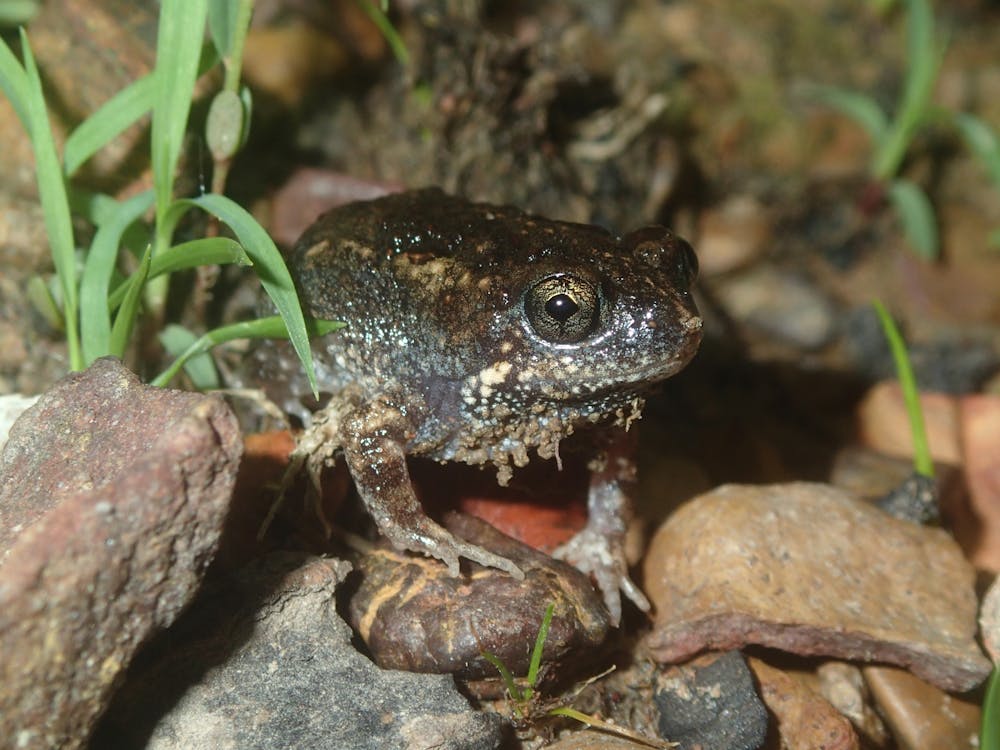 The stonemason toadlet, Uperoleia lithomoda
Jodi Rowley, Author provided
The stonemason toadlet, Uperoleia lithomoda
Jodi Rowley, Author provided
In the driest parts of Australia, where it doesn’t rain for months at a time, frog species such as the eastern water-holding frog (Cyclorana platycephala) spend most of their lives underground. These frogs are protected from dehydration by a “cocoon” of their own skin and skin secretions. They only pop above the surface when it’s wet enough for them to breed in the flood waters.
While many species are common, more than 30 are threatened with extinction. On top of that, we’ve already lost at least four species — part of out natural heritage, gone forever.
The major frog threats are disease (particularly chytridiomycosis, caused by the amphibian chytrid fungus), habitat loss and modification, introduced species and climate change.
We should care that our frogs are disappearing, as they are an important part of healthy ecosystems. Frogs are major consumers of invertebrates, and are also eaten by a wide array of predators including fish, birds and mammals. Tadpoles may also be the dominant grazers in aquatic systems, helping keep streams from clogging up with algae. When frogs disappear, other animals follow, and ecosystems are forever altered.
Read more: A deadly fungus threatens to wipe out 100 frog species – here's how it can be stopped
When meeting your local frogs, be careful not to disturb them or their habitat, and clean your shoes if going to more than one area of frog habitat so you don’t accidentally spread frog disease. One of the best ways to learn about your local frogs, and to help understand and conserve them, is by recording their calls using the free FrogID app.
Here are some of the frog species you are likely to hear, and maybe even see, this summer.
1. Peron’s tree frog
Peron’s tree frog (Litoria peronii) is a large frog species that can be found in southern Queensland, New South Wales, Victoria and southeastern South Australia.
With cream to dark grey skin flecked with tiny emerald spots, cross-shaped pupils, and a loud, laugh-like call, this frog species is very commonly encountered around our homes — often hiding in pot plants, watering cans or even our letterboxes.
2. Motorbike frog
While the haunting call of the moaning frog (Heleioporus eyrei) fills autumn and winter nights around Perth, the motorbike frog (Litoria moorei) makes up a large part of Perth’s summer soundtrack.
Common in backyards throughout the southwest of Western Australia, this species is named after its drawn-out call, resembling an old motorbike racing up the street, changing gears.
This large tree frog, variably marbled with green and gold, often basks in the sun on reeds during the day.
3. Striped marsh frog
The striped marsh frog (Limnodynastes peronii) is commonly heard but rarely seen throughout its range along eastern Australia from north Queensland to Tasmania, and into the eastern edge of South Australia.
Its call is familiar to many, resembling a tennis ball being hit, or a dripping tap. This species loves backyard ponds, and is found even in the most built-up areas of cities, creating foamy nests for their eggs after a successful night of calling.
Adults have smooth, striped brown skin, and long, spidery toes. Males can be distinguished by females as they have much more robust arms.
4. Banjo frog
Banjo frogs occur throughout much of Australia, with a familiar loud “bonk” call, somewhat resembling the pluck of a banjo string reverberating from dams, wetlands and slow-flowing sections of streams and rivers.
During dry times, banjo frogs bury themselves underground, emerging after, or sometimes just before, summer rains. They are large, rather solid, frogs with a round snout, and are often mistaken for cane toads.
There are four species of banjo frog. In the southeast, the eastern banjo frog (Limnodynastes dumerilii) is very common, particularly in farm dams. Meanwhile, the northern banjo frog (Limnodynastes terraereginae) lives in northern NSW and throughout much of Queensland.
The giant banjo frog (Limnodynastes interioris) can be found in inland NSW and Victoria, and the western banjo frog (Limnodynastes dorsalis) is found in southwestern Western Australia.
5. Stonemason toadlet
The stonemason toadlet (Uperoleia lithomoda) is a tiny brownish-grey burrowing frog found across the top of Australia: in north Queensland, the Northern Territory and Western Australia.
This species emerges from underground after heavy monsoonal rains, and males produces an extraordinarily loud call that sounds like a harsh “click”.
With bumpy skin, they resemble toads enough to be called “toadlets”, and are often mistaken for young cane toads (Rhinella marina).
6. Eastern dwarf tree frog
The eastern dwarf tree frog (Litoria fallax) is highly adaptable and usually found along the east coast, from north Queensland to the borders of NSW and Victoria.
In recent years, it has also established populations in Victoria, well outside its native range, likely as a result of hitchhiking on produce or nursery plants.
Like the motorbike frog, the eastern dwarf tree frog is often seen during the day, basking in the sun, and will even call during the day on vegetation far from water.
Authors: Jodi Rowley, Curator, Amphibian & Reptile Conservation Biology, Australian Museum

















