

Vaccines may soon make travel possible again. But how quickly will it return — and will it be forever changed?
- Written by: Joseph M. Cheer, Professor in Sustainable Tourism, Wakayama University
The COVID-19 pandemic brought the global tourism industry to a screeching halt in 2020. With vaccines starting to be rolled out, there is hope international travel can resume soon, but exactly when — and how — is the million-dollar question.
Before COVID-19, there was much concern about whether tourism had grown too big for our planet. There were calls to scale back tourism, make it more environmentally sustainable and help over-touristed locations become more resilient to crises.
However, with almost no international travel in 2020, we now have the opposite problem. The pandemic caused a 70% drop in international tourist arrivals globally from January to August, compared to the same period last year.
Destinations reliant on international tourists have been the hardest hit. Many are in developing countries, where tourism is a major export earner. For example, according to the World Bank, tourism makes up nearly 15% of Thailand’s GDP, which is why it recently started allowing select foreign tourists to return for extended stays.
But attempts to reboot international travel on a wider scale have so far failed due to successive waves of COVID-19.
As a more transmissible and harder-to-control coronavirus variant has emerged in the UK and South Africa in recent days, dozens of countries have announced they would close their doors to travellers from both nations. Some countries, like Japan and Israel, have gone a step farther, banning all foreign nationals from entering.
Even before this, travel bubbles and corridors between countries have been proposed, but few have managed to take root.
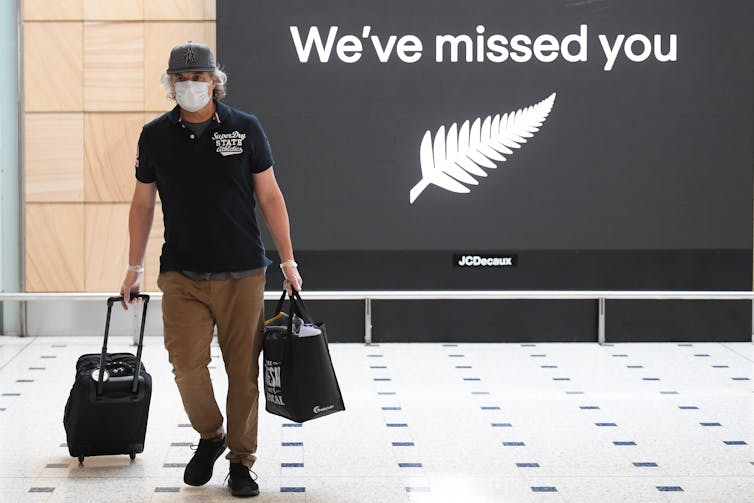 The recently-announced trans-Tasman bubble between Australia and New Zealand is one of the few options for international travel in the pipeline.
DEAN LEWINS/AAP
The recently-announced trans-Tasman bubble between Australia and New Zealand is one of the few options for international travel in the pipeline.
DEAN LEWINS/AAP
With borders closed, many countries have put a focus on attracting domestic tourists instead. This has helped maintain economic stability in countries such as China and Japan.
Hopes for a swift recovery of international travel are now pinned on a silver bullet: the rapid and widespread distribution of a vaccine.
Beyond this, we believe getting people back in the air again will be shaped by three key issues.
Read more: A vaccine will be a game-changer for international travel. But it's not everything
1) What travel regulations will prove effective?
Travel health requirements may soon start to resemble the past. In the 1970s, having appropriate vaccinations and health clearances was essential for travel to and from many countries. Coronavirus vaccinations will likely become similarly standard for international flights.
This should be rapidly adopted by all countries, and could even be applied more broadly - in hotels, for example.
However, any vaccination regime will need governments to pass strong laws and regulations. Digital travel passes and vaccination passports may be one solution, but in order to work, these will require standardisation across borders.
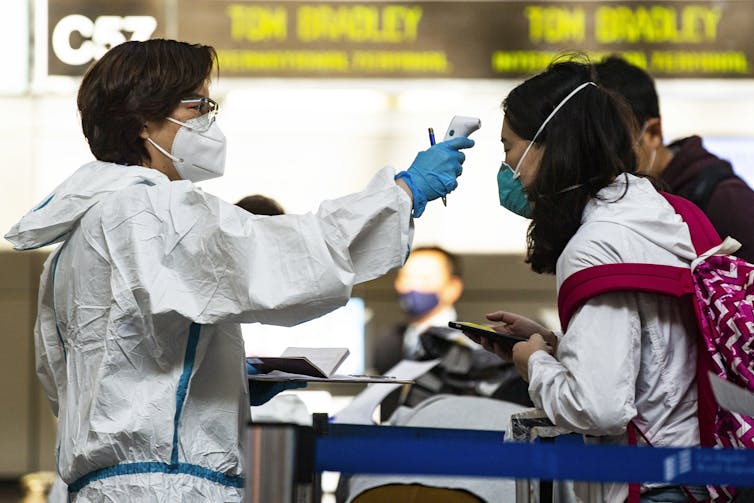 Travellers are screened and have their temperature checked at Los Angeles International Airport.
ETIENNE LAURENT/EPA
Travellers are screened and have their temperature checked at Los Angeles International Airport.
ETIENNE LAURENT/EPA
One solution may be the CommonPass, a new digital health passport that looks to be a trustworthy model for validating people’s COVID-free status consistently across the globe.
Other health measures will also remain vital, including mandatory in-flight masks, pre-departure and arrival testing, mandatory quarantining and social distancing. If vaccination uptake in destinations is low, these measures will become even more important.
Touchless travel should also become standard at most airports through the use of biometric technology. And passengers should expect temperature screening and reduced in-flight services to be the new norm.
Lengthy quarantine periods are one of the biggest obstacles to restarting international tourism — few people can afford 14 days in a quarantine hotel on top of their holiday.
There are potential alternatives being tested. Before the new COVID variant emerged, British Airways and American Airlines had piloted a voluntary testing program for some passengers as a way of avoiding the mandatory 14-day quarantine period in the UK.
The British government also implemented its new “test and release” policy in mid-December, which could shorten the quarantine period to five days for international arrivals.
2) How will airlines restart their businesses?
The International Air Transport Association expects the airline industry won’t reach pre-pandemic levels again until at least 2024.
This means any tourism restart is going to require restoring transportation infrastructure and networks, especially for aviation and cruising.
Many planes are now parked in deserts in the US and Australia. They will need to be retrieved and thoroughly serviced before recommencing flights. Crews will have to be rehired or retrained.
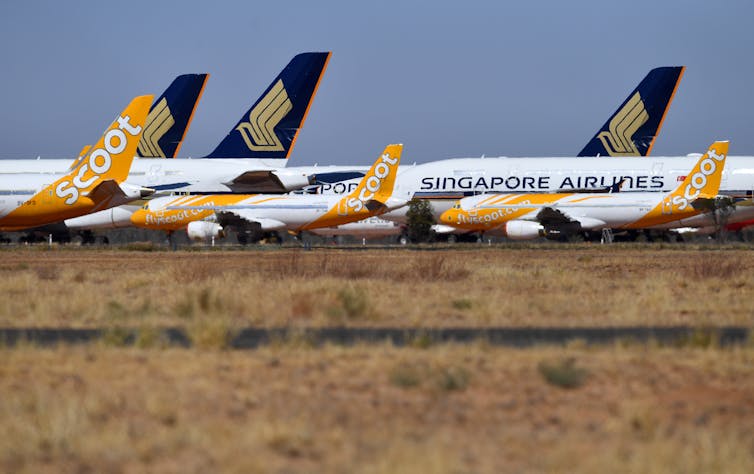 Grounded planes parked at a storage facility in Alice Springs, Australia.
DARREN ENGLAND/AAP
Grounded planes parked at a storage facility in Alice Springs, Australia.
DARREN ENGLAND/AAP
But it’s not as simple as just getting planes back in the air. A more formidable challenge for airlines will be reestablishing air routes while ensuring their ongoing viability.
As airlines slowly build up these networks again, travellers will have to put up with less frequent connections, longer journeys and drawn out stopovers.
There is some encouraging news, though. In the US, domestic airfares have dropped, and though international flight schedules have been drastically reduced, low demand has kept some prices down.
Smaller and more nimble airlines should perform better. And expect smaller and more efficient aircraft to also become more common. Demand for long-haul flights may remain low for some time.
Airports, meanwhile, will require temporary or permanent reconfigurations to handle new public heath screening and testing arrangements — providing yet another possible frustration for travellers.
Cruise ships and port terminals will face similar requirements, as will hotels and other accommodation providers.
3) Will traveller confidence return?
For leisure travellers, the lingering fear of coronavirus infections will be the most formidable obstacle to overcome.
The Thanksgiving holiday in the US and Golden Week in China suggest the appetite for travel remains robust. Some analysts also anticipate leisure travel will likely recover faster than business travel.
However, it remains to be seen whether travellers will have a high appetite for risk, or how quickly they’ll adapt to new safety protocols.
The key to bringing traveller confidence back again will be standardising safety and sanitation measures throughout the global travel supply chain. One idea is a “Safe Travels” stamp once companies have complied with health and hygiene protocols.
How we can build back better
COVID-19 has prompted much reflection about our relationship with the planet.
Advocates for more sustainable tourism are hoping the coming years will lead to a rethink of international travel, with more innovation and a renewed commitment to addressing climate change and crisis management.
However, the likely reality is that destinations will be desperate for economic recovery and will compete vigorously for tourism dollars when borders reopen.
So, if consumer behaviour trends are anything to go by, the new normal might not be too dissimilar from the old. It’s doubtful, for example, that we would tolerate flying less when travel is proven safe again. This doesn’t bode well for the planet.
If international travel is going to “build back better”, communities, governments and the global tourism industry must come up with a transformative plan that is workable and helps drive traveller behaviour change and decarbonisation.
The pandemic has given us a chance for a reset — we should make the most of the opportunity.
Authors: Joseph M. Cheer, Professor in Sustainable Tourism, Wakayama University


















