

'Panic-buying' events are the new normal; here's how supply chains have adapted
- Written by: Flavio Romero Macau, Senior Lecturer in Supply Chain Management and Global Logistics, Edith Cowan University
I live in Perth. Like most people here, on Sunday I was ready for a busy week of getting the kids to school, going to work, visiting the gym and so on. I planned to spend the hot afternoon at the beach.
That changed with the announcement of a five-day lockdown, effective from 6pm, sparked by a security guard at one of Perth’s quarantine hotels testing positive to COVID-19.
The lockdown rules are similar to those in other Australian cities in recent months. Shops for essentials such as groceries, medicine and other necessary supplies remain open. West Australian premier Mark McGowan urged people not to “panic buy”:
There is no need to rush to the supermarket. There will not be a shortage of toilet paper or other goods. You will be able to go out and shop for essentials over the course of this week. I urge everyone to remain calm and to act responsibly.
It made no difference. Within the hour, long queues formed outside supermarkets, service stations and other stores. People stood in 35⁰C heat for up to an hour awaiting their turn to strip store shelves of toilet paper and other items.
Read more: A toilet paper run is like a bank run. The economic fixes are about the same
We’ve seen this all before – nationwide in March, in Melbourne in July, Adelaide in November, and Sydney in December.
People are nervous, I get it. But the premier is right. There’s no need. The only shortages that will occur are those brought on by this very behaviour.
The good news, however, is that any induced shortages will be short-lived. In fact, by the time you read this, the fuss might be over.
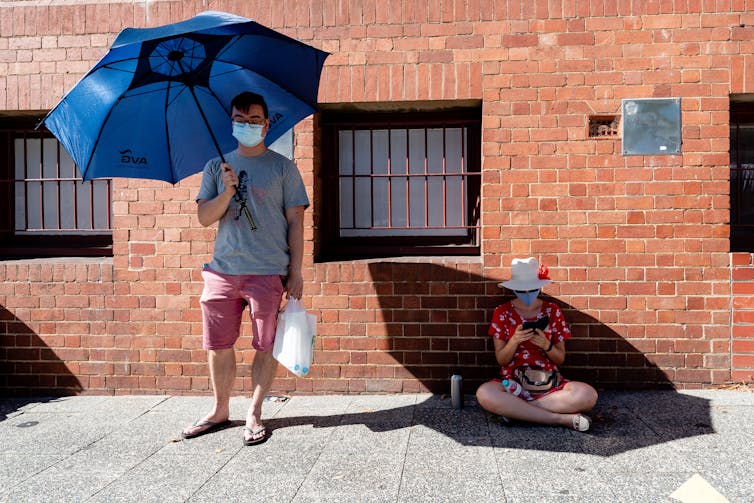 A hot day to queue: waiting to take a COVID-19 test at the Royal Perth Hospital Sunday, afternoon, January 31 2021.
Richard Wainwright/AAP
A hot day to queue: waiting to take a COVID-19 test at the Royal Perth Hospital Sunday, afternoon, January 31 2021.
Richard Wainwright/AAP
The psychology behind stockpiling
For some, the news of a lockdown has little to no effect. Their behaviour is guided by a rational response to uncertainty. They watch in dismay the extreme responses of others during stressful times.
For some a lockdown triggers a complex psychological chain reaction, leading to panic buying and hoarding. Particularly for those more prone to feelings of insecurity and anxiety, stocking up on items is a way to feel more in control. The fact there’s no actual need, because supermarkets will be open tomorrow, has little to do with it. The fear of missing out (FOMO) overcomes rationality.
Not all stockpiling behaviour can be explained away as “irrational”, though. As we’ve seen in recent cases such as GameStop’s share price, people also make “rational” calculations about other people’s behaviour, and respond accordingly.
In this case, based on past evidence, it might seem quite sensible to predict some people will “panic buy” and decide the rational response to that irrational behaviour is to get in first.
Read more: Stocking up to prepare for a crisis isn't 'panic buying'. It's actually a pretty rational choice
There’s little a political leader (or anyone else) can say that will change this. In fact, official warnings against panic buying might even do more harm than good by drawing attention to its probability.
Things will work themselves out
The good news is that any shortages are likely to be very short-lived – even if this lockdown continues beyond its scheduled five days.
Last March, when stockpiling led to weeks-long shortages of toilet paper, hand sanitiser and grocery staples such as pasta, it was because most of Australia was involved. Business and supply chains primed to run as efficiently as possible with highly predictable demand were taken by surprise. They struggled to compensate.
This time, having now had multiple experiences to hone their preparedness and response, supply chain managers know the drill.
Knowing such lockdowns are now a risk, they’ve added more fat to supply chains. Inventory is not kept at a minimum. Supermarkets are quick to limit the amount customers can buy. In most case shelves stripped today will likely be replenished tomorrow.
Read more: A toilet paper run is like a bank run. The economic fixes are about the same
With a localised event, also – in this case Perth and Western Australia’s southwest – extra stock can be diverted from around the country. There’s no need for suppliers to suddenly ramp up production. The only thing stopping supply returning to normal is the speed of transportation and restocking.
What happened across the nation in March 2020 was like a major accident leading to delays and detour on a supply chain highway. This situation is more like a car with a flat tyre slowing the traffic on a local road.
What comes next?
COVID-19 outbreaks – with short, sharp lockdowns in response – look to be part of the “new normal”, until the pandemic is over.
Outbreaks of store stripping also look to be part of the new normal. But so long as we don’t have these outbreaks in multiple states simultaneously, they will pass quickly.
So stay calm and avoid the rush.
Authors: Flavio Romero Macau, Senior Lecturer in Supply Chain Management and Global Logistics, Edith Cowan University


















