

This unique ancient megabeast had perpetually 'bent' elbows
- Written by Hazel L. Richards, PhD candidate, Monash University
Imagine going through life with your arms permanently bent and locked at the elbows. Awkward, right?
Until recently we thought the mega-marsupial Palorchestes azael lived exactly like this. This rare, distant relative of the wombat became extinct (along with much of Australia’s megafauna) about 40,000 years ago.
But our research, published today in the Journal of Anatomy, shows Palorchestes could in fact move its elbows — but only a very tiny amount compared to other mammals.
Thus, we think this enigmatic creature would have had a highly unusual gait, which may provide a clue to why it went extinct.
Read more: Meet the giant wombat relative that scratched out a living in Australia 25 million years ago
A strange setup
The humble elbow has been around since the ancestors of all four-limbed animals first hauled themselves out of the water and onto land.
For most mammals, the elbow is a hinge-like joint that connects the humerus (which runs from shoulder to elbow) with the ulna and radius (which run from elbow to wrist).
The elbow allows the bending and straightening of the arm and is essential for four-legged walking. In the wild it’s also useful for tasks such as feeding, fighting, climbing and grooming.
But Palorchestes seemingly gave much of that up. Unlike other large mammals alive or extinct, it kept its arms in a perpetual “push-up” position.
So what would moving around have looked like for Palorchestes? And why might it have evolved such a narrow range of elbow motion in the first place?
Peculiar Palorchestes
Palorchestes was an unusual-looking marsupial. With a slender jaw indicating a long tongue and tiny nasal bones retracted high up in a narrow skull, some palaeontologists have suggested it had a tapir-like trunk (although others think this is unlikely).
Fossils of Palorchestes’s robust bones show evidence of heavily muscled forelimbs with huge, sharp claws suited for clinging and tearing. And we recently found it may have grown to weigh more than a tonne.
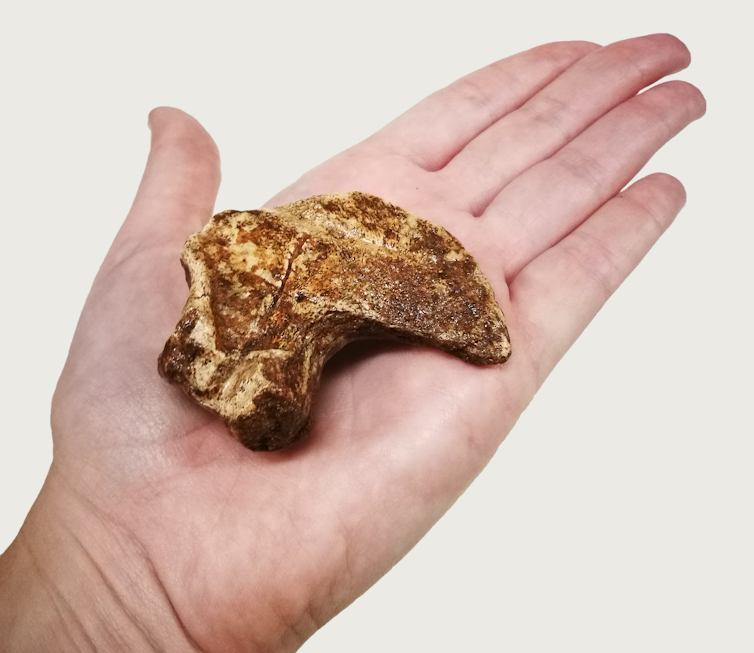 The massive claw bone of Palorchestes azael is equivalent to the bone we have in our fingertip. When Palorchestes was alive, this claw bone would have been covered by a keratin sheath that extended its length up to 50%.
Hazel Richards
The massive claw bone of Palorchestes azael is equivalent to the bone we have in our fingertip. When Palorchestes was alive, this claw bone would have been covered by a keratin sheath that extended its length up to 50%.
Hazel Richards
Still, for us the most interesting aspect of Palorchestes is its flattened elbow joint surfaces, which seem to indicate its elbows stayed bent at around a 100° angle.
We scanned the fossilised arm bones of Palorchestes and created computer simulations to model the full range of movements possible at its arm joint.
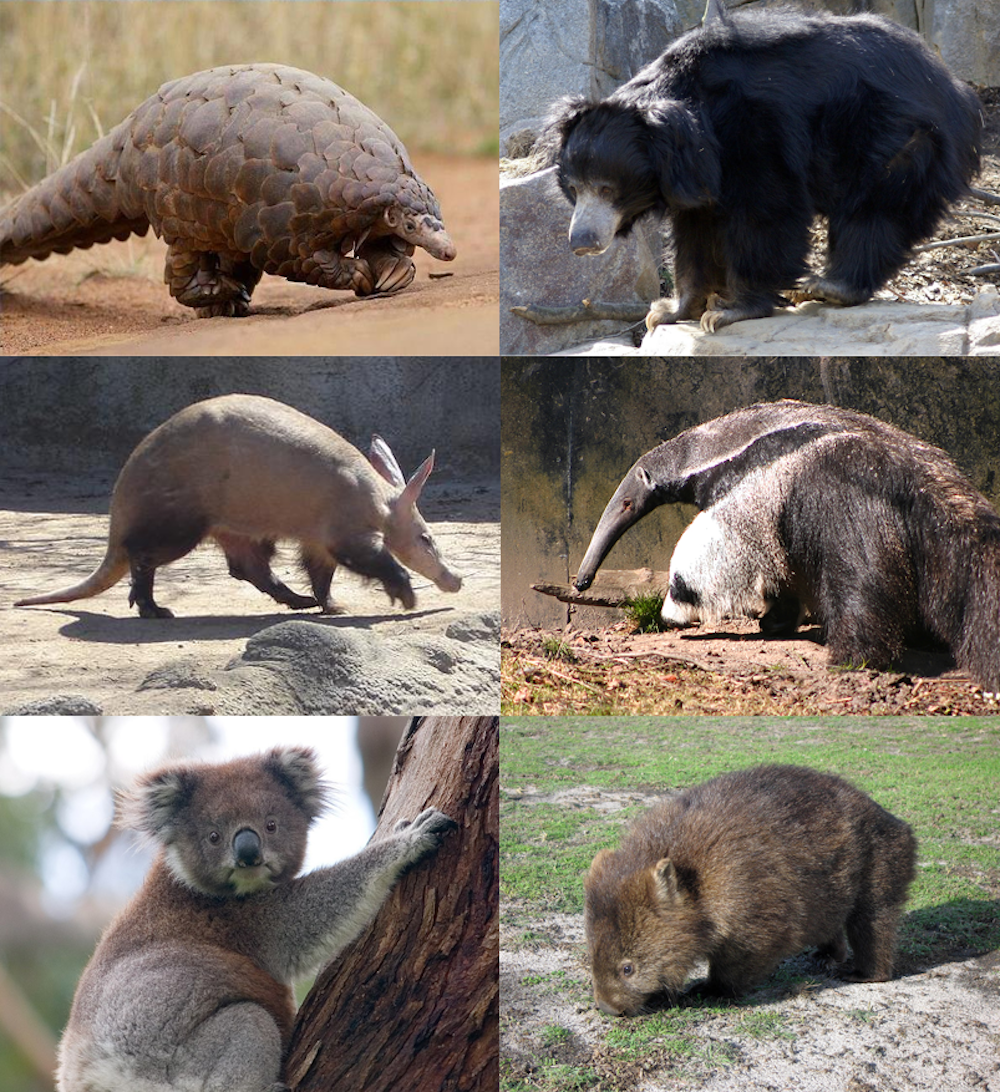 Palorchestes had drastically less elbow mobility than the living mammals we compared it to. Clockwise from the top left: pangolin, sloth bear, anteater, wombat, koala and aardvark.
Wikimedia Commons
Palorchestes had drastically less elbow mobility than the living mammals we compared it to. Clockwise from the top left: pangolin, sloth bear, anteater, wombat, koala and aardvark.
Wikimedia Commons
Our results indicate Palorchestes could move its elbows, but only in an off-axis motion that was tiny compared to other clawed mammals with chunky limbs such as wombats, pangolins, aardvarks and bears. Even its closest extinct megafaunal relatives had vastly more elbow function.
This suggests none of these creatures are good templates for understanding how Palorchestes moved.
By adding sliding movement as well as rotations, we used our 3D simulations to calculate the “average” motion in Palorchestes, from fully flexed to fully extended elbow poses. We found the axis of this small movement was skewed, like a “wonky” hinge.
The interactive below shows the maximum elbow motion that would have been theoretically possible for Palorchestes azael.
This skew means Palorchestes probably held its arms sprawled out from its body, allowing what little elbow mobility was possible to contribute to each stride while walking.
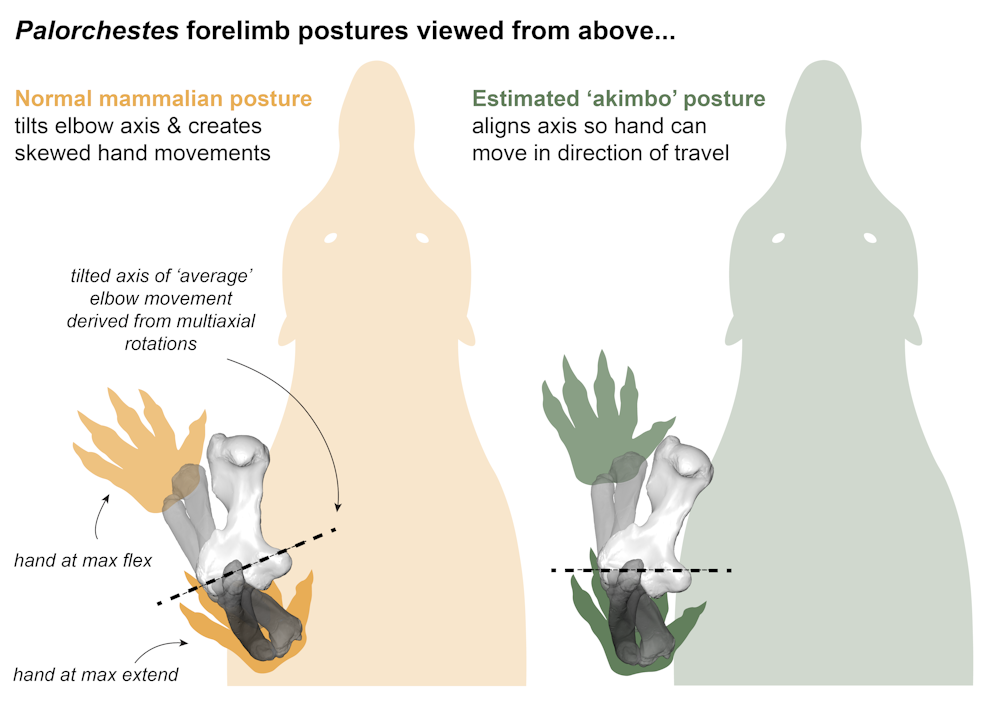 We modelled the whole range of motion possible at Palorchestes’s elbow to calculate its ‘average’ movement. If placed in a ‘normal’ mammal forelimb posture, Palorchestes’s hands would splay out to the sides as the elbows moved (left image). Instead, having forelimbs in a sprawled posture would have let its minute elbow movements contribute to each stride (right image)
Arms akimbo make for awkward walking
Our findings suggest Palorchestes would have trundled along on crouched forelimbs, with its elbows sprawled out to the sides — a highly inefficient gait compared with the pillar-like limbs and tucked-in elbows of its relatives and large mammals alive today.
We think this posture was a compromise which let it use its strong arms and giant claws to access food in a specialised way, which was probably unique even back then.
While exact details remain a mystery, it could be that Palorchestes clung to tree trunks and hauled itself up onto its back legs to reach higher foliage with its long tongue.
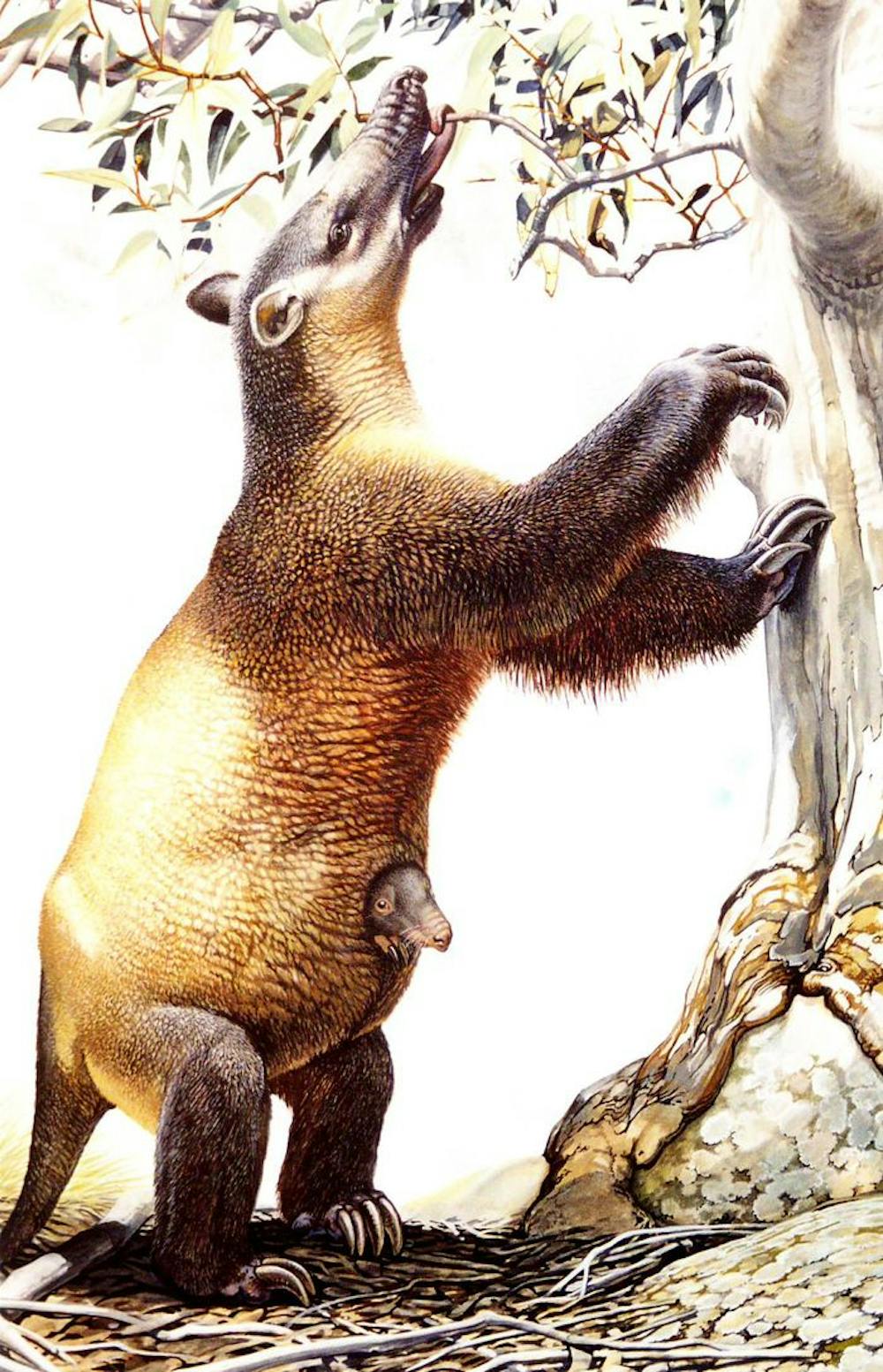 This reconstruction of Palorchestes azael is from the 1980s. Although we now know the forelimb position shown here was highly unlikely, Palorchestes may have still used its strong arms and bent elbows to haul itself up against trees like this for better access to foliage.
Peter Schouten
This reconstruction of Palorchestes azael is from the 1980s. Although we now know the forelimb position shown here was highly unlikely, Palorchestes may have still used its strong arms and bent elbows to haul itself up against trees like this for better access to foliage.
Peter Schouten
Or it might have used its huge, bulky body to push over tree ferns to access the young nutritious fronds higher up.
Whatever it did, Palorchestes was evidently pretty successful. While its fossils are rare, they’re widely distributed right across eastern Australia.
The specialisation trap
The fossils of Palorchestes tell us it was a specialist, highly adapted to a forest landscape.
Large animals have large appetites to match, but Palorchestes’s inefficient walk probably limited its ability to roam widely in search of food.
This would be no problem in times of plenty. But when shifts in Australia’s climate caused sweeping environmental changes across the eastern half of the continent, large specialised megafauna such as Palorchestes were especially vulnerable.
Even small changes in the vegetation mix would have made it difficult to find enough food.
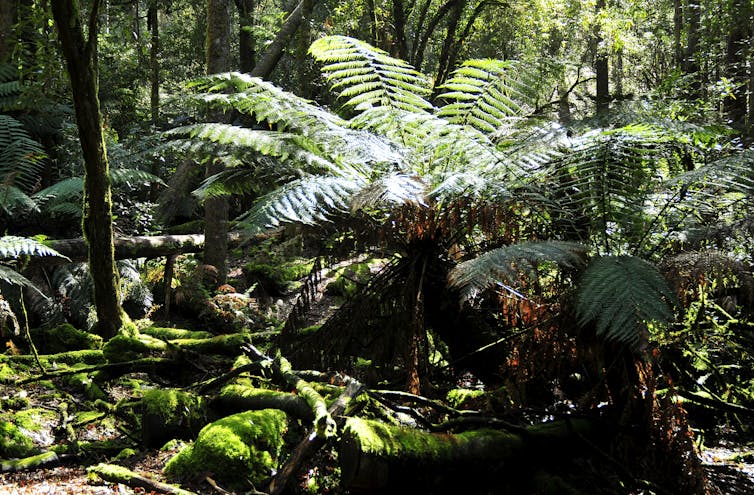 Palorchestes probably lived in forests such as this one in Tasmania and may have used its specialised forelimbs to tear apart ferns and logs.
Wikimedia Commons
Palorchestes probably lived in forests such as this one in Tasmania and may have used its specialised forelimbs to tear apart ferns and logs.
Wikimedia Commons
So an adaptation that can be a recipe for success in one environment can lead to a species’ demise in a changing world.
And while there’s nothing like Palorchestes alive today, many unique species now face the same fate due to drastic changes in their habitats.
Read more: Did people or climate kill off the megafauna? Actually, it was both
Authors: Hazel L. Richards, PhD candidate, Monash University
Read more https://theconversation.com/this-unique-ancient-megabeast-had-perpetually-bent-elbows-153094

















