

these distant 'baby' black holes seem to be misbehaving — and experts are perplexed
- Written by: Kathryn Ross, PhD Student, Curtin University
Radio images of the sky have revealed hundreds of “baby” and supermassive black holes in distant galaxies, with the galaxies’ light bouncing around in unexpected ways.
Galaxies are vast cosmic bodies, tens of thousands of light years in size, made up of gas, dust, and stars (like our Sun).
Given their size, you’d expect the amount of light emitted from galaxies would change slowly and steadily, over timescales far beyond a person’s lifetime.
But our research, published in the Monthly Notices of the Royal Astronomical Society, found a surprising population of galaxies whose light changes much more quickly, in just a matter of years.
What is a radio galaxy?
Astronomers think there’s a supermassive black hole at the centre of most galaxies. Some of these are “active”, which means they emit a lot of radiation.
Their powerful gravitational fields pull in matter from their surroundings and rip it apart into an orbiting donut of hot plasma called an “accretion disk”.
This disk orbits the black hole at nearly the speed of light. Magnetic fields accelerate high-energy particles from the disk in long, thin streams or “jets” along the rotational axes of the black hole. As they get further from the black hole, these jets blossom into large mushroom-shaped clouds or “lobes”.
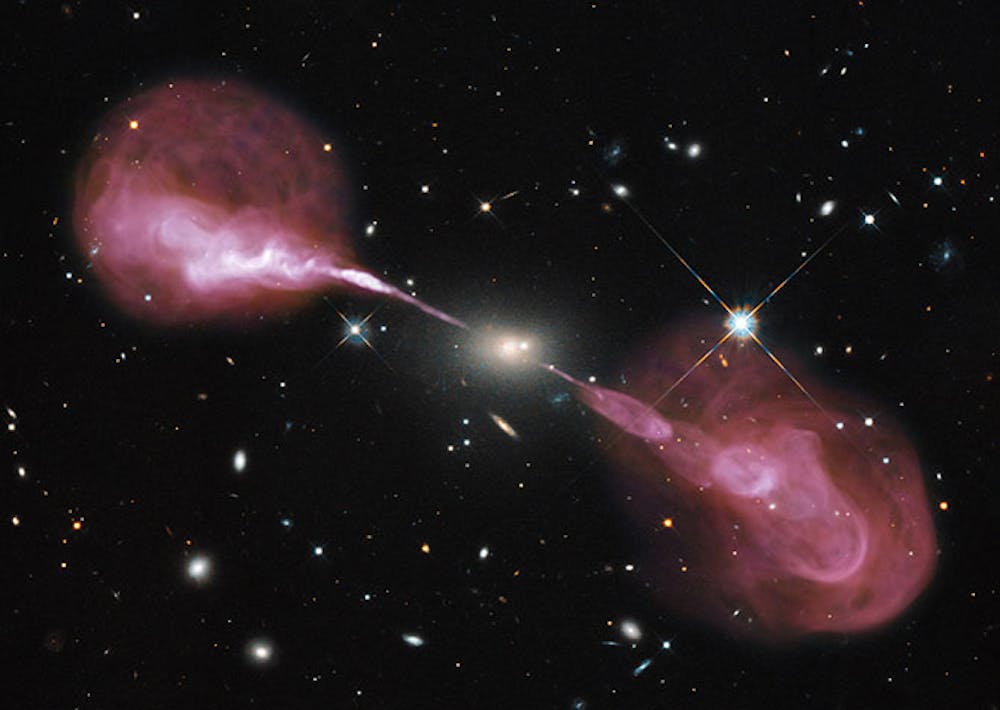 The radio galaxy Hercules A has an active supermassive black hole at its centre. Here it is pictured emitting high energy particles in jets expanding out into radio lobes.
NASA/ESA/NRAO
The radio galaxy Hercules A has an active supermassive black hole at its centre. Here it is pictured emitting high energy particles in jets expanding out into radio lobes.
NASA/ESA/NRAO
This entire structure is what makes up a radio galaxy, so called because it gives off a lot of radio-frequency radiation. It can be hundreds, thousands or even millions of light years across and therefore can take aeons to show any dramatic changes.
Astronomers have long questioned why some radio galaxies host enormous lobes, while others remain small and confined. Two theories exist. One is that the jets are held back by dense material around the black hole, often referred to as frustrated lobes.
However, the details around this phenomenon remain unknown. It’s still unclear whether the lobes are only temporarily confined by a small, extremely dense surrounding environment — or if they’re slowly pushing through a larger but less dense environment.
The second theory to explain smaller lobes is the jets are young and have not yet extended to great distances.
Old ones are red, babies are blue
Both young and old radio galaxies can be identified by a clever use of modern radio astronomy: looking at their “radio colour”.
We looked at data from the GaLactic and Extragalactic All Sky MWA (GLEAM) survey, which sees the sky at 20 different radio frequencies, giving astronomers an unparalleled “radio colour” view of the sky.
From the data, baby radio galaxies appear blue, which means they’re brighter at higher radio frequencies. Meanwhile the old and dying radio galaxies appear red and are brighter in the lower radio frequencies.
We identified 554 baby radio galaxies. When we looked at identical data taken a year later, we were surprised to see 123 of these were bouncing around in their brightness, appearing to flicker. This left us with a puzzle.
Something more than one light year in size can’t vary so much in brightness over less than one year without breaking the laws of physics. So, either our galaxies were far smaller than expected, or something else was happening.
Luckily, we had the data we needed to find out.
Past research on the variability of radio galaxies has used either a small number of galaxies, archival data collected from many different telescopes, or was conducted using only a single frequency.
For our research, we surveyed more than 21,000 galaxies over one year across multiple radio frequencies. This makes it the first “spectral variability” survey, enabling us to see how galaxies change brightness at different frequencies.
Some of our bouncing baby radio galaxies changed so much over the year we doubt they are babies at all. There’s a chance these compact radio galaxies are actually angsty teens rapidly growing into adults much faster than we expected.
While most of our variable galaxies increased or decreased in brightness by roughly the same amount across all radio colours, some didn’t. Also, 51 galaxies changed in both brightness and colour, which may be a clue as to what causes the variability.
3 possibilities for what is happening
1) Twinkling galaxies
As light from stars travels through Earth’s atmosphere, it is distorted. This creates the twinkling effect of stars we see in the night sky, called “scintillation”. The light from the radio galaxies in this survey passed through our Milky Way galaxy to reach our telescopes on Earth.
Thus, the gas and dust within our galaxy could have distorted it the same way, resulting in a twinkling effect.
2) Looking down the barrel
In our three-dimensional Universe, sometimes black holes shoot high energy particles directly towards us on Earth. These radio galaxies are called “blazars”.
Instead of seeing long thin jets and large mushroom-shaped lobes, we see blazars as a very tiny bright dot. They can show extreme variability in short timescales, since any little ejection of matter from the supermassive black hole itself is directed straight towards us.
3) Black hole burps
When the central supermassive black hole “burps” some extra particles they form a clump slowly travelling along the jets. As the clump propagates outwards, we can detect it first in the “radio blue” and then later in the “radio red”.
So we may be detecting giant black hole burps slowly travelling through space.
Where to now?
This is the first time we’ve had the technological ability to conduct a large-scale variability survey over multiple radio colours. The results suggest our understanding of the radio sky is lacking and perhaps radio galaxies are more dynamic than we expected.
 An artist’s impression of the SKA telescope. On the left is SKA-Mid, fading into SKA-Low on the right.
SKAO/ICRAR/SARAO
An artist’s impression of the SKA telescope. On the left is SKA-Mid, fading into SKA-Low on the right.
SKAO/ICRAR/SARAO
As the next generation of telescopes come online, in particular the Square Kilometre Array (SKA), astronomers will build up a dynamic picture of the sky over many years.
In the meantime, it’s worth watching these weirdly behaving radio galaxies and keeping a particularly close eye on the bouncing babies, too.
Authors: Kathryn Ross, PhD Student, Curtin University


















