

how much does the NDIS cost and where does this money come from?
- Written by: Helen Dickinson, Associate Professor, Public Service Research Group, UNSW
Although the National Disability Insurance Scheme (NDIS) is relatively young, there has been much debate over how it will be funded.
Treasurer Scott Morrison recently said Labor had left a A$57 billion shortfall in funding for the NDIS. So many were left scratching their heads at the announcement that next year’s proposed increase in the Medicare levy – which was supposed to cover some of this shortfall – would be scrapped.
Read more: Turnbull government abandons $8.2 billion Medicare levy increase
So how much does, and will, the scheme actually cost? Who is supposed to pay for it and why is there debate over the funding?
Calculating the costs
These are difficult questions to answer because we lack high-quality data about the extent and nature of disability in Australia. The information we do have is based on predictions, and work is underway to check these are accurate.
The case for creating an NDIS was made by the Productivity Commission in its 2011 inquiry on Disability Care and Support. The commission recommended Australia’s system of inequitable, fragmented and inefficient disability services be replaced by a new national scheme that would provide insurance cover to all Australians in the event of significant disability.
The one thing all sides of politics agree on is the NDIS represents a significant increase in disability spending, which stood at around A$8 billion per year at the time of the initial Productivity Commission report.
Original estimates suggested the NDIS would cover 411,000 participants and cost A$13.6 billion at maturity. However the Productivity Commission now estimates that around 475,000 people with disability will receive individualised support at a cost of around A$22 billion per year.
The A$8.9 billion difference between the Productivity Commission’s original estimates and the current estimate is a substantial gap. But A$6.4 billion of this difference is due to pay rises awarded to social and community services employees.
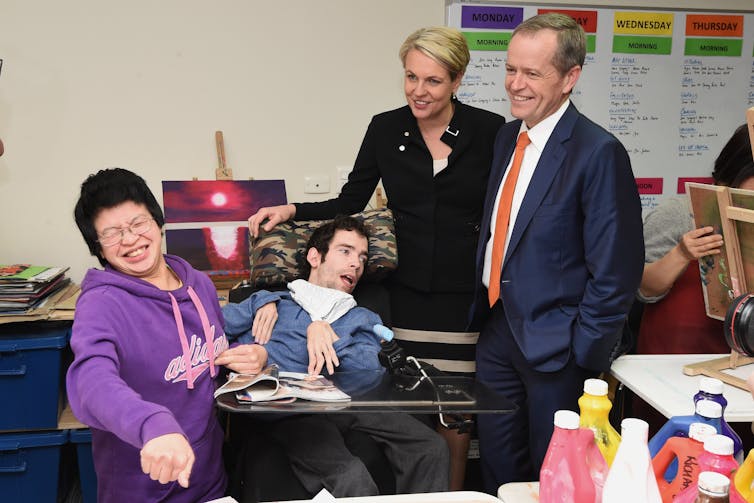 The Treasurer blamed the former Labor government for a A$57 billion NDIS funding shortfall.
AAP/Mick Tsikas
The Treasurer blamed the former Labor government for a A$57 billion NDIS funding shortfall.
AAP/Mick Tsikas
The remainder is due to the growth in the population and also the inclusion of participants over 65 years who were not included in original estimates. Once we account for these, estimates are fairly close to those originally predicted.
Last year’s Productivity Commission review of costs found the NDIS was broadly coming in on budget. Greater-than-expected numbers of children with autism and intellectual disability were accessing the scheme, but not all those with an individualised plans were able to spend their budgets.
So, for now, the NDIS seems to be tracking as intended. The NDIS budget is estimated to gradually increase over time to 1.3% of GDP by 2044-45 as participants age. Estimates also suggest the scheme will produce benefits adding around 1% to the GDP.
Where the money comes from
The original Productivity Commission report suggested the federal government be the single funder of the NDIS and that revenue to support the NDIS be paid into a separate fund (the National Disability Insurance Premium Fund) to provide stable funding for the scheme.
The Productivity Commission suggested this approach because disability services have long been subject to debate about who should bear the costs of these services: the Commonwealth or the states and territories. Indeed, part of the reason for the NDIS was to guarantee funding for disability services and stop these debates and blame-shifting.
But this isn’t what happened.
The way the NDIS is funded is complex, with revenue coming from a number of sources. The NDIS is funded via a pooled approach from Commonwealth and state and territory governments. The Commonwealth provides just over half of the funding for the NDIS and the rest comes from state and territories. This arrangement is governed by a number of bilateral agreements that are revisited every five years.
At the creation of the scheme, all existing money spent by various governments was directed into the NDIS to cover costs. Then, in July 2014 we saw a first increase in the Medicare levy: from 1.5% to 2% of taxable income.
However, the increased Medicare levy doesn’t meet the full costs of the scheme – just as the levy doesn’t cover all the annual costs of Medicare. This revenue was directed into a special fund for the NDIS, DisabilityCare Australia, which is designed to reimburse governments for NDIS expenditure.
Any additional funding the NDIS needs has to come from general budget revenue or borrowings.
The NDIS Savings Fund Special Account was established to collect the Commonwealth’s contribution to the scheme. This fund pools underspends or savings from across government, protecting these as a forward contribution to the scheme as it grows over future budgets.
Behind the funding debate
Warnings have been sounded about the NDIS’s reliance on multiple sources, fearing it creates a risk of future instability of financing.
When the Labor government originally introduced the NDIS, it said it would fund the scheme through an increase in the Medicare levy, reforms to private health insurance and retirement incomes, and a range of “selected long-term savings” including an increase in tobacco excise and changes to fringe benefits tax rules.
 For now it looks like funding for the NDIS is secure.
Nuiza11/Shutterstock
For now it looks like funding for the NDIS is secure.
Nuiza11/Shutterstock
Labor said the combination of these revenue streams would ensure the NDIS was fully funded to 2023. But many of the savings Labor promised were intentional, rather than set in stone, and were not dedicated to the NDIS as the Medicare levy was.
It’s estimated the Commonwealth will contribute around A$11.2 billion to the NDIS in 2019. Of this, around A$6.8 billion will come from the redirection of existing disability funds and the Commonwealth’s share of the DisabilityCare Australia Fund.
This leaves an annual funding gap of around A$4 billion once the scheme becomes fully operational, accumulating to around A$56 billion by 2028.
The Commonwealth announced it would increase the Medicare levy from 2% to 2.5% of taxable income from July 2019 as a way of filling the funding gap. Estimates predicted this would raise an additional A$8 billion in revenue over its first two years.
The bill needed to do this had stalled in the Senate, with Labor and the Greens opposed. They suggested the increase should only be applied to those in higher income tax brackets.
Last week the Treasurer announced tax receipts were running A$4.8 billon higher than was estimated in December, meaning the levy was no longer needed.
For now it looks like funding for the NDIS is assured, but many within the disability community have expressed concern this does not assure funding for the long term and uncertainty may continue to prevail.
Read more: Disability workers are facing longer days with less pay
Authors: Helen Dickinson, Associate Professor, Public Service Research Group, UNSW


















