

Australia's fuel stockpile is perilously low, and it may be too late for a refill
- Written by: Samantha Hepburn, Director of the Centre for Energy and Natural Resources Law, Deakin Law School, Deakin University
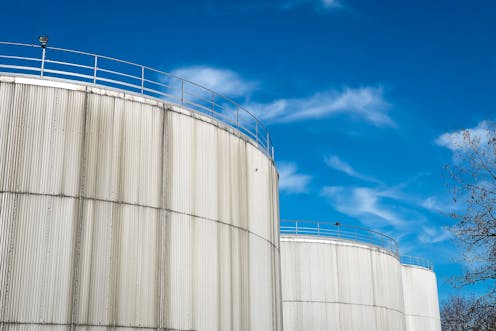
Australia is an island nation that depends heavily on imported fuel – and our stockpile is critically low. According to recent reports, we have just 22 days’ worth of crude oil, 59 days of liquefied petroleum gas (LPG), 20 days of petrol, 19 days of aviation fuel, and 21 days of diesel in reserve.
This is clearly in contravention of Australia’s obligation as a member of the International Energy Agency (IEA) to hold at least 90 days of supply.
Read more: Running on empty: Australia's risky approach to oil supplies
Australia is the only import-dependent country in the IEA that has not imposed any stockholding obligation and which has no current bilateral obligation to stockpile in another country. This makes us highly vulnerable to international disruptions. These might include political instability and air strikes in OPEC countries, or transit difficulties in established routes such as the Straits of Hormuz and the Strait of Malacca – the latter a known target for offshore terrorism.
In response, the federal energy minister, Josh Frydenberg, has ordered a liquid fuel security review, to be completed by the end of 2018. It will examine how fuel is supplied and used in Australia, and assess our capacity to withstand international disruption.
The expectation is that once the review is completed, we will be in a position to comply with our IEA obligations by 2026. But that is eight years away. If there is disruption before that, our low stockpiles may rapidly diminish and the review will be too little, too late.
What are our obligations?
Australia is one of 29 IEA countries. Twenty of them (including Australia) have minimum stockholding obligations, as IEA members, which require at least 90 days of supply. Members that are also within the European Union are subject to an even more stringent stockholding directive, introduced in 2009. This requires them to cover either 90 days of net imports or 61 days of consumption, whichever is greater.
This effectively means that net exporting countries such as Denmark, which are excluded from the IEA stockpiling obligations, are nevertheless required to hold 61 days of consumption in reserve.
There are three types of fuel stockpile that countries can use to ensure they meet the minimum requirements: industry stock, government stock, and specialist agency stock.
Industry stock is (as the name suggests) held by industry, whether for commercial purposes or to comply with legislative requirements. Ordinarily, the obligation imposed is set in proportion to the company’s oil import share, or its share of sales in the domestic market. Twenty of the 29 IEA countries meet their obligations through legislative obligations on industry stock.
Government stock is held exclusively for emergency purposes. Legislative mandates for emergency government stock exist in New Zealand and the United States. But Australia has no legislation that requires the government to maintain an emergency fuel stockpile.
Agency stocks are held by a separate agency that has the responsibility to stockpile in accordance with legislative requirements. Such agencies may be administered either by industry or by government. Such agencies exist in Spain and Ireland – but, again, Australia has no equivalent agency.
Depending on differences in oil market structure, geography and national policy, IEA-compliant countries may impose mandates upon one or more category of stockholders. Australia imposes no legislative mandate upon any category. This effectively means it has no rules at all about maintaining a proper fuel stockpile.
Why is Australia non-compliant?
Australia has reached this critical point for several reasons.
The first is simply a product of inertia. Unlike the fuel shocks suffered by the United States in the 1970s, for instance, Australia has never experienced strong fuel disruption. Having been used to having huge surpluses of coal, gas and uranium, energy security has never been a strong concern.
This also reflects our tendency as a nation to be reactive rather than proactive when it comes to energy security. Added to this is the lingering free market complacency that underpins our refusal to impose extra regulations on private industry in response to global security issues.
The second reason is economic. The IEA stockholding obligation does not determine whether the reserve must be in the form of crude or refined oil. This is a significant issue because storing refined products is more expensive than storing crude oil. Australia, with limited domestic refining capacity following the closure of ageing oil refineries, will need to bear a greater storage burden than other countries because we need to stockpile refined products.
Read more: Security in doubt as Australia's aging oil refineries shut down
The future
The liquid fuel security review is long overdue. We have been aware of our fuel vulnerabilities for many years.
Singapore provides us with most our refined petroleum and, in turn, relies on the Middle East for more than 80% of its crude oil supply. There is no doubt that political instability in the Strait of Hormuz could seriously hurt our energy security.
Petrol, diesel and jet fuel together account for 98% of our transport needs. If conflict did break out, or crucial transport routes were blocked or subject to significant terrorism threats, Australia would face the real possibility of running out of fuel.
This is an unacceptable risk. We urgently need legislation that will give us a much bigger buffer against global energy uncertainty.
Authors: Samantha Hepburn, Director of the Centre for Energy and Natural Resources Law, Deakin Law School, Deakin University


















