

4 key takeaways from the aged care royal commission's final report
- Written by: Stephen Duckett, Director, Health Program, Grattan Institute
The Royal Commission into Aged Care Quality and Safety’s final report into aged care has laid out an extensive plan to overhaul Australia’s aged-care system.
Among the 148 recommendations, the report calls for a new system underpinned by a rights-based Act, funding based on need, and much stronger regulation and transparency.
Over two years, through more than 10,500 submissions and 600 witnesses, the two commissioners heard extensive evidence of a system in crisis. Australians might have expected the commissioners to provide one streamlined blueprint for reform.
But the commissioners diverged on a number of large and some smaller recommendations. This makes the already complex path to reform even more confusing. It reduces the power of the final report. More disappointingly, it gives the government room to pick and choose recommendations as the cabinet likes.
Nonetheless, if the major recommendations are adopted, Australia will get a transformed aged care system over the next five years.
Here are our top four takeaways from this landmark report.
Read more: Paid on par with cleaners: the broader issue affecting the quality of aged care
1. Australia needs a rights-based aged-care system
In its recommendations, the final report highlights Australia needs a new Aged Care Act to underpin reform. The new Act should set out the rights of older people, including their entitlement to care and support based on their needs and preferences.
This would be a significant shift away from the current ration-based system, and would bring aged care more in line with the principles of Medicare.
Practically, this would mean the number of people in the system would no longer be capped — the long waiting lists for care would disappear over time. The current aged-care programs, such as home-care packages and residential care, would be replaced by a single program.
Under this new program, all older Australians in need of support would be independently assessed, and allocated care according to their personal needs and preferences — whether at home or in residential care.
This is a huge step forward, and, with the right support, would enable older Australians more choice and control over their care.
2. The system needs stronger governance
Ineffective governance and weak regulation of aged care must end. The final report calls for much stronger governance, regulation of the quality of care, prudential regulation, and an independent mechanism to set prices.
These changes would ensure the “quasi-market” aged-care system, as commissioner Tony Pagone described it, was much better regulated, holding providers to a higher standard of care, and better able to address any service gaps in the system. We might see the introduction of home care in locations where home-care services were not previously available, for example.
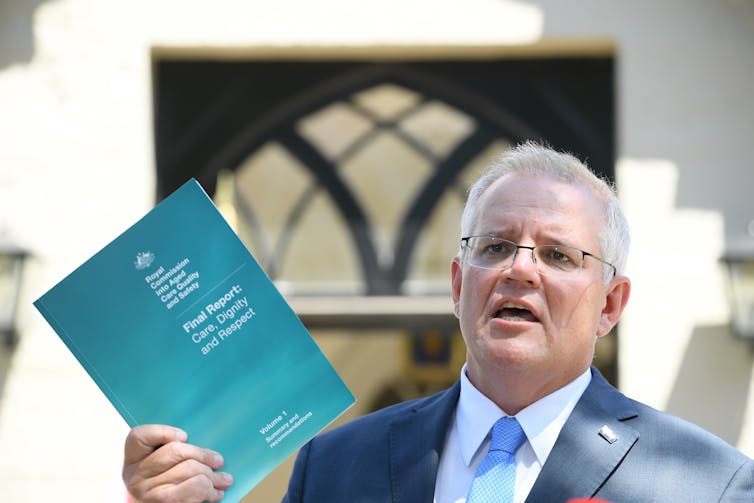 The final report contained 148 recommendations to fix the aged-care system.
Dean Lewins/AAP
The final report contained 148 recommendations to fix the aged-care system.
Dean Lewins/AAP
This change would require all aged-care providers to be accredited against the new standards. We hope that process would weed out some of the poorest performers in the sector. The new system would have offices across the country, to provide on-the-ground support to older Australians and providers.
Unfortunately, the commissioners diverged on the exact mechanisms for these changes. Pagone wants an independent commission to be responsible for aged care, at arms-length from the health department. Meanwhile, commissioner Lynelle Briggs wants governance to remain with a reformed department, but with quality regulation managed by an independent quality commission.
Given the department’s poor track record on managing aged care, we need to see a major change of culture. We urge the government to accept commissioner Pagone’s recommendation.
3. We need to improve workforce conditions and capability
The final report makes numerous important recommendations to enhance the capability and work conditions of formal carers. It calls for better wages and a new national registration scheme for all personal care workers, who would be required to have a minimum Certificate III training.
Residential care facilities would need to ensure minimum staff time with residents. By July 1 2022, this would be at least 200 minutes per resident per day for the average resident, with at least 40 minutes of that time with a registered nurse.
The facilities would be required to report staffing hours provided each day, specifying the breakdown of residents’ time with personal care workers versus nursing staff.
While these measures are good, they are the bare minimum, and would only give facilities a minimum 2 or 3 star rating. But coupled with recommendations for stronger transparency, including the publication of star ratings and quality indicators to compare provider performance, providers might be incentivised to go above this minimum standard.
4. A better system will cost more
The final report makes a series of complex recommendations about fees and funding, with the commissioners diverging in view as to the specific arrangements. But essentially, the proposed new funding model would provide universal funding for care services, such as nursing.
This means there would be no requirement for aged-care recipients to pay a co-contribution, like public patients in public hospitals. Instead, the expectation is people pay for their ordinary costs of living, such as cleaning, subject to a means test and up to a maximum amount in residential care.
 A rights-based system means funding is determined by each individual’s needs.
Shutterstock
A rights-based system means funding is determined by each individual’s needs.
Shutterstock
These changes would coincide with the phase-out of the burdensome refundable accommodation deposits, which some residents currently pay as a lump sum to providers when they enter residential care. This approach is a shift away from the current muddled set of means-tested arrangements, and may help offset some of the additional spending needed to pay for a rights-based system.
Unfortunately, the report does not touch on how much the recommended changes would cost. Australia should be prepared to pay the price of a better aged care system.
Read more: View from The Hill: royal commission confronts Morrison government with call for aged care tax levy
The government has been underspending on aged care. Most Australians agree the government should provide more funding for aged care. Commissioner Briggs has the more persuasive proposal for funding the new system. She wants the government to introduce legislation by July 1 2022 that establishes an aged-care improvement levy of 1% of taxable personal income.
Commissioner Pagone is weaker on this point. He wants the Productivity Commission to investigate the establishment of an hypothecated aged-care levy (meaning the money raised by the levy can only be spent on aged care).
Either approach will be politically difficult, but Australians should demand their government lock-in a secure funding supply. That will help produce an aged-care system that protects the rights, upholds the dignity, and celebrates the contribution of all older Australians.
Authors: Stephen Duckett, Director, Health Program, Grattan Institute
Read more https://theconversation.com/4-key-takeaways-from-the-aged-care-royal-commissions-final-report-156109


















