

'Biodegradable' plastic will soon be banned in Australia. That's a big win for the environment
- Written by Jenni Downes, Research Fellow, BehaviourWorks Australia (Monash Sustainable Development Institute), Monash University
To start dealing with Australia’s mounting plastic crisis, the federal government last week launched its first National Plastics Plan.
The plan will fight plastic on various fronts, such as banning plastic on beaches, ending polystyrene packaging for takeaway containers, and phasing in microplastic filters in washing machines. But we’re particularly pleased to see a main form of biodegradable plastic will also be phased out.
Biodegradable plastic promises a plastic that breaks down into natural components when it’s no longer wanted for its original purpose. The idea of a plastic that literally disappears once in the ocean, littered on land or in landfill is tantalising — but also (at this stage) a pipe dream.
Why ‘biodegradable’ ain’t that great
“Biodegradable” suggests an item is made from plant-based materials. But this isn’t always the case.
A major problem with “biodegradable” plastic is the lack of regulations or standards around how the term should be used. This means it could, and is, being used to refer to all manner of things, many of which aren’t great for the environment.
Many plastics labelled biodegradable are actually traditional fossil-fuel plastics that are simply degradable (as all plastic is) or even “oxo-degradable” — where chemical additives make the fossil-fuel plastic fragment into microplastics. The fragments are usually so small they’re invisible to the naked eye, but still exist in our landfills, water ways and soils.
Read more: We composted 'biodegradable' balloons. Here's what we found after 16 weeks
The National Plastics Plan aims to work with industry to phase out this problematic “fragmentable” plastic by July, 2022.
Some biodegradable plastics are made from plant-based materials. But it’s often unknown what type of environment they’ll break down in and how long that would take.
Those items may end up existing for decades, if not centuries, in landfill, litter or ocean as many plant-based plastics actually don’t break down any quicker than traditional plastics. This is because not all plant-based plastics are necessarily compostable, as the way some plant-based polymers form can make them incredibly durable.
 There’s no evidence to suggest anything labelled as ‘biodegradable’ is better for the environment.
Shutterstock
There’s no evidence to suggest anything labelled as ‘biodegradable’ is better for the environment.
Shutterstock
So it’s best to avoid all plastic labelled as biodegradable. Even after the ban eliminates fragmentation — the worst of these — there’s still no evidence remaining types of biodegradable plastics are better for the environment.
Compostable plastics aren’t much better
Compostable plastic is another label you may have come across that’s meant to be better for the environment. It’s specifically designed to break down into natural, non-toxic components in certain conditions.
Unlike biodegradable plastics, there are certification standards for compostable plastics, so it’s important to check for one the below labels. If an item doesn’t have a certification label, there’s nothing to say it isn’t some form of mislabelled “biodegradable” plastic.
 Home compost label.
Australasian Bioplastics Association (ABA)
Home compost label.
Australasian Bioplastics Association (ABA)
But most certified compostable plastics are only for industrial composts, which reach very high temperatures. This means they’re unlikely to break down sufficiently in home composts. Even those certified as “home compostable” are assessed under perfect lab conditions, which aren’t easily achieved in the backyard.
And while certified compostable plastics are increasing, the number of industrial composting facilities that actually accept them isn’t yet keeping up.
Nor are collection systems to get your plastics to these facilities. The vast majority of kerbside organics recycling bins don’t currently accept compostable plastics and other packaging. This means placing compostable plastics in these bins is considered contamination.
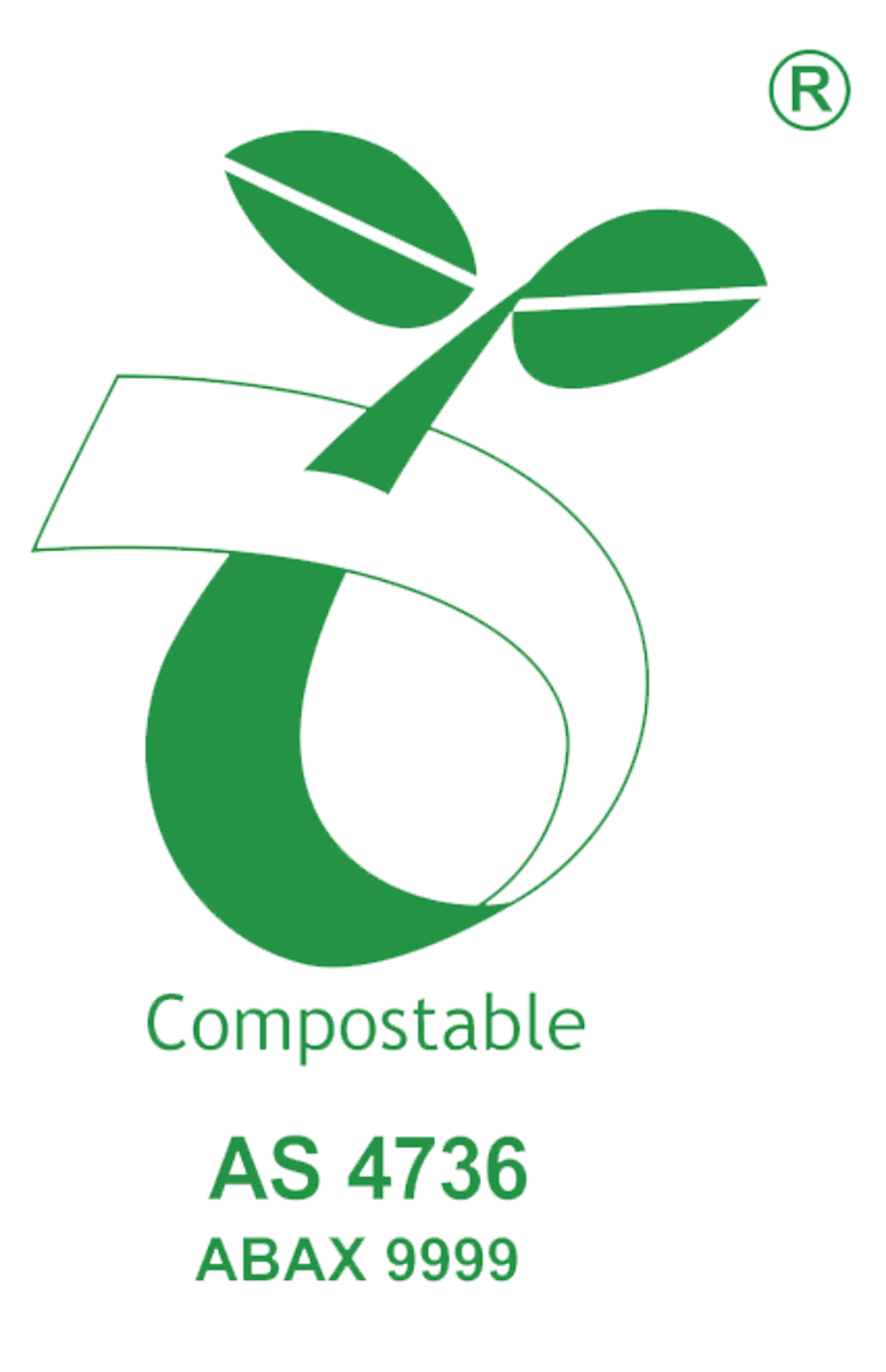 Industrial compost label.
Australasian Bioplastics Association (ABA)
Industrial compost label.
Australasian Bioplastics Association (ABA)
Even if you can get your certified compostable plastics to an appropriate facility, composting plastics actually reduces their economic value as they can no longer be used in packaging and products. Instead, they’re only valuable for returning nutrients to soil and, potentially, capturing a fraction of the energy used to produce them.
Finally, if you don’t have an appropriate collection system and your compostable plastic ends up in landfill, that might actually be worse than traditional plastic. Compostable plastics could release methane — a much more potent greenhouse gas than carbon dioxide — in landfill, in the same way food waste does.
So, you should only consider compostable plastics when you have a facility that will take them, and a way to get them there.
And while the National Plastics Plan and National Packaging Targets are aiming for at least 70% of plastics to be recovered by 2025 (including through composting), nothing yet has been said about how collection systems will be supported to achieve this.
Read more: Why compostable plastics may be no better for the environment
Is recycling helpful?
Only an estimated 9% of plastics worldwide (and 18% in Australia) are actually recycled. The majority ends up in landfill, and can leak into our oceans and natural environments.
In Australia, systems for recycling the most common types of plastic packaging are well established and in many cases operate adequately. However, there are still major issues.
 Compostable plastics aren’t usually made for your backyard compost bin.
Shutterstock
Compostable plastics aren’t usually made for your backyard compost bin.
Shutterstock
For example, many plastic items can’t be recycled in our kerbside bins (including soft and flexible plastics such as bags and cling films, and small items like bottle lids, plastic cutlery and straws). Placing these items in your kerbside recycling bin can contaminate other recycling and even damage sorting machines.
Read more: Think all your plastic is being recycled? New research shows it can end up in the ocean
What’s more, much of the plastic collected for recycling doesn’t have high value “end markets”. Only two types of plastic — PET (think water or soft drink bottles and some detergent containers) and HDPE (milk bottles, shampoo/conditioner/detergent containers) — are easily turned back into new plastic containers.
The rest end up in a stream called “mixed plastics”, much of which we have traditionally exported overseas for recycling due to low demand here. The new waste export ban may help fix this in the future.
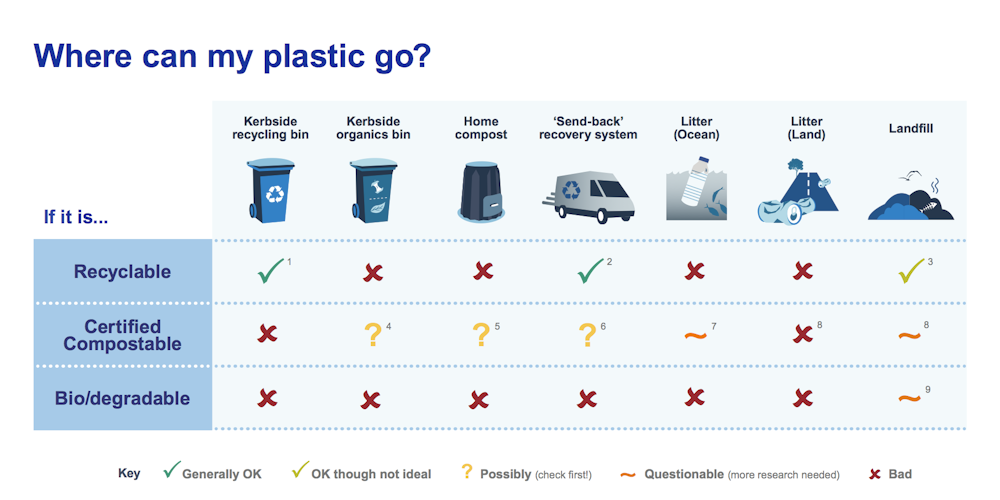 A brief guide to help you responsibly dispose of your plastic.
University Technology Sydney, Author provided
A brief guide to help you responsibly dispose of your plastic.
University Technology Sydney, Author provided
So what do you do about plastic?
The obvious answer then, is to eliminate problematic plastic altogether, as the National Plastics Plan is attempting to do, and replace single-use plastics with reusable alternatives.
Little actions such as bringing your reusable water bottle, coffee cup and cutlery, can add up to big changes, if adequately supported by businesses and government to create a widespread culture shift. So too, could a swing away from insidious coffee capsules, cling wrap and cotton buds so many of us depend on.
Opting too, for plastic items made from recycled materials can make a big impact on the feasibility of plastic recycling.
If you do end up with plastic on your hands, take a quick glance at the graphic above, or read the University Technology Sydney’s Detailed Decision Guide to Disposing of Plastics.
Read more: How to break up with plastics (using behavioural science)
Authors: Jenni Downes, Research Fellow, BehaviourWorks Australia (Monash Sustainable Development Institute), Monash University

















