

Max Richter's Sleep, a filmed antidote to modern life with music to dream by
- Written by: Frederic Kiernan, Research fellow, The University of Melbourne
Review: Max Richter’s Sleep, directed by Natalie Johns.
Music does things. For German-born, English-raised composer Max Richter, music is a “vehicle for travelling through the world, for getting through life”. So he says in the film Max Richter’s Sleep, written and directed by Natalie Johns, which hits Australian screens today.
The film focuses on a composition by Richter which spans more than 200 movements and lasts over eight hours. During performances of this work, audience members (probably not the right term in this case) spend almost the whole concert resting or asleep in hundreds of cots and camping beds lined up where you would normally find seats.
Richter, a prodigious contemporary composer, has made music for solo albums, ballets, concert hall performances, theatre and film and television series (including The Crown, The Leftovers and Peaky Blinders). His Sleep performance-events were conceived with his collaborator and partner Yulia Mahr, a BAFTA-winning filmmaker. The film focuses primarily on an open-air concert in downtown Los Angeles, although it weaves in performance footage from other locations around the world including Berlin, the Sydney Opera House and Paris.
Audience members arrive at the concert in the evening, before being lulled into a dream-state by Richter (on the piano) and his band of musicians. They wake the next morning to find them still softly playing. The technical achievement of the composer, performers and organisers is undeniable. But as a musicologist with strong sociological leanings, my own interest lies in Richter’s treatment of audience expectations and listening behaviours, as well as his interesting perspective on the kinds of things music can do.
‘It’s not [music] necessarily to be listened to … but to be experienced.’Read more: Review: David Byrne’s American Utopia is a film honouring the love of the live performance
Listen up and settle down
People listen to music in different ways for different reasons. We might use music to keep pace during a gym workout or while jogging. This is partly because our bodily rhythms (heart rate and breathing) can synchronise with externally heard rhythms — something psychologists call rhythmic entrainment.
We often use music to regulate our emotions and moods, to mark occasions such as weddings and birthdays, and to celebrate sporting victories from club to Olympic level, where the music acts not as decoration but as a kind of social glue.
Music listening habits also change over time. In the 18th century, opera-goers were notoriously lively, more likely facing each other than the stage, but since the 19th century these audiences have become rather more reverent. Classical music audiences still typically display “serious” listening behaviours, although companies such as Play On are upending these conventions. By inviting audiences to sleep through an entire concert, Richter and Mahr are doing the same, with interesting results.
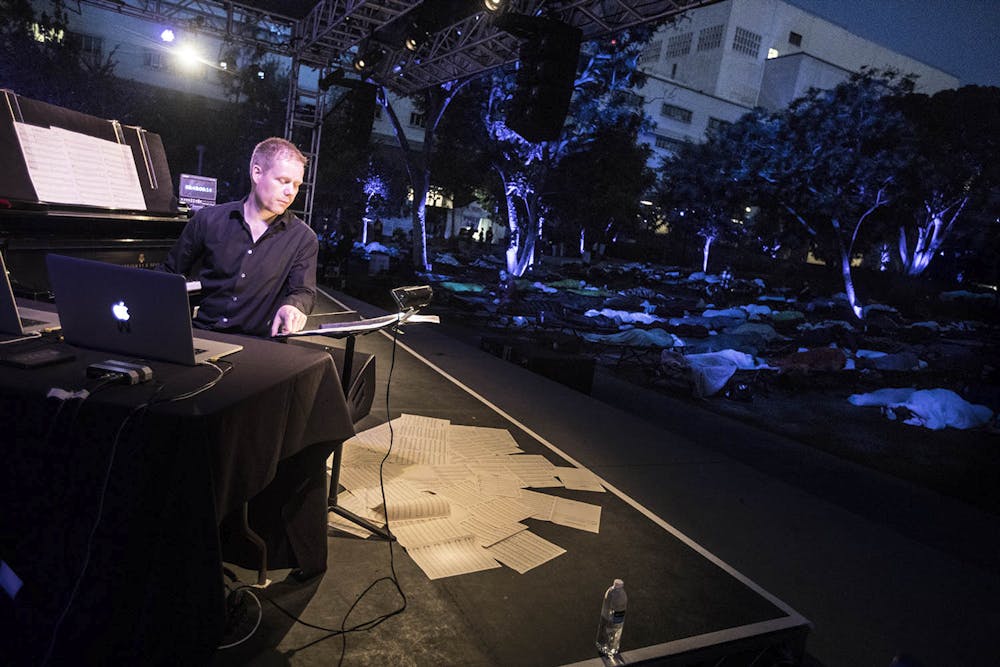 During the performance, musicians including Richter leave the stage to eat or take a toilet break.
Madman
During the performance, musicians including Richter leave the stage to eat or take a toilet break.
Madman
Richter describes the composition as an “eight-hour lullaby”. It is a soothing musical remedy for the increasingly hectic pace of modern life, in which sleep is often considered an inconvenience or even a weakness.
Music is widely used nowadays as a therapeutic tool. In fact the practice of “prescribing” music for soothing, energising or mood-regulating purposes dates back at least as far as ancient Greece. Pythagoras, for example, is said to have sung and played the lyre for his disciples to induce a calm mood prior to sleep, and to shake off numbness and tiredness upon waking.
Read more: Having trouble sleeping? Here's the science on 3 traditional bedtime remedies
Perchance to dream
For centuries, sleep was regarded as a suspension of activity — a passive state of unconsciousness. However during the 18th and 19th centuries new theories of the origin of sleep emerged, linking sleep to the build up of toxins during the day, blood flow and the paralysis of nerve cells. Many of these ideas are still being explored in current sleep science, which now highlights the active nature and generative power of sleep, as well as the potential benefits of music listening for sleep quality. Musical activities, like other creative activites, can have a positive impact on our wellbeing, as research at the University of Melbourne is showing.
Richter observes in the film that the hectic pace of modern life suits corporations more so than humans. His Sleep opus offers a “quiet protest”, a moment to withdraw and reflect, treating the sleeping mind as a valuable complement to our waking life. The film mirrors what I imagine attendance at a live performance of the work to be like.
 The Sleep score hopes to counter the frenetic pace of modern life.
Denys Nevozhai/Unsplash, CC BY
The Sleep score hopes to counter the frenetic pace of modern life.
Denys Nevozhai/Unsplash, CC BY
Read more: The Portal review: can meditation change the world?
As viewers, we, along with audience members in the film, settle into our own journey. Long passages of deeply resonant music exert their visceral emotional pull, in slow rhythms and very low frequencies outside the usual range of acoustic instruments.
As the piece unfolds through the night, the musicians alternately take breaks, perhaps to eat or use the bathroom. Richter moves from the piano around the venue, to see “what the piece is doing”, before returning to the stage to continue playing.
Darkness shades much of the film visually, and commentary is provided by various audience members who are never quite introduced, as if in a dream. There are scholarly musings too, on the science of sleep and the relationship between music and mathematics.
Richter and Mahr also recount the origins of the piece and the risks, gambles and unknowns they faced as artists. As audience members rouse themselves at the conclusion of the film, their reflections reveal they were not really audience members at all, but participants in a musical study of sleep. This explored music’s capacity to soothe deeply, and, in being soothed, allowed participants to become vulnerable and open to connection with one another.
Can the film successfully replicate the live experience? Of course not. Do I now wish I could attend (and sleep through) a live performance of this piece? Absolutely.
Max Richter’s Sleep is in Australian cinemas from today.
Authors: Frederic Kiernan, Research fellow, The University of Melbourne


















