

'God, I miss fruit!' 40% of students at Australian universities may be going without food
- Written by Craig Jeffrey, Professor of Geography, The University of Melbourne
The COVID-19 pandemic led to food insecurity among students making headlines in Australia and the United States. But even before the pandemic, increasing numbers of students were reporting they sometimes went without food. Rising tuition and living costs combined with declining state support for students and privatised food outlets on campuses have increased students’ food insecurity in places as diverse as the US, Malaysia and Nigeria.
Student food insecurity is a particular problem in Australia. The reasons include the high proportion of international students, lack of cheap subsidised food on many university campuses, and low awareness of the issue.
In the early 2010s, research in Queensland suggested one in four students (25%) suffered from food insecurity. More recent studies suggest the proportion could be over 40%.
The problem nevertheless remains largely hidden, a “faceless” and “silent” issue. When it does come up in conversation, it is often normalised – with jokes about “starving students”, for example.
What did students say about it?
We are concerned about the silence on this issue. We have been working to understand food insecurity among University of Melbourne students.
Most studies on university student food insecurity have been quantitative. We chose a more qualitative, interview-based approach. This involved co-producing the research with students.
We recruited four students as co-researchers who themselves had experienced food insecurity. These four students interviewed an additional 40 students who had experienced food insecurity. They were given supermarket vouchers in exchange for their time.
Our project showed many students at the university are experiencing food insecurity. The problem is worst among international students.
Some students said they had to skip meals. More commonly, students reported a lack of money, time and information meant having to compromise the diversity and nutritional quality of their diets. When asked about food insecurity, one student exclaimed: “God, I miss fruit!” Another said: “You can’t live on instant noodles for three years”.
Several students said they were vegetarians “by necessity rather than choice”. Some referred to intermittent fasting as a strategy. Others mentioned they lost weight after enrolling at university.
In many cases, COVID-19 added to the problem.
However, some students said it had actually become easier to get food because of the food relief measures and increased Centrelink payments during the pandemic. Students particularly praised the voucher scheme for international students to obtain food from Queen Victoria Market. Some students also voiced appreciation for the university’s free cooked meals, a program developed during the pandemic.
Food insecurity has many knock-on effects. Our research pointed to close relationships between food insecurity and physical and/or mental ill health, poor performance in studies, and difficulties navigating social relationships on campus. Shame associated with food insecurity was an especially notable issue.
Read more: Hunger in the lucky country – charities step in where government fails
One of our goals was to show that students aren’t passive in response to food insecurity. They are active agents who seek to resolve the problem on multiple levels.
Our interviews richly illustrated students’ capacity to “hustle” for food on campus. For example, they sought out events that provided food. Some told of “surfing” the campus in search of barbecues providing free sausages.
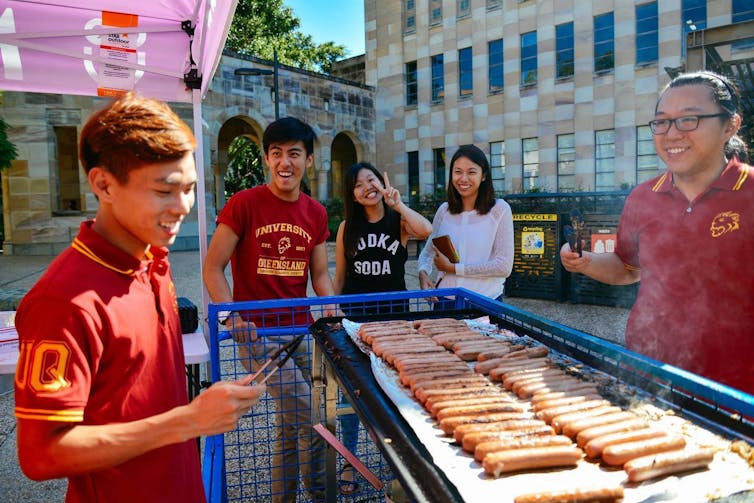 Students have learnt to make the most of the free sausage sizzles offered by various groups on campus.
UQ Singapore Students' Society/Facebook
Students have learnt to make the most of the free sausage sizzles offered by various groups on campus.
UQ Singapore Students' Society/Facebook
Students also told us how their experience of food insecurity had led them to reflect on the politics of food more broadly. They talked about their right to move away from being victims of food insecurity to being citizen agents, with rights to shape the conditions of production, distribution and consumption of food.
Read more: We've had a taste of disrupted food supplies – here are 5 ways we can avoid a repeat
The sense of care and responsibility that students felt for each other was clear. Especially evident was a sense of obligation among domestic students to help international students.
Time for a more ambitious approach?
In North America, universities and governments have often acknowledged and addressed food insecurity. However, universities have tended to concentrate on providing emergency assistance – setting up food pantries, for example.
This approach has at at least two drawbacks. It risks stigmatising students and doesn’t provide access to fresh food, since most pantries contain only non-perishable items. A notable exception is the CalFresh program at the University of California.
There are some promising examples in Australia of thinking creatively about food security in particular, and food more generally, such as Second Bite and the Nourish Network. Universities have been especially active during the pandemic in developing new schemes.
Students have also been active. They have, for example, helped develop food co-operatives, free breakfasts, food banks and initiatives such as the student-run Fair Food Challenge aimed at improving campus food systems.
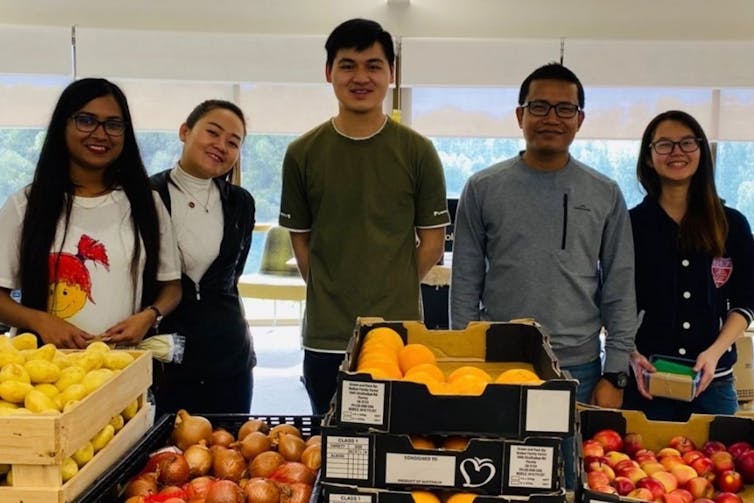 At Flinders University, a community market provides free fruit and vegetables and low-cost pantry items.
Flinders University
At Flinders University, a community market provides free fruit and vegetables and low-cost pantry items.
Flinders University
The COVID-19 pandemic provides an opportunity to think more ambitiously about how to counter hunger on campus. Our research suggests students are keen to build on existing efforts in at least four ways:
think creatively about how universities might draw on the excellent work done in the mental health area as a way of destigmatising food insecurity
reflect on whether university policy of inviting large numbers of private providers to occupy food spaces on campuses might be balanced with initiatives to provide nutritious subsidised food, perhaps revisiting the traditional idea of the university canteen
universities could do more to reduce food waste
since many universities have agriculture departments and diverse landholdings they might try to link students’ consumption with ethically produced, local and nutritious food on university farms.
Students can and must be central to all these changes.
Read more: What a simulated Mars mission taught me about food waste
We would like to acknowledge the assistance of Rafaela Anja, Louisa Ellis, Sara Guest, Sophie Lamond, Aasha Sriram, Mia Zentari and Eugenia Zoubtchenko in carrying out the research upon which this article is based and preparing this article.
Authors: Craig Jeffrey, Professor of Geography, The University of Melbourne

















