

Australia's COVID vaccine rollout is well behind schedule — but don't panic
- Written by Elizabeth Jackson, Senior Lecturer in Supply Chain Management & Logistics, Curtin University
On March 11 — exactly a year after the World Health Organization declared COVID a pandemic — Australia’s health department secretary Brendan Murphy fronted a Senate select committee to discuss potential delays to the government’s timetable for the vaccine rollout.
The federal government had initially pledged to vaccinate 4 million Australian adults by early April, and all remaining adults by October. But with each of the approved COVID vaccines requiring two shots, it was unclear whether these deadlines referred to complete vaccination, or merely a first dose.
But Murphy argued this distinction isn’t as clear-cut as it might sound, because of the complex and evolving evidence about what dose interval offers vaccine recipients the best protection.
“The original end-of-October modelling was done when we had a planned four-week dose interval with AstraZeneca,” he told the Senate committee. “Now we’re giving the second dose at a 12-week interval […] I suspect it’s unlikely we will have completed the second doses of the AstraZeneca vaccines by [October].”
What’s more, Murphy also said “the first dose is nearly as good as the second dose” in terms of conferring immunity, although it’s not clear what evidence he was relying on here.
Besides the evidently simplistic deadlines, there is also the fact that the rollout is a hugely complex logistical operation, involving manufacture, transport, storage and administration of the vaccine under very specific conditions.
Given this atypical supply chain, and the rapidly evolving evidence around the vaccines, perhaps we as a society should be respectful of this situation and guard against pushing too hard.
How it started
Australia’s COVID vaccination program began on February 21. The ABC reports 159,294 people have been vaccinated as of March 12. Modelling published by The Guardian suggests 2 million doses would need to have been given by mid-March to meet the April target.
Preliminary research also suggests Australia needs to be administering 200,000 vaccines per day, on average, to hit the October deadline.
Read more: Australia must vaccinate 200,000 adults a day to meet October target: new modelling
Almost a month into the rollout, the total number of vaccinated Australians is fewer than the number we’ll need to vaccinate each and every day. It’s fair to say we’ve not exactly hit the ground running.
How it’s going
Of course, it is reasonable to expect we might start slow and then speed up. We can assume the rate will pick up once CSL begins domestic production of the AstraZeneca vaccine, towards the end of March, with the aim of producing a million doses a week.
Notwithstanding any teething problems with the manufacture itself, there are already logistics systems in place to move and store the vaccine, and training programs for medical professionals and vaccine hubs to administer it. Domestic manufacture also has a shorter supply chain than international shipping, which helps minimise the risks.
Is Australia behind on its rollout of the COVID-19 vaccine? Yes. Will it catch up? Most likely, yes.
 Prime Minister Scott Morrison is one of relatively few Australians already vaccinated.
Joel Carrett/AAP
Prime Minister Scott Morrison is one of relatively few Australians already vaccinated.
Joel Carrett/AAP
The risks of going too fast
There are risks in accelerating and pressuring the supply chain purely to hit an arbitrary deadline. Even with the very best planning and control, novel supply chain systems are notoriously fragile and frequently crack under excessive pressure.
We’ve seen signs of this already in various countries. The European Union has suffered delays in vaccine supplies and blocked a shipment to Australia. The US vaccine rollout has been hindered by severe winter storms, contract issues and factory fires. Some nations have paused the AstraZeneca vaccine rollout amid fears of side-effects. And the ethical debate continues about the need for wealthy nations to share their vaccine stockpiles with poorer countries.
It’s inevitable there will be mishaps along the way, but excessive haste increases the risk. Already we have seen patients accidentally given multiple doses of the vaccine by medical professions without adequate training, and doses wasted by operator error in Victoria.
Read more: How the Pfizer COVID vaccine gets from the freezer into your arm
It is understandable the public should hold the federal government to account over its promises about the timetable for the vaccine rollout. But as the federal government’s official vaccine rollout policy states, the entire operation is “complex and atypical”.
Research on situations of humanitarian disaster relief show the dangers of pressuring supply chains to overperform in time-critical, unpredictable situations. By one estimate, more than 40% of humanitarian organisations’ spending on relief is wasted due to factors such as duplication of resources and incomplete spending analysis.
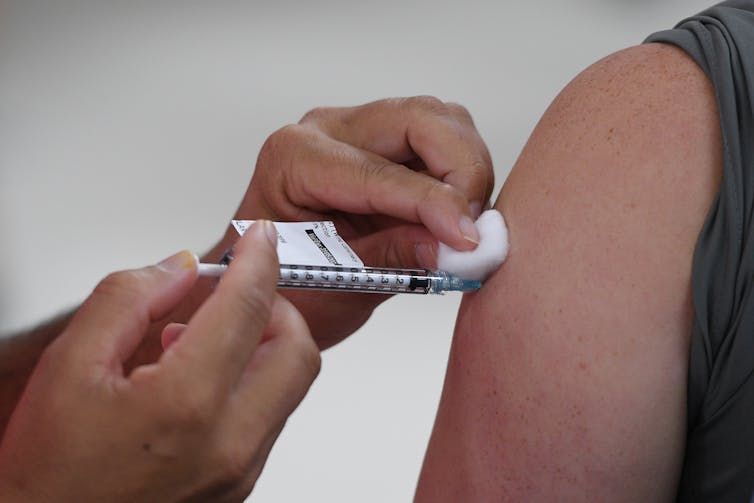 Australia’s government would be wiser to underpromise and over-deliver.
Dean Lewins/AAP
Australia’s government would be wiser to underpromise and over-deliver.
Dean Lewins/AAP
Some countries are already suffering humanitarian disaster at the hands of COVID, but not Australia. We have experienced far less social and economic disruption than many other countries, and have generally weathered the COVID crisis remarkably well.
Given that fact, and the unique challenges of a successful vaccine rollout, it would definitely be wiser for the government to underpromise and over-deliver on COVID vaccines, rather than the other way around.
Authors: Elizabeth Jackson, Senior Lecturer in Supply Chain Management & Logistics, Curtin University

















