

Is temporary the new permanent? COVID street experiments open our eyes to creating better cities
- Written by: Helen Rowe, PhD Candidate, Centre for Urban Research, RMIT University
Over the past year, many of us have enjoyed outdoor dining in spaces that would otherwise have been car parks or part of the road. These spaces are one example of the temporary projects that popped up to help cities in Australia and around the world adapt to COVID. These quickly installed projects have met our changing needs for space for walking, cycling, public space and, of course, dining to help businesses to stay afloat.
While these temporary projects were driven by the necessity for short-term fixes, we can draw deeper lessons from these experiences. They have been, intentionally or not, a large-scale experience with experimentation in cities, and short-and long-term impacts should flow. In the short term, some of these experiments can be become permanent. In the long term, wider-scale urban experiments can become a permanent feature of how we shape cities.
Experiments can help us navigate change in cities. They can also make us braver by allowing us to test out ideas that might fail or that not everyone seems to like. If the past year has made us more comfortable and confident with experimenting, all the better to help our cities meet the challenges ahead.
Read more: 4 ways our streets can rescue restaurants, bars and cafes after coronavirus
Opening our eyes to new possibilities
At their simplest, of course, experiments test things. The projects that popped up during COVID have helped meet our short-term needs (well, we hoped they would be short-term) for different ways to live and get around, like pop-up bike lanes.
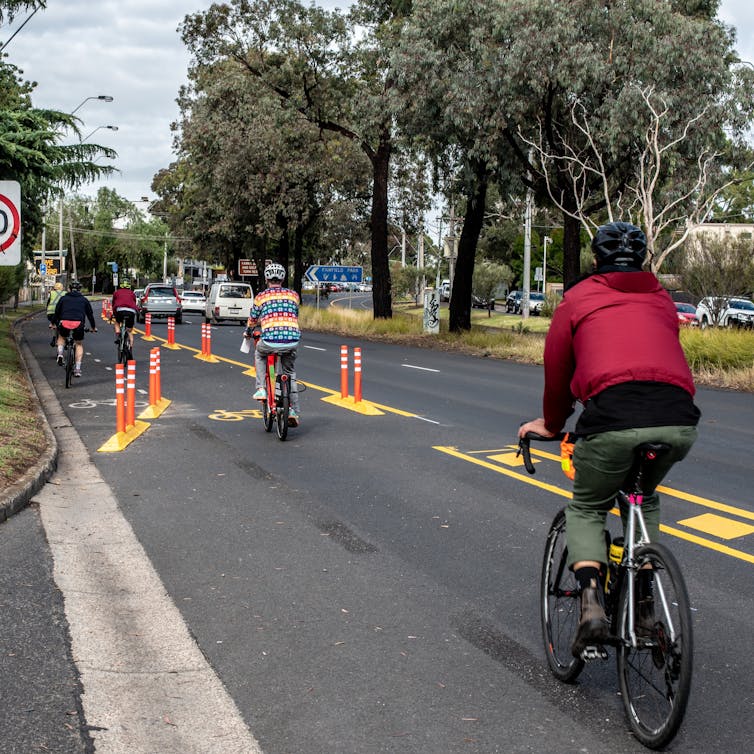 A pop-up bike lane created along Heidelberg Road in inner Melbourne.
Author provided
A pop-up bike lane created along Heidelberg Road in inner Melbourne.
Author provided
In making these short-term changes, we tried something new and perhaps we’ve found we like the results.
During COVID, I meandered down Lygon Street, Carlton, full of new al fresco dining areas making the street feel even more European. Along the Victorian coast, I sipped coffee in Skiplets. It could always be this nice, I thought.
These projects are already sparking debate about the future use of streets and bringing the trade-offs into focus. One example is the trade-off between parking revenue and outdoor dining.
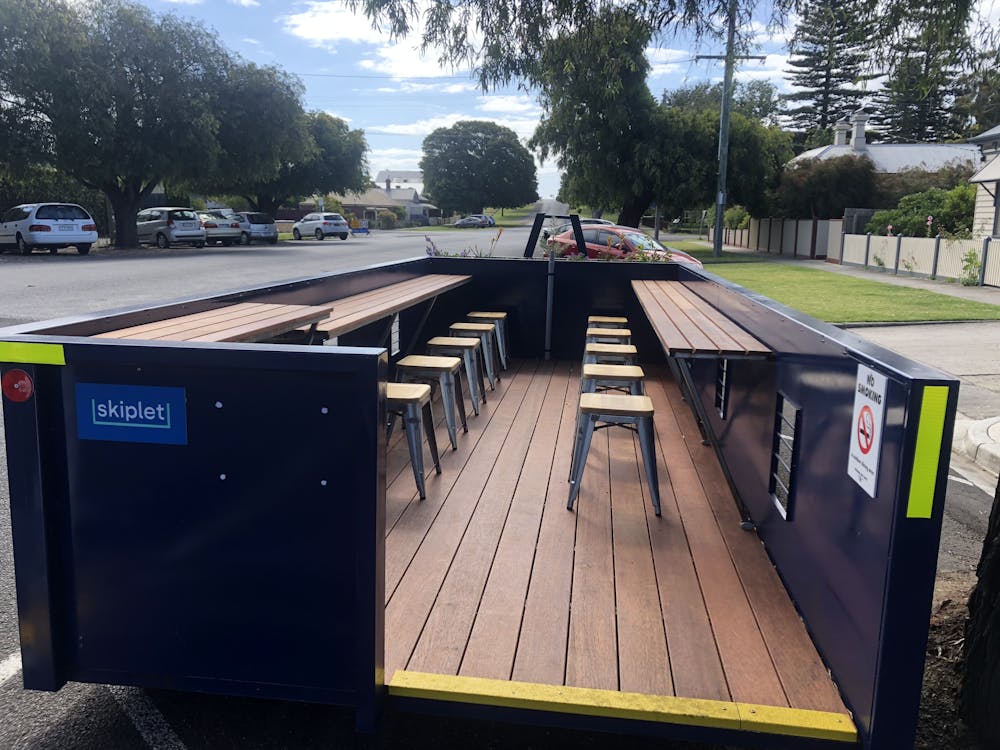 Skiplets were installed in parking spaces as pop-up eating places in the Victorian towns of Queenscliff and Point Lonsdale.
Helen Rowe, Author provided
Skiplets were installed in parking spaces as pop-up eating places in the Victorian towns of Queenscliff and Point Lonsdale.
Helen Rowe, Author provided
What more can we gain from ‘tactical ubanism’?
Well before COVID, cities started using temporary projects to test changes. From New York to Yarraville, cities used experiments to test out risky ideas and balance competing street uses. This is often referred to as tactical urbanism .
Read more: We can't let coronavirus kill our cities. Here's how we can save urban life
Benefits gleaned from these experiences show we have much to gain from more experimenting beyond COVID. City experiments get things moving and let us figure out if an idea is a good one.
New York City has remade its streets, seeking a better balance by providing more space for walking, biking and transit services.In the aptly titled book Street Fight, former New York City transport commissioner Janette Sadik-Khan describes turning the tangled intersection at Times Square into a pedestrian plaza. It began as a temporary experiment. A lower-cost, temporary version meant getting the project on the ground right away, rather than spending years convincing everyone to build it permanently. The added advantage was collecting data during the trial to prove it actually worked.
Overcoming suspicion of change
Experiments help navigate change, which we don’t always like. Based on my own research, street experiments help cities work with, not against, some people’s tendency to dislike change.
People’s hackles can go up in response to change. They prefer to stick with what’s familiar over something new. This is the type of status quo bias Nobel laureate Daniel Kahneman discusses in Thinking Fast and Slow.
A temporary experiment can help disarm this response. As one of my interviewees put it:
“If change is worrisome, then it’s not that big a deal if we can come back to where we are today.”
Through experimenting, people allow themselves to try it. Often they also get to see their fears aren’t realised.
Read more: Don't forget the footpath – it's vital public space
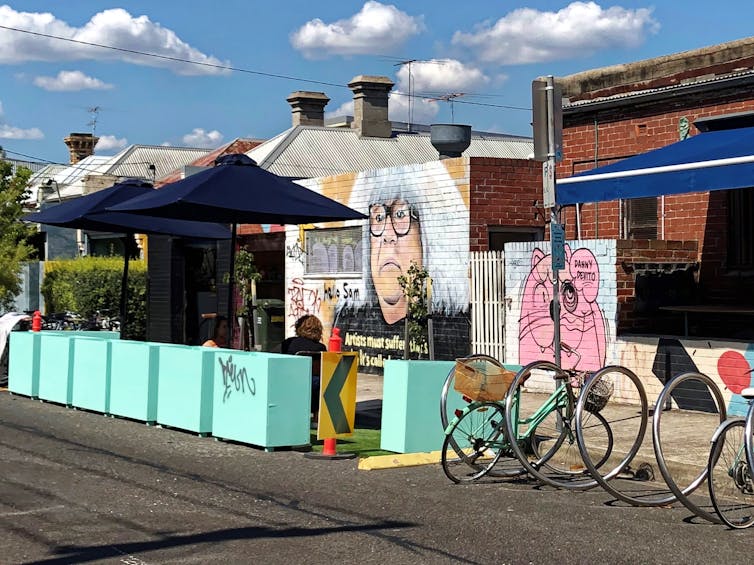 Parking space becomes a pop-up eating area in Brunswick, an inner Melbourne suburb.
Helen Rowe, Author provided
Parking space becomes a pop-up eating area in Brunswick, an inner Melbourne suburb.
Helen Rowe, Author provided
Experiments let us tweak projects to get them right. In 2008, Copenhagen rolled out a bold experiment on Nørrebrogade, providing wider bike lanes and bus-only sections painted with huge red dots. Experimenting, they found, helped them have a better conversation with the community. They were able to tweak the design in response to community feedback and evaluation.
Read more: A time to embrace the edge spaces that make our neighbourhoods tick
Experiments also do the imagining for us. My current research (as yet unpublished) looks at ways city transport planners try to effect change.
One barrier to change planners discussed is that people often struggle to imagine how things could be different. Without this, they tend to happy to stick with the status quo. Experiments show us how streets can be different.
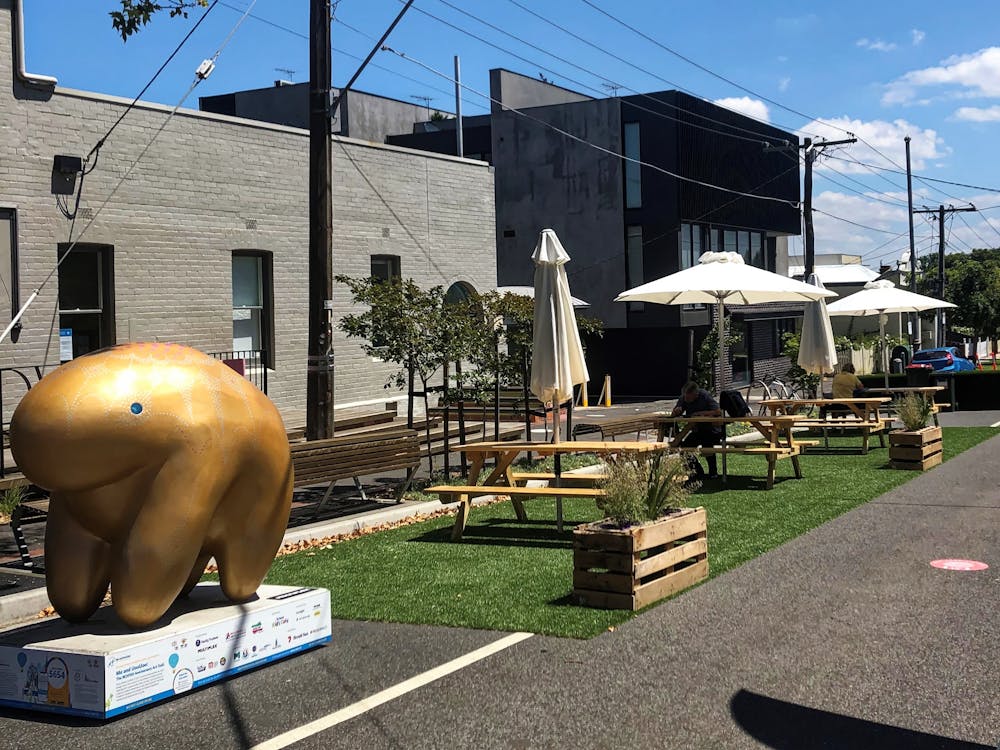 A pop-up parklet transforms the street in the inner Melbourne suburb of Ascot Vale.
Helen Rowe, Author provided
A pop-up parklet transforms the street in the inner Melbourne suburb of Ascot Vale.
Helen Rowe, Author provided
Read more: People love parklets, and businesses can help make them happen
What stands in the way of more street experiments?
My research suggests many city planners are striving to find new and better ways to explore change and help cities adapt to challenges. Many are starting to experiment with temporary projects, but it’s not always easy.
A number of transport planners I’ve talked with say doing temporary projects can be hard. That’s not because they are difficult to build but because the rules about what can be done on streets are set up for building things permanently. This can be a barrier to temporary experimenting.
However, after delivering many temporary projects during the pandemic, cities should now be well placed to embed processes that make street experiments easier.
Given COVID is just one of the many looming challenges facing our cities, being braver and adaptable is going to be more important that ever. Experimenting can help pave the way.
The impact of temporary projects is the focus of the MPavilion event, Is Temporary the New Permanent?, on March 22.
Authors: Helen Rowe, PhD Candidate, Centre for Urban Research, RMIT University

















