

The secret agents protecting our crops and gardens
- Written by: Lizzy Lowe, Postdoctoral researcher, Macquarie University
Insect pests cause a huge amount of damage to crops globally. In Australia alone, pests are responsible for around A$360 million of crop losses a year. Controlling pest outbreaks is crucial for food security and human health. Since the 1940s, our primary defence against crop pests has been synthetic pesticides. But using pesticides comes at a huge cost.
Not all bugs are bad!
Bees, flies and butterflies help to pollinate our plants. Decomposers like beetles and worms help break down wastes and return nutrients to the soil. Meanwhile, predators and parasites help control the species that are pests. One of the biggest environmental problems with pesticides is that they can affect these beneficial species as well as the pests they’re targeting.
Predatory insects and spiders control pests with none of the health and environmental risks of chemicals. So when we kill these species with insecticides, we are shooting ourselves in the foot.
Read more: The real cost of pesticides in Australia's food boom
Losing insects also has flow-on effects for larger animals that rely on them for food. Because invertebrates have such important roles to play in our environment, losing them to insecticides can completely change how ecosystems function.
An alternative to insecticides
Biological control (or biocontrol) relies on “secret agents” – the natural enemies (predators and parasitoids) of pests that live freely in the ecosystems around us.
There is a huge range of predatory invertebrates that eat pests. They include dragonflies, preying mantids, beetles (including ladybugs), lacewings, spiders, mites, wasps, and even some flies.
Parasitoids, meanwhile, are insects that lay their eggs in the bodies of other invertebrates. Their larvae extract nutrients from the host during their development, which ultimately kills the host. Wasps are best known for this strategy but there are also parasitoid flies and beetles.
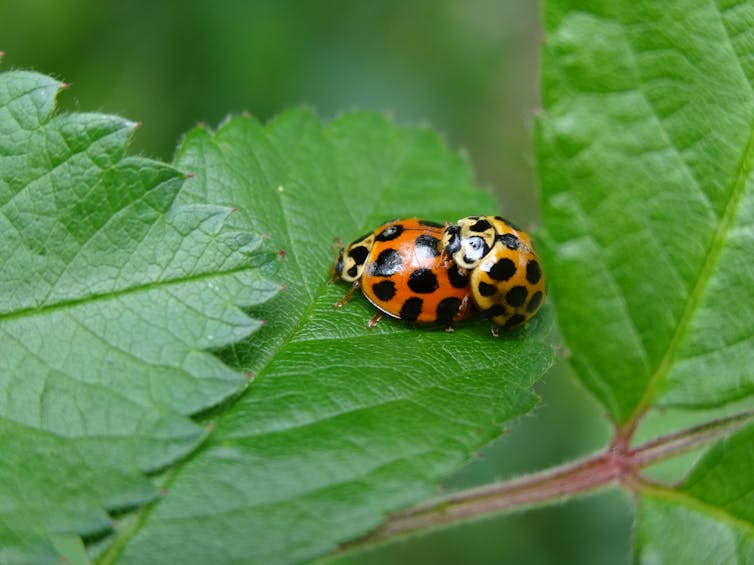 Lady birds are voracious predators ready to eat pests in crops and gardens.
Manu Saunders
Lady birds are voracious predators ready to eat pests in crops and gardens.
Manu Saunders
Predators and parasitoids are useful because they use pest insects, like caterpillars and aphids, as food to reproduce and grow their populations. We walk past many of these hard working agents every day without knowing it.
One biocontrol method that gardeners and land managers use is called augmentation. This simply means raising lots of live individuals of particular natural enemies, like ladybirds or wasps, and releasing them into an area to control pests.
Alternatively, gardeners might change the local environment to encourage these natural enemies to move in on their own. They might include natural insectariums or planting different types of vegetation to encourage diverse invertebrate communities. There is increasing evidence of the success of these strategies in organic farming so we should be thinking about using them more broadly.
Selecting your insects
If you want to release biocontrol agents, you need to choose them carefully, just like human special agents. Like any introduced plant or animal, there is a risk that good bugs could become pests (if they feed on the wrong insects, for example).
Selecting biological control agents requires close collaboration between managers, skilled entomologists and other scientists. For each new species, they identify the pest and some potential predators. They look at the predator’s life cycle and resource needs, and consider how it interacts not just with pests, but with other insects too. If agents are coming in from overseas, they also need to be cleared by government biosecurity.
Parasiotid wasps, lacewings, predatory mites, ladybird beetles, and nematodes are all common biocontrol agents. These species are relatively easy to raise in large numbers and work well when released into the field. Spiders are also a really important predator of many pest insects, but they’re often overlooked in the biocontrol game because they are harder to breed - and for some reason people don’t always like releasing large numbers of spiders.
Many biocontrol agents are enemies of pests in general, preying on aphids, caterpillars and fruit flies alike. It’s important to have generalists around for every day pest control, but sometimes a more targeted approach is needed. This is when specialised predators or parasitoids come in. These are species that only target specific pests like leaf miners, beetles, scale insects or spider mites. This way the target pest can be managed with no risk of the parasitoids accidentally attacking other beneficial invertebrates.
Raising good bugs
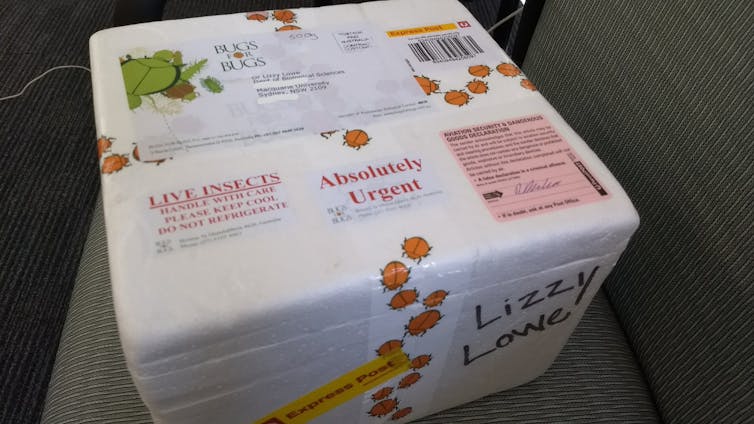 It’s very exciting to get live insects in the mail!
Lizzy Lowe
It’s very exciting to get live insects in the mail!
Lizzy Lowe
Once a biocontrol agent has been selected, greenhouses or lab facilities start raising a large population. This is an emerging market in Australia, but there are already a number of companies in Australia who specialise in rearing biological control agents.
This is a tricky job because demand for the product is variable and is not easy to predict. Warmer seasons are the peak time for most pests, but problems can arise at any time of the year. In most cases the biocontrol company will maintain breeding colonies throughout the year and will be ready to ramp up production at a moment’s notice when a farmer identifies a pest problem. Each company usually provides 10-20 different biocontrol agents and are always looking for new species that might be useful.
Read more: Birds, bees and bugs: your garden is an ecosystem, and it needs looking after
When it comes to getting the agents to the farmers, the bugs can be shipped as eggs (ready to hatch on arrival), or as live adults ready to disperse and lay their own eggs. The packages are express posted in boxes designed to keep the insects cool and safe.
Once the farmer or natural resource manager receives the bugs, applying them is quite simple. The secret agents are released among the crops, usually by hand, but in some special cases they may be airlifted in via specialised drones!
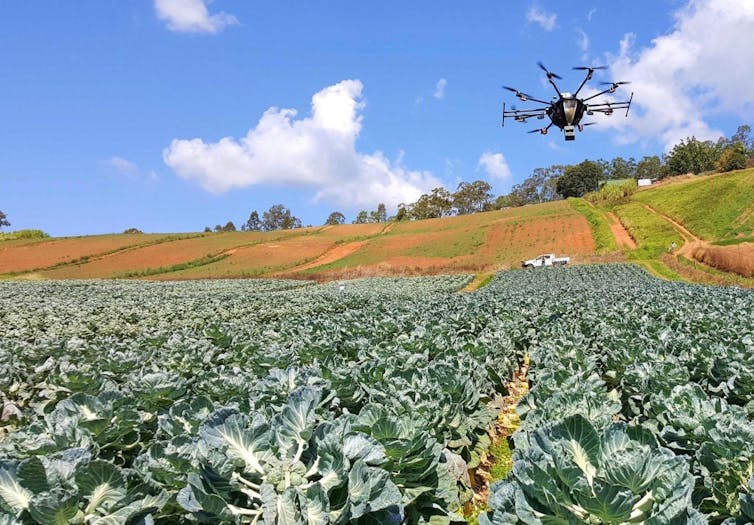 Drones can be used to deploy biological control agents.
Nathan Roy (Aerobugs)
Drones can be used to deploy biological control agents.
Nathan Roy (Aerobugs)
It’s important to monitor the pests and the biological control agents after release to check that the agents are working. Some farmers are happy to do this themselves but most biological control companies have experts to visit the farms and keep an eye on all parties.
Can I use good bugs in my garden?
If you have a problem with a pest like aphids it is possible to buy predators such as ladybirds or lacewings to quickly deal with the problem. But for long term pest control, there are probably already some natural enemies living in your garden! The easiest and cheapest way to help them is to put the insecticides away and ensure your garden is a friendly environment for secret agents.
Authors: Lizzy Lowe, Postdoctoral researcher, Macquarie University
Read more http://theconversation.com/the-secret-agents-protecting-our-crops-and-gardens-94304


















