

If 80% of Australians care about climate action, why don't they vote like it?
- Written by Rebecca Colvin, Senior lecturer, Crawford School of Public Policy, Australian National University
Poll after poll suggests a large majority of Australians cares about climate change. Yet in recent federal elections, this hasn’t translated into wins for parties with stronger policy platforms on climate change.
So what determines someone’s climate change attitude, and how does it translate into voting?
In research published today, we studied 2,033 Australian voters’ attitudes across the political spectrum in the context of the 2019 federal election. And we found over 80% said they think it’s important Australia reduce greenhouse gas emissions. This includes close to 70% of conservative voters (those voting for Coalition parties).
However, digging deeper reveals nuance to these attitudes. While most Australians support climate action, stark differences emerge along political party preferences in terms of how important voters think it is.
Our research suggests the question about social support for climate action in Australia is no longer: “does climate change matter to enough Australians?”. Instead, the critical question may well be: “does climate change matter enough to Australians to shift climate politics?”.
Why the ‘climate election’ didn’t pan out
We conducted our survey in July 2019, two months after the Coalition won the federal election. Its victory came as a surprise to many, as the election was sometimes billed the “climate election”, implying climate change was a bellwether issue.
The climate policies of the two major parties were night and day, with the Labor Party campaigning on ambitious mitigation targets and the incumbent Coalition maintaining the status quo of very limited climate policy.
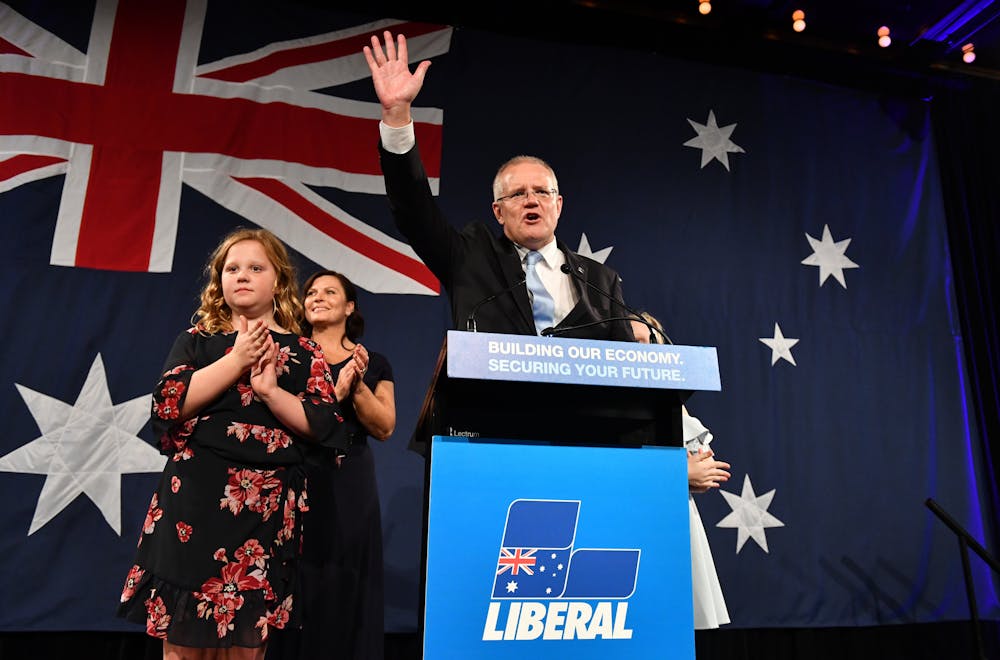 Prime Minister Scott Morrison led the LNP to victory in 2019, defying the polls.
AAP Image/Mick Tsikas
Prime Minister Scott Morrison led the LNP to victory in 2019, defying the polls.
AAP Image/Mick Tsikas
So what were the voters thinking?
We found about half of Australian voters (52%) said climate change was important when deciding their vote in the 2019 Australian federal election. However, climate was the most important issue for only 14% of voters.
Even among those who said they felt it was extremely important for Australia to reduce greenhouse gas emissions, most (58%) said climate change was important, but not the most important issue, when deciding their vote.
Read more: Australia’s major parties' climate policies side-by-side
Climate change was stated as the most important issue for 21% of Labor voters and 39% of Greens voters, but for less than 5% of Liberal Party, National Party, and Queensland LNP voters.
This pattern was reversed for those who didn’t take climate change policy into account in their vote: 26% of Liberal, 21% of National, and 31% of Queensland LNP voters did not consider climate change when deciding their vote. Under 15% of Labor and Greens voters did the same.
And when we looked at how much voters cared about climate action, the differences become more potent. Three quarters (73%) of progressive voters (those voting for the ALP or the Greens) see Australian action to reduce emissions as “extremely important”. Only one quarter (26%) of conservative voters say the same thing.
Who’s more willing to make sacrifices for the climate?
Our research also explored the extent voters were willing to accept a personal cost to support climate action. We asked about their willingness to accept a significant or small personal cost, but didn’t specify what we meant by small or significant, because a small cost to one person may be a significant cost to another.
Most voters (72%) said they’d be willing to incur some personal cost in return for emissions reductions. Across the political spectrum, the proportion of voters willing to accept a small personal cost is relatively similar: 60% of progressive voters, 55% of conservative voters.
Major differences emerge when it comes to “significant personal cost”.
While 26% of progressive voters are willing to incur a significant personal cost, only 5% of conservative voters feel similarly. At the other end of the spectrum, 40% of conservative voters are unwilling to incur any personal cost, but only 14% of progressive voters feel the same.
Support for strong climate policies may depend on whether the policies will, or are perceived to, personally impact voters. Given political leaders’ stances influence public support for climate policies (as 2018 research showed), our research highlights an opportunity for conservative political leaders to clarify their position on climate change.
Interestingly, age was a consistent predictor of responses. Younger people were more likely than older people to consider it important that Australia reduce greenhouse gas emissions. Younger people were more willing to incur a personal cost to support climate action, and to consider climate change when deciding their vote.
In fact, we found an Australian voter from the Baby Boomer generation is half as likely as a voter from Generation Z to consider it important to reduce greenhouse gas emissions.
Divisive politics have a limited shelf life
If future young people cared just as much about climate change as today’s young people, and if existing cohorts don’t change their views as they age, then the percentage of Australian voters who consider greenhouse gas emissions to be “extremely important” is likely to increase from 52% in our 2019 data, to 56% by 2030. By 2050, this figure could rise to 65%.
These projections are purely on the basis of more climate-aware cohorts coming into voting age and replacing older voters. It doesn’t consider any future changes in attitudes within cohorts (which may also make a big difference).
The key implication is simple. If Australian political leaders pursued stronger climate action, they could rest assured most of the voting population will broadly support them, along with most of their own voter base — regardless of which party is in power.
This will become only more pronounced with gradual generational change, and likely changes in attitudes within age groups. In any case, it’s clear divisive politics that result in climate delay have a limited shelf life.
Read more: Nearly 80% of Australians affected in some way by the bushfires, new survey shows
Authors: Rebecca Colvin, Senior lecturer, Crawford School of Public Policy, Australian National University

















