

Here's why the Coalition favours optional preferential voting: it would devastate Labor
- Written by Benjamin Reilly, Professor, University of Western Australia
Could a change be afoot in the way Australians vote in federal elections?
The Coalition government may be eyeing a shift to optional preferential voting — as used in New South Wales — which allows voters to simply vote “1” or allocate only a partial list of preferences on their ballot, instead of a full ordering of preferences for every candidate.
The proposal was included in a series of potentially revolutionary changes to our electoral system that were quietly released by a parliamentary committee in December, when few people were paying attention.
The joint standing committee on electoral matters claimed a shift to optional preferential voting would help address rising rates of “informal voting” in NSW caused by the differences between the state and federal systems. The reason: a valid vote at the state level with less than a full list of preferences would be invalid if repeated at a federal election.
What the committee did not say is that based on current voting patterns, a shift to optional preferencing could also cement the Coalition in government.
As a follow-up to a newly published study, we have modelled how recent federal elections would have changed if an optional preferential system had been used. We found the results would have been devastating for Labor.
Read more: Parliamentary electoral committee floats bigger parliament, longer terms and no byelections
Labor supported by Greens preferences
The reason the Coalition would benefit from an optional preferential voting system is simple.
In recent decades, Labor’s primary vote has slumped in federal elections, but full preferential voting has kept its two-party preferred vote high.
This is because Labor benefits from consistent preference flows from parties to the left, in particular the Greens. Approximately 80% of Greens preferences at federal elections go to the ALP at present.
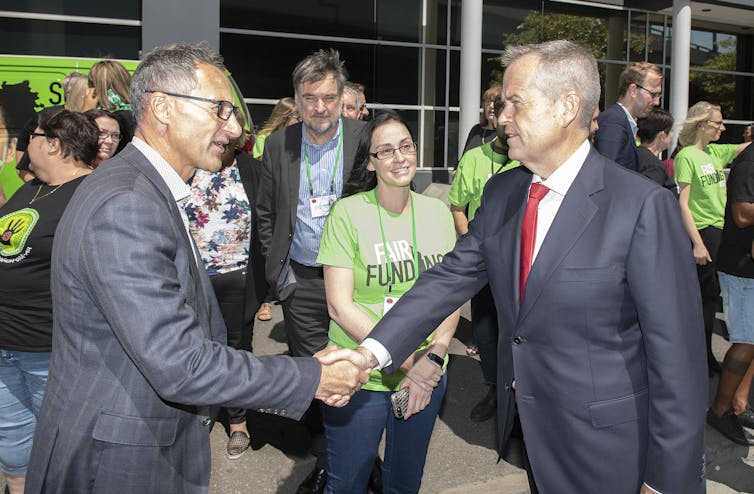 The Greens have preferenced Labor ahead of the Coalition in an overwhelming majority of races in recent years.
Ellen Smith/AAP
The Greens have preferenced Labor ahead of the Coalition in an overwhelming majority of races in recent years.
Ellen Smith/AAP
A significant proportion of this preference flow is the result of Greens voters being forced to choose between Labor and the Coalition at some point – even in their final preference markings on the ballot – so their votes are valid.
Labor and the Greens oppose changing the current voting system, but the proposal from the joint standing committee reportedly has support from some Senate cross-benchers.
Read more: With One Nation on the march, a change to compulsory voting might backfire on Labor
How Labor would have fared under optional preferences
Data collected by the ABC’s election analyst, Antony Green, at the 2015 NSW election shows the rate of Greens preferences transferring to Labor declines precipitously from 82.7% under full preferential voting to just 37.4% under optional preferential voting.
In our study, we extrapolated how past election outcomes would have been affected if this was repeated nationally. We were conscious of the challenges that come with generalising in this way, and comparing one state’s data to the country as a whole.
We found that in most seats, switching to optional preferential voting would have partisan effects that are sharply skewed to the right.
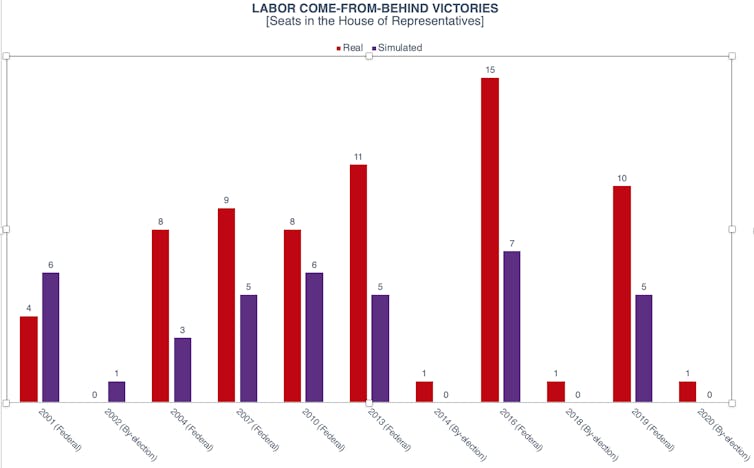
This is best illustrated by looking at the seats Labor has won in recent elections by overtaking the Coalition after trailing on first preferences. These would be the seats most affected by a shift from full to optional preferential voting.
These “come-from-behind” victories would become much rarer under optional preferential voting. By our calculations, Labor would have won somewhere between five and eight fewer seats at each recent federal election, as the graph below shows.
 Author provided
This means Labor would have lost the 2010 election outright and suffered heavier defeats in the 2013, 2016 and 2019 elections if optional preferences had been in use. Labor would also have lost the byelections in 2018 and 2020.
In 2010, the fragile Labor minority government would have likely won independent Andrew Wilkie’s and The Greens’ Adam Bandt’s seats under optional preferential voting, but would have lost four others to the Liberals, including Treasurer Wayne Swan’s seat of Lilley. Labor would not have had enough seats to form government.
Labor won a total of 36 come-from-behind seats in the 2013, 2016 and 2019 elections. Our analysis suggests Labor would have won less than half (17) of these seats under optional preferencing.
Author provided
This means Labor would have lost the 2010 election outright and suffered heavier defeats in the 2013, 2016 and 2019 elections if optional preferences had been in use. Labor would also have lost the byelections in 2018 and 2020.
In 2010, the fragile Labor minority government would have likely won independent Andrew Wilkie’s and The Greens’ Adam Bandt’s seats under optional preferential voting, but would have lost four others to the Liberals, including Treasurer Wayne Swan’s seat of Lilley. Labor would not have had enough seats to form government.
Labor won a total of 36 come-from-behind seats in the 2013, 2016 and 2019 elections. Our analysis suggests Labor would have won less than half (17) of these seats under optional preferencing.
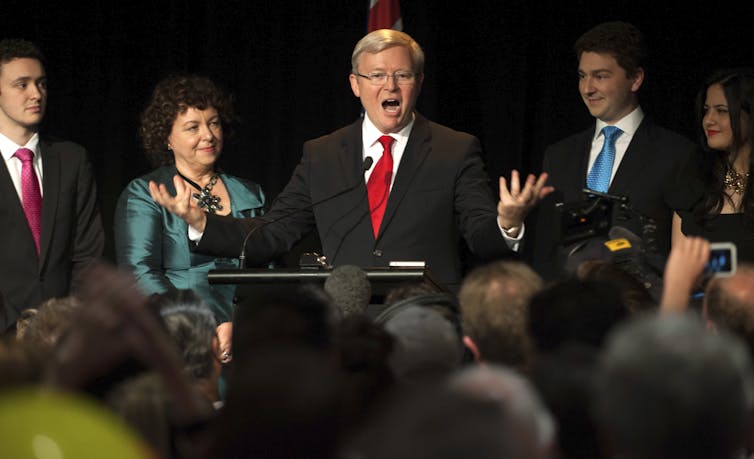 The Coalition swept to power in the 2013 federal election, defeating incumbent Prime Minister Kevin Rudd and ending six years of Labor rule.
John Pryke/AAP
Minor parties and independents would also be shut out
Our model also suggests minor parties and independents would struggle to win under optional preferential voting.
As mentioned before, Labor would have won the seats of Melbourne and Dension from Bandt and Wilkie in 2010.
And the Liberals would have triumphed over Cathy McGowan (independent), Clive Palmer (Palmer United Party) and Bob Katter (Katter’s Australian Party) in 2013; Rebekha Sharkie (Nick Xenophon Team/Centre Alliance) in 2016 and 2019; Kerryn Phelps (independent) in 2018 and Helen Haines (independent) in 2019.
The Coalition swept to power in the 2013 federal election, defeating incumbent Prime Minister Kevin Rudd and ending six years of Labor rule.
John Pryke/AAP
Minor parties and independents would also be shut out
Our model also suggests minor parties and independents would struggle to win under optional preferential voting.
As mentioned before, Labor would have won the seats of Melbourne and Dension from Bandt and Wilkie in 2010.
And the Liberals would have triumphed over Cathy McGowan (independent), Clive Palmer (Palmer United Party) and Bob Katter (Katter’s Australian Party) in 2013; Rebekha Sharkie (Nick Xenophon Team/Centre Alliance) in 2016 and 2019; Kerryn Phelps (independent) in 2018 and Helen Haines (independent) in 2019.
 Our modelling suggests Independent MP Cathy McGowan would have lost the 2019 election for the seat of Indi under optional preferential voting.
Lukas Coch/AAP
With fewer independents and minor parties, the House of Representatives would be a less diverse and colourful place, and the crossbench less politically influential.
Given this, it is striking that both Centre Alliance and One Nation will reportedly back the government in the Senate if it decides to push for a change to optional preferential voting.
Read more:
Explainer: how does preferential voting work in the House of Representatives?
Whether the government pursues reform before the next election probably comes down to the Senate numbers, given Labor and the Greens will bitterly oppose any change.
It will also depend on internal Coalition management considerations, with the National Party traditionally opposed to optional preferences, and the government’s more precarious numbers in the House since Craig Kelly’s move to the crossbench.
The government response to the joint standing committee’s report is currently being prepared by the assistant minister for electoral matters, Ben Morton, a former party secretary.
While tightly guarded, we can say with confidence that the reason advanced by the committee for the change – that it will reduce informal voting – is unlikely to feature highly in his calculations. Instead, raw political calculations must make this a highly tempting reform for the government.
Jack Stewart, a Bachelor of Philosophy (Hons) student at the University of Western Australia, compiled the data for this study.
Our modelling suggests Independent MP Cathy McGowan would have lost the 2019 election for the seat of Indi under optional preferential voting.
Lukas Coch/AAP
With fewer independents and minor parties, the House of Representatives would be a less diverse and colourful place, and the crossbench less politically influential.
Given this, it is striking that both Centre Alliance and One Nation will reportedly back the government in the Senate if it decides to push for a change to optional preferential voting.
Read more:
Explainer: how does preferential voting work in the House of Representatives?
Whether the government pursues reform before the next election probably comes down to the Senate numbers, given Labor and the Greens will bitterly oppose any change.
It will also depend on internal Coalition management considerations, with the National Party traditionally opposed to optional preferences, and the government’s more precarious numbers in the House since Craig Kelly’s move to the crossbench.
The government response to the joint standing committee’s report is currently being prepared by the assistant minister for electoral matters, Ben Morton, a former party secretary.
While tightly guarded, we can say with confidence that the reason advanced by the committee for the change – that it will reduce informal voting – is unlikely to feature highly in his calculations. Instead, raw political calculations must make this a highly tempting reform for the government.
Jack Stewart, a Bachelor of Philosophy (Hons) student at the University of Western Australia, compiled the data for this study.
Authors: Benjamin Reilly, Professor, University of Western Australia

















