

A 'deep clean' has been ordered for a Brisbane hospital ward. What does that actually involve?
- Written by: Brett Mitchell, Professor of Nursing, University of Newcastle
The Australian public’s infection control literacy continues to expand. We know what PPE is, what “flattening the curve” means, and we are growing increasingly familiar with the term “deep clean”. But what does a deep clean involve, and when is it necessary?
This week, media reported that a ward at Brisbane’s Princess Alexandra Hospital was to undergo further “deep cleaning” after testing found a “COVID-19 related virus” in the ward. This was to be combined with further engineering reviews, although the ward’s isolation rooms were deemed to be functioning as expected.
What role does environmental cleaning play?
SARS-CoV-2, the virus that causes COVID-19, can survive on surfaces. This means if a surface is contaminated by someone with COVID-19, it is theoretically possible for other people to become infected if they touch those surfaces and then touch their nose, mouth, or eyes.
It is not clear how many cases of COVID-19 are acquired through surface transmission, although the risk from this transmission route is thought to be lower than other routes, such as droplets, aerosols and direct contact.
The other good news is that SARS-CoV-2 is easily broken down and can degrade quickly upon contact with particular cleaning agents and under certain environmental conditions.
Read more: How worried should I be about news the coronavirus survives on surfaces for up to 28 days?
Nonetheless, because SARS-CoV-2 can survive on surfaces and there is a theoretical risk, it is important that measures to reduce subsequent transmission include cleaning. This is on top of other, potentially more important measures such as increasing appropriate ventilation, waiting as long as possible before entering the space (at least several hours), and using personal protective equipment (PPE).
So, what is a deep clean?
There is no nationally agreed definition of what constitutes a “deep clean”. The term seems to have originated during disease outbreaks in hospitals in the 1990s and 2000s.
Cleaning is a complex and skilled process involving many facets. Evidence has shown that improving routine cleaning in hospitals can reduce infection risk, and that this is cost-effective. But what is the difference between a routine cleaning and deep cleaning?
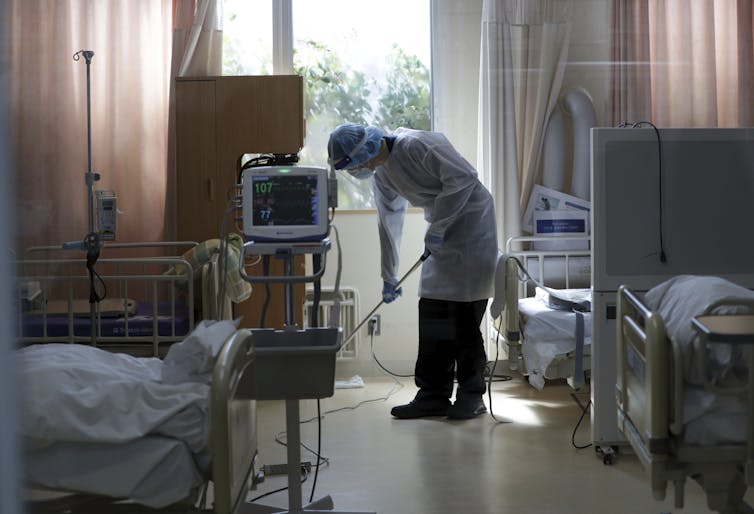 There’s no agreed definition of a deep clean, but it goes a long way beyond mopping the floor.
Masanori Inagaki/AP
There’s no agreed definition of a deep clean, but it goes a long way beyond mopping the floor.
Masanori Inagaki/AP
In the absence of detailed guidelines, institutions and companies have developed their own approach to deep cleaning. In Victoria, there is some limited guidance of what a deep clean involves.
Broadly speaking, a deep clean should pay particular attention to cleaning objects or surfaces that may not be cleaned as part of a routine clean. These could include walls, ventilation ducts, curtains, and harder-to-reach surfaces that are touched less frequently. In contrast, routine cleaning focuses on surfaces that are frequently touched.
Deep cleaning typically involves the use of a disinfectant, as well as a detergent. Typically detergents are used to remove organic matter. Disinfectant can kill bacteria and viruses (depending on the type of disinfectant). Products or surfaces that are more difficult to clean, such as carpets, soft furnishings or certain equipment, may also be included in a more thorough clean, noting that care has to be taken not to damage such items in the process.
Training and auditing are also crucial for effective cleaning. Cleaners need to be properly trained, including in the correct use of PPE to ensure they are protected.
Regular auditing of cleaning can be done in various ways, including direct observation or by using fluorescent markers. Fluorescent markers are invisible to the naked eye, but are removed when a surface is cleaned. They can be applied before cleaning a surface and checked again after, to determine whether it has been effectively cleaned.
What about ‘fogging’?
Media footage often shows workers “fogging” rooms and facilities as part of a deep clean. This involves spraying the area with very fine droplets of disinfectant, and it certainly makes for compelling television.
But several Australian organisations have recommended against fogging, including the Victorian Department of Health and Human Services, New South Wales’ Clinical Excellence Commission and Safe Work Australia.
The US Environmental Protection Agency does not recommend fogging or fumigation, unless the product label specifically includes disinfection directions. Australia’s Therapeutical Goods Administration has also noted that testing of disinfectants may not apply to techniques such as fogging.
Where to from here?
Like all things COVID-19, our understanding of the role of surface transmission and the benefits of deep cleaning continues to evolve. Any unusual transmission events or “mystery” cases, particularly in a health-care setting, need to be thoroughly investigated.
Technologies such as genomic testing, which provide detailed information about specific chains of transmission between people, could provide rich data to help us understand the role of the environment and inform future strategies.
Importantly, any findings from investigating these unusual events need to be made publicly available so the wider community can better understand how to combat the spread of COVID-19.
Read more: Catching COVID from surfaces is very unlikely. So perhaps we can ease up on the disinfecting
Authors: Brett Mitchell, Professor of Nursing, University of Newcastle

















