

'Self-driving' cars are still a long way off. Here are three reasons why
- Written by Hussein Dia, Professor of Future Urban Mobility, Swinburne University of Technology
The recent crash of a Tesla car in the United States, in which two people died, has reignited debate about the capabilities and safety of today’s “self-driving” technologies.
Tesla cars include an “autopilot” feature which monitors surrounding traffic and lane markings, and the company is currently rolling out a more advanced “full self-driving” system which promises automatic navigation, stopping at traffic lights, and more.
Investigators say it appears nobody was in the driver’s seat of the vehicle when it crashed. Tesla chief executive Elon Musk has said no self-driving features were in use at the time.
Nonetheless, the tragic incident has raised questions over self-driving technology: how safe is it, and how much attention does it require from drivers?
What do we mean by ‘self-driving’?
Experts talk about six levels of autonomous vehicle technology, ranging from level 0 (a traditional vehicle with no automation) to level 5 (a vehicle that can independently do anything a human driver can).
Most automated driving solutions available on the market today require human intervention. This puts them at level 1 (driver assistance, such as keeping a car in a lane or managing its speed) or level 2 (partial automation, such as steering and speed control).
These capabilities are intended for use with a fully attentive driver prepared to take control at any moment.
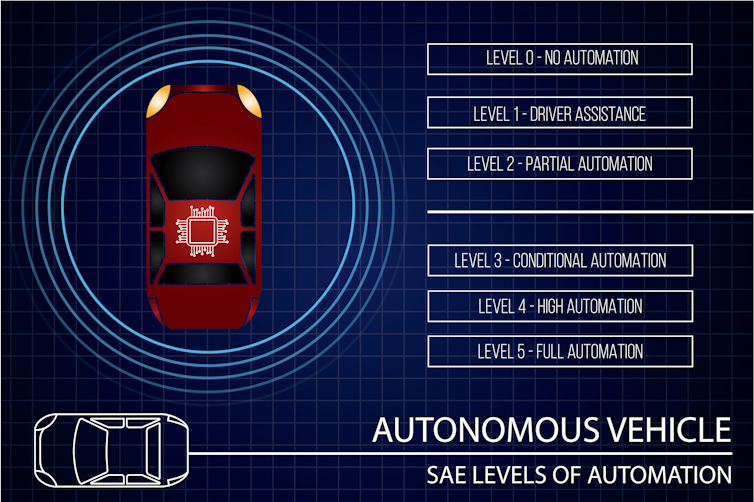 The standard levels of vehicle automation.
Shutterstock
The standard levels of vehicle automation.
Shutterstock
Level 3 vehicles have more autonomy and can make some decisions on their own, but the driver must still remain alert and take control if the system is unable to drive.
In the past few years, several fatal crashes involving level 2 and level 3 vehicles have occurred. These crashes were largely attributed to human error, and to mistaking these levels of automation for full self-driving capabilities.
Vehicle manufacturers and regulators have been criticised for not doing enough to make these systems more resilient to misuse by inattentive drivers.
The path towards higher levels of automation
For higher levels of automation, a human driver won’t necessarily be involved in the driving task. The driver would effectively be replaced by the AI self-driving software.
Level 4 is a “self-driving” vehicle that has a bounded scope of where and when it will drive. The best example of a level 4 vehicle is Google’s Waymo robotaxi project. Other companies are also making significant progress in developing level 4 vehicles, but these vehicles are not commercially available to the public.
Level 5 represents a truly autonomous vehicle that can go anywhere and at any time, similar to what a human driver can do. The transition from level 4 to level 5, however, is orders of magnitude harder than transitions between other levels, and may take years to achieve.
While the technologies required to enable higher levels of automation are advancing rapidly, producing a vehicle that can complete a journey safely and legally without human input remains a big challenge.
Three key barriers must be overcome before they can be safely introduced to the market: technology, regulations and public acceptance.
Machine learning and self-driving software
The self-driving software is a key differentiating feature of highly automated vehicles. The software is based on machine learning algorithms and deep learning neural networks that include millions of virtual neurons that mimic the human brain.
The neural nets do not include any explicit “if X happens, then do Y” programming. Rather, they are trained to recognise and classify objects using examples of millions of videos and images from real-world driving conditions.
The more diverse and representative the data, the better they get at recognising and responding to different situations. Training neural nets is something like holding a child’s hand when crossing the road and teaching them to learn through constant experience, replication and patience.
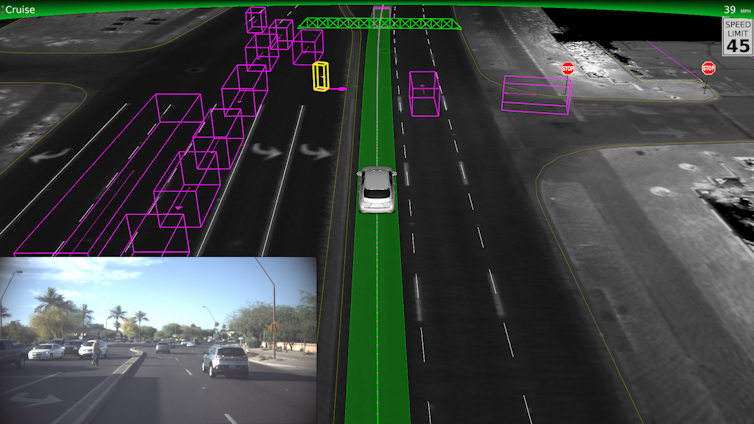 How a self-driving car sees the world.
Waymo
How a self-driving car sees the world.
Waymo
While these algorithms can detect and classify objects very accurately, they still can’t mimic the intricate complexities of driving. Autonomous vehicles not only need to detect and recognise humans and other objects, but must also interact with, understand and react to how these things behave.
They also need to know what to do in unfamiliar circumstances. Without a large set of examples for all possible driving scenarios, the task of managing the unexpected will be relatively resistant to deep learning and training.
Regulations
Policy-makers and regulators around the world are struggling to keep pace. Today, the industry remains mostly self-regulating, particularly in determining whether the technology is safe enough for open roads. Regulators have largely failed to provide criteria for making such determinations.
While it is necessary to test the performance of self-driving software under real-world conditions, this should only happen after comprehensive safety testing and evaluation. Regulators should come up with a set of standard tests and make companies benchmark their algorithms on standard data sets before their vehicles are allowed on open roads.
In Australia, current laws do not support the safe commercial deployment and operation of self-driving vehicles. The National Transport Commission is spearheading efforts to develop nationally-consistent reforms that support innovation and safety to allow Australian to access the benefits of the technology.
Read more: Who (or what) is behind the wheel? The regulatory challenges of driverless cars
A graduated approach to certification is needed, in which a self-driving system could first be evaluated in simulations, then in controlled real-world environments. Once the vehicles pass specific benchmark tests, the regulators can allow them on open roads.
Public acceptance
The public must be involved in decisions regarding self-driving vehicle deployment and adoption. There is a real risk of undermining public trust if self-driving technologies are not regulated to ensure public safety. A lack of trust will affect not only those who want to use the technology, but also those who share the road with them.
 Trials of self-driving technologies can help improve public perception and acceptance.
Shutterstock
Trials of self-driving technologies can help improve public perception and acceptance.
Shutterstock
Finally, this incident should serve as a catalyst to bring regulators and industry to establish a strong and robust safety culture to guide innovations in self-driving technologies.
Without this, autonomous vehicles would go nowhere very fast.
Authors: Hussein Dia, Professor of Future Urban Mobility, Swinburne University of Technology

















