

Feral desert donkeys are digging wells, giving water to parched wildlife
- Written by: Erick Lundgren, PhD Student, Centre for Compassionate Conservation, University of Technology Sydney
In the heart of the world’s deserts – some of the most expansive wild places left on Earth – roam herds of feral donkeys and horses. These are the descendants of a once-essential but now-obsolete labour force.
These wild animals are generally considered a threat to the natural environment, and have been the target of mass eradication and lethal control programs in Australia. However, as we show in a new research paper in Science, these animals do something amazing that has long been overlooked: they dig wells — or “ass holes”.
In fact, we found that ass holes in North America — where feral donkeys and horses are widespread — dramatically increased water availability in desert streams, particularly during the height of summer when temperatures reached near 50℃. At some sites, the wells were the only sources of water.
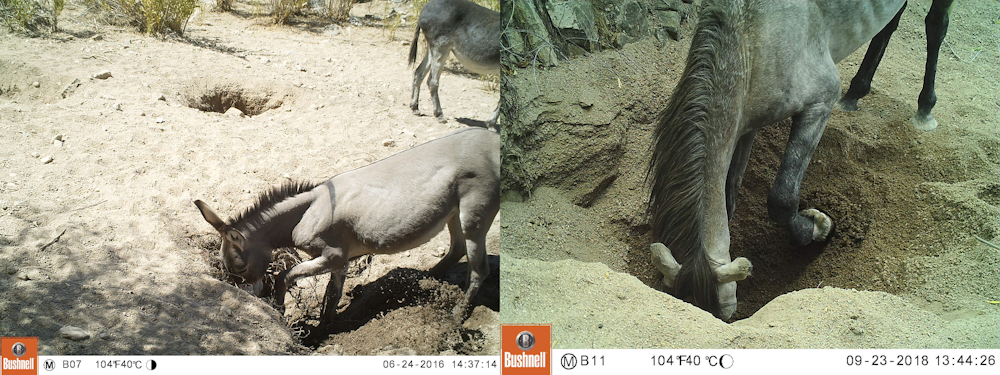 Feral donkeys and horses dig wells to desert groundwater.
Erick Lundgren
Feral donkeys and horses dig wells to desert groundwater.
Erick Lundgren
The wells didn’t just provide water for the donkeys and horses, but were also used by more than 57 other species, including numerous birds, other herbivores such as mule deer, and even mountain lions. (The lions are also predators of feral donkeys and horses.)
Incredibly, once the wells dried up some became nurseries for the germination and establishment of wetland trees.
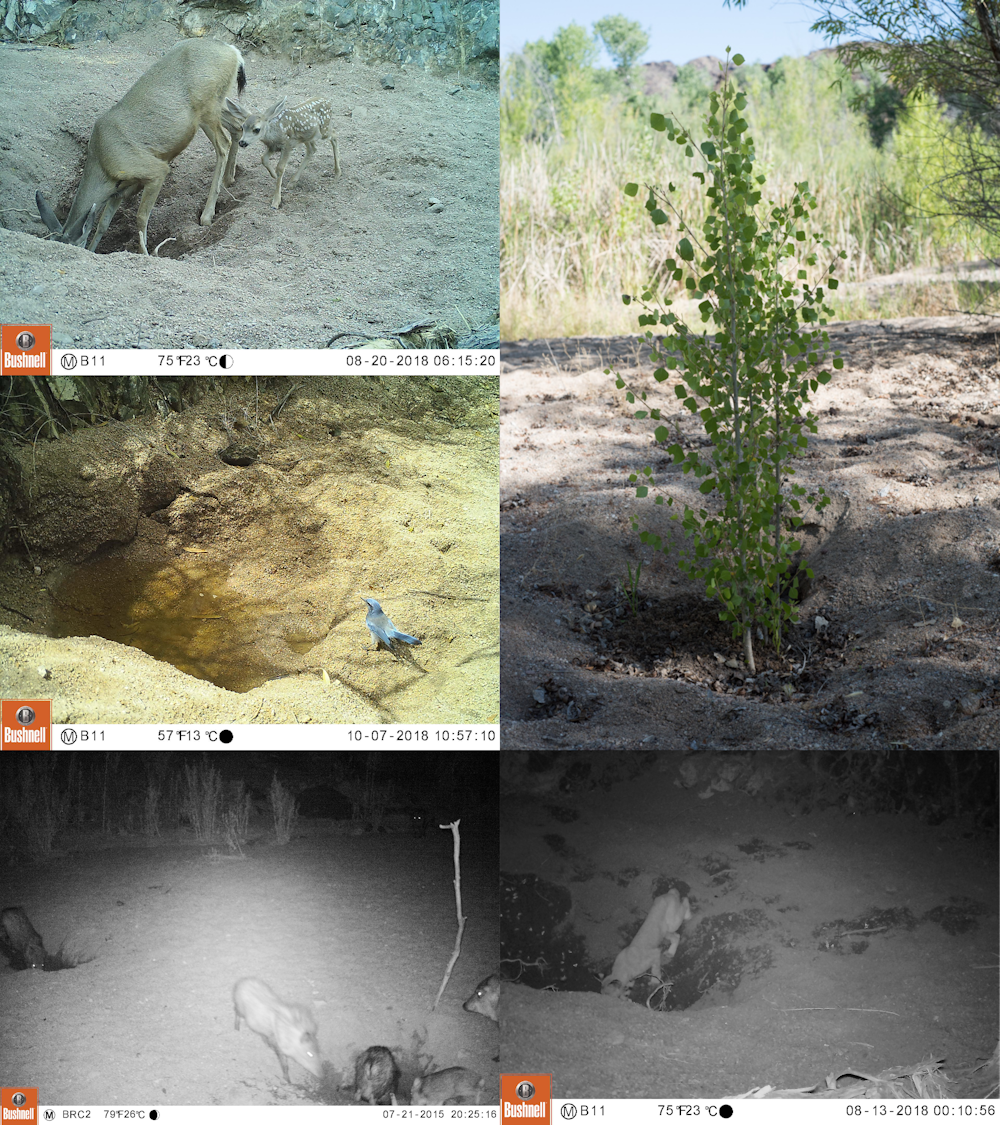 Numerous species use equid wells. This includes mule deer (top left), scrub jays (middle left), javelina (bottom left), cottonwood trees (top right), and bobcats (bottom right).
Erick Lundgren
Numerous species use equid wells. This includes mule deer (top left), scrub jays (middle left), javelina (bottom left), cottonwood trees (top right), and bobcats (bottom right).
Erick Lundgren
Ass holes in Australia
Our research didn’t evaluate the impact of donkey-dug wells in arid Australia. But Australia is home to most of the world’s feral donkeys, and it’s likely their wells support wildlife in similar ways.
Across the Kimberley in Western Australia, helicopter pilots regularly saw strings of wells in dry streambeds. However, these all but disappeared as mass shootings since the late 1970s have driven donkeys near local extinction. Only on Kachana Station, where the last of the Kimberley’s feral donkeys are protected, are these wells still to be found.
In Queensland, brumbies (feral horses) have been observed digging wells deeper than their own height to reach groundwater.
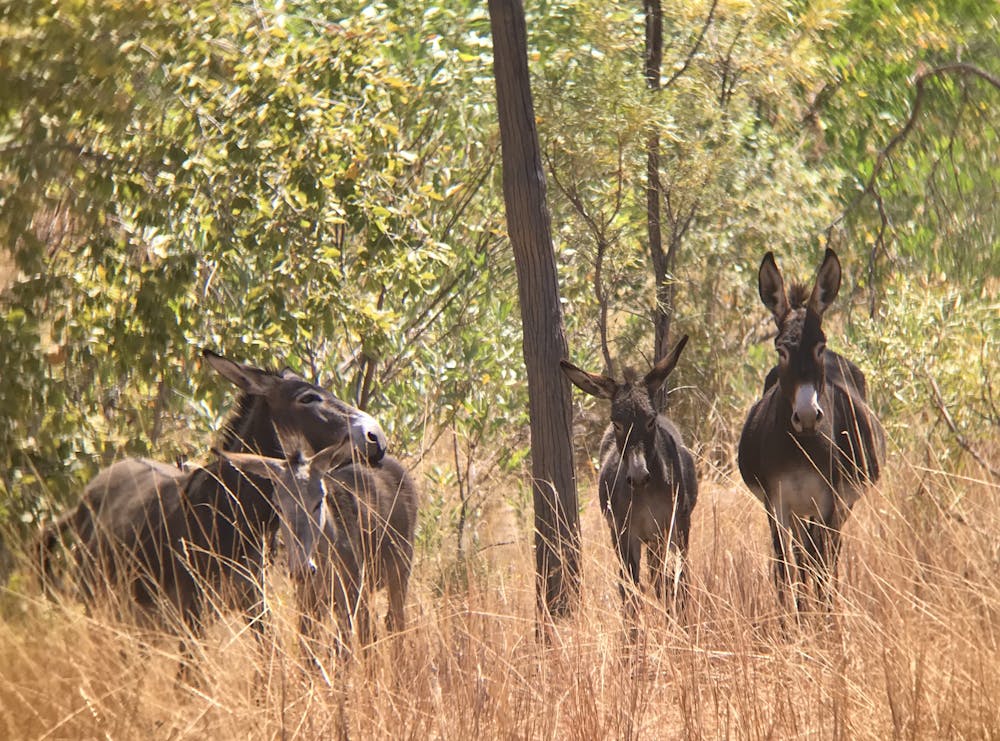 Some of the last feral donkeys of the Kimberley.
Arian Wallach
Some of the last feral donkeys of the Kimberley.
Arian Wallach
Feral horses and donkeys are not alone in this ability to maintain water availability through well digging.
Other equids — including mountain zebras, Grevy’s zebras and the kulan — dig wells. African and Asian elephants dig wells, too. These wells provide resources for other animal species, including the near-threatened argali and the mysterious Gobi desert grizzly bear in Mongolia.
These animals, like most of the world’s remaining megafauna, are threatened by human hunting and habitat loss.
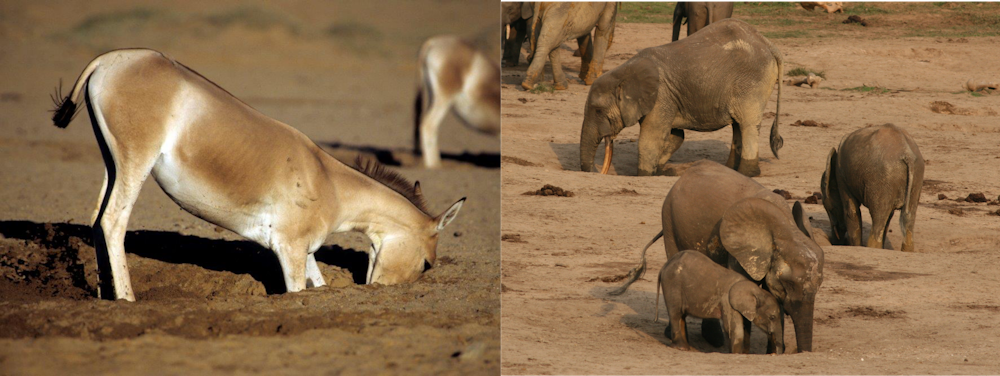 Other megafauna dig wells, too, including kulans in central Asia, and African elephants.
Petra Kaczensky, Richard Ruggiero
Other megafauna dig wells, too, including kulans in central Asia, and African elephants.
Petra Kaczensky, Richard Ruggiero
Digging wells has ancient origins
These declines are the modern continuation of an ancient pattern visible since humans left Africa during the late Pleistocene, beginning around 100,000 years ago. As our ancestors stepped foot on new lands, the largest animals disappeared, most likely from human hunting, with contributions from climate change.
Read more: Giant marsupials once migrated across an Australian Ice Age landscape
If their modern relatives dig wells, we presume many of these extinct megafauna may have also dug wells. In Australia, for example, a pair of common wombats were recently documented digging a 4m-deep well, which was used by numerous species, such as wallabies, emus, goannas and various birds, during a severe drought. This means ancient giant wombats (Phascolonus gigas) may have dug wells across the arid interior, too.
Likewise, a diversity of equids and elephant-like proboscideans that once roamed other parts of world, may have dug wells like their surviving relatives.
Indeed, these animals have left riddles in the soils of the Earth, such as the preserved remnants of a 13,500-year-old, 2m-deep well in western North America, perhaps dug by a mammoth during an ancient drought, as a 2012 research paper proposes.
Read more: From feral camels to 'cocaine hippos', large animals are rewilding the world
Acting like long-lost megafauna
Feral equids are resurrecting this ancient way of life. While donkeys and horses were introduced to places like Australia, it’s clear they hold some curious resemblances to some of its great lost beasts.
Our previous research published in PNAS showed introduced megafauna actually make Australia overall more functionally similar to the ancient past, prior to widespread human-caused extinctions.
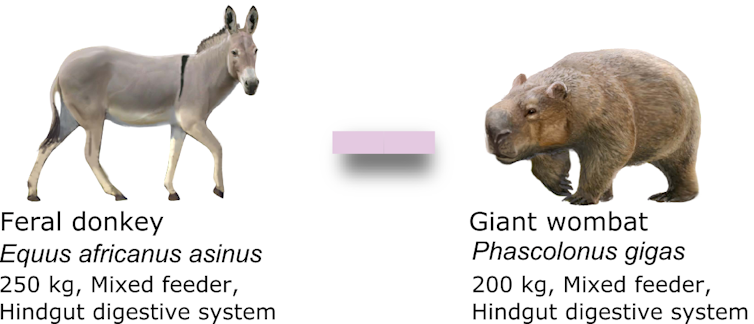 Donkeys share many similar traits with extinct giant wombats, who once may have dug wells in Australian drylands.
Illustration by Oscar Sanisidro
Donkeys share many similar traits with extinct giant wombats, who once may have dug wells in Australian drylands.
Illustration by Oscar Sanisidro
For example, donkeys and feral horses have trait combinations (including diet, body mass, and digestive systems) that mirror those of the giant wombat. This suggests — in addition to potentially restoring well-digging capacities to arid Australia — they may also influence vegetation in similar ways.
Water is a limited resource, made even scarcer by farming, mining, climate change, and other human activities. With deserts predicted to spread, feral animals may provide unexpected gifts of life in drying lands.
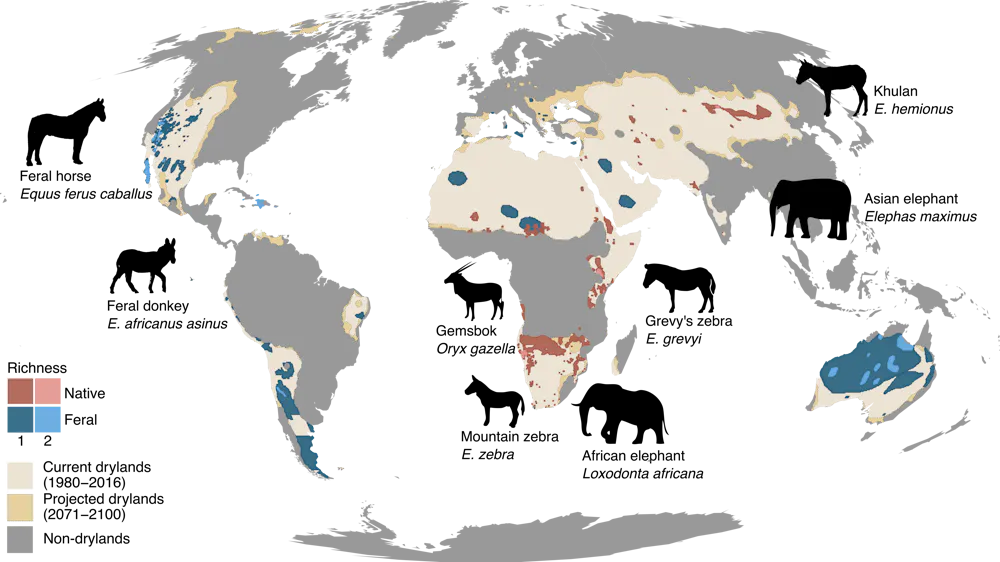 Feral donkeys, horses (mapped in blue), and other existing megafauna (mapped in red) may restore digging capacities to many drylands. Non-dryland areas are mapped in grey, and the projected expansion of drylands from climate change in yellow.
Erick Lundgren/Science, Author provided
Feral donkeys, horses (mapped in blue), and other existing megafauna (mapped in red) may restore digging capacities to many drylands. Non-dryland areas are mapped in grey, and the projected expansion of drylands from climate change in yellow.
Erick Lundgren/Science, Author provided
Despite these ecological benefits in desert environments, feral animals have long been denied the care, curiosity and respect native species deservedly receive. Instead, these animals are targeted by culling programs for conservation and the meat industry.
However, there are signs of change. New fields such as compassionate conservation and multispecies justice are expanding conservation’s moral world, and challenging the idea that only native species matter.
Authors: Erick Lundgren, PhD Student, Centre for Compassionate Conservation, University of Technology Sydney


















