

We may never achieve long-term global herd immunity for COVID. But if we're all vaccinated, we'll be safe from the worst
- Written by: Gideon Meyerowitz-Katz, PhD Student/Epidemiologist, University of Wollongong
In early 2020, during the first thrashes of the pandemic, we were all talking about herd immunity.
At that stage, many commentators were arguing we should let COVID-19 rip through populations so we could get enough people immune to the virus that it would stop spreading. As I argued at the time, this was a terrible idea that would overwhelm hospitals and gravely sicken and kill many people.
Now we have safe and effective vaccines, we can aim to reach herd immunity in a much safer way. It’s certainly possible we’ll be able to reach and maintain local herd immunity in certain regions, states and countries. However the pandemic ends, it will involve this immunity to some extent.
But it’s still very uncertain whether long-term, global herd immunity is achievable. It’s quite likely the coronavirus could continue to spread even in places with high proportions of their populations vaccinated. It will probably never be eliminated.
However, if we’re all vaccinated, we’ll be largely safe from the worst ravages of the infection even if it does break out.
What is herd immunity again? And what does it mean for us long-term?
There are a few different definitions of herd immunity. Nevertheless, they all deal with the “reproductive number” of a disease, known as the R number. This is the average number of people an infected person will pass a disease on to, at a certain point in time.
Read more: What is herd immunity and how many people need to be vaccinated to protect a community?
The R number depends on how infectious a disease is. Measles is often used as an example, because it’s one of the most infectious diseases. In a group of people among whom no one is immune to the disease, on average one person will pass measles on to around 15 others.
But as more people in the community become immune, either through vaccination or getting the disease and recovering, each infected person will pass on the infection to fewer and fewer others. Eventually, we reach a point at which the R number is below 1, and the disease starts to die out. The R number falling below 1 here is in a population where there are no social restrictions, so the disease starts to die out because of immunity and not because of measures like lockdowns. This is one definition of herd immunity.
However, another potential definition is that herd immunity is a state where enough people are immune in a population that a disease won’t spread at all. One of the more confusing parts of the pandemic is we scientists haven’t always used the same definition across the board.
For example, when we say “reached the herd immunity threshold”, we could be talking about a transient state where we’re likely to see another epidemic in the near future, or a situation where the vast majority of a population is immune and thus the disease won’t spread at all. Both are technically “herd immunity”, but they’re very different ideas.
How’s herd immunity calculated?
COVID-19 has an R number somewhere between 2 and 4 in groups of people where no one is immune. Using a simple mathematical formula, 50-75% of people need to be immune to COVID-19 for the R number to fall below 1 so it starts to die out, in a population with no social restrictions. Some researchers have done more complex versions of this calculation throughout the pandemic, but that’s the basic idea behind them all.
However, herd immunity is a moving target. For example, if everyone in your local population is taking great care to socially distance, COVID-19 won’t spread as much. Therefore, in practice, different cultures spread diseases to different extents, so the R number varies in both place and time.
Vaccines are the ultimate path to long-term immunity
Vaccines give us immunity against diseases, often to a greater extent than contracting the disease itself, and without the nasty consequences of being sick.
Our COVID-19 vaccines are safe and effective. Without going too much into the debate over which one is better, they are all capable of getting us to a point at which the disease would no longer spread through the community. For some vaccines, the percentage of people who we need to immunise is higher. But it’s the same basic idea regardless, and we need to vaccinate as many people as we can to have a shot at herd immunity.
We can already see this happening in some places. For example, in the United Kingdom and Israel, enough people have been vaccinated that even though restrictions are being relaxed, infection rates are staying low or continuing to drop. This is a beautiful sight.
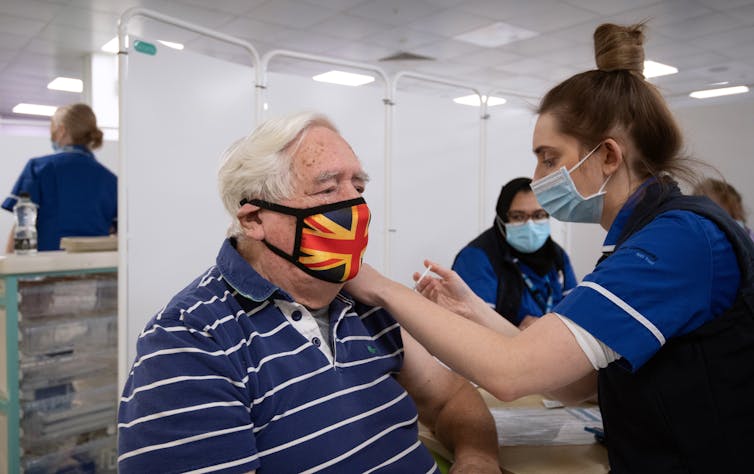 There are parts of the world where COVID-19 vaccines are already having a big impact on transmission.
Joe Giddens/POOL/EPA/AAP
There are parts of the world where COVID-19 vaccines are already having a big impact on transmission.
Joe Giddens/POOL/EPA/AAP
The coronavirus will probably never be eliminated
Even with great vaccines, the problem is complex. There are almost always communities who aren’t immunised, for various reasons, even in countries with large proportions of the total population vaccinated. These small communities can continue to get sick and spread the disease long after the general population has passed the herd immunity line, which means there may always be some risk of COVID-19 outbreaks.
On top of this, new variants of the virus have emerged. Our current vaccines are probably enough to provide most people with immunity to the original strain in the long term. But several variants may substantially reduce our vaccines’ effectiveness as time goes by, so we may need boosters at some point.
What’s more, the global situation isn’t rosy. India and Brazil are currently experiencing horrifying COVID-19 outbreaks. The global case count continues to rise, partially because developed nations have hoarded vaccine doses jealously, despite this being a terrible approach to a pandemic. Rising case numbers anywhere increase the chances even more variants pop up, thereby impacting us all.
Even if we overcome vaccine hesitancy and global inaction, and we immunise most of the world, we may not be protected against the virus forever. Even higher-income nations may never get rid of COVID-19.
It’s quite likely this virus will never be eradicated (eliminated from every country across the globe). There may be places where the disease is gone, where local campaigns are successful, but there’ll also be places where the disease is still spreading.
Read more: COVID-19 will probably become endemic – here's what that means
What does this mean for Australia?
This presents a challenge for Australia. We have virtually no local COVID-19 transmission, so there’s no real risk from the virus as long as our border controls hold steady.
However, we probably can’t maintain this level of vigilance forever. And even with our very effective vaccines, we may not have long-term herd immunity — of any definition — to COVID-19.
At some point in the future, it’s likely we will see some cases of COVID-19 spreading in even the safest places in the world, including Australia.
Even so, getting vaccinated enormously reduces your risk of severe outcomes like hospitalisation and death. We should aim to vaccinate as many people as possible, while acknowledging that the future is inherently uncertain, and herd immunity is a challenging goal.
Authors: Gideon Meyerowitz-Katz, PhD Student/Epidemiologist, University of Wollongong


















