

motherhood across the animal kingdom
- Written by Oliver Griffith, Lecturer, Macquarie University
With Mother’s Day around the corner, it’s a good opportunity to ask what being a mother looks like across the animal kingdom. Most of us have a solid concept of human motherhood, but in nature maternal care comes in many forms.
Let’s take a closer look at the diversity of ways animals provide care, to give young the best chance of success.
The power of the placenta
For many species, life begins in the womb. One of the most significant ways mothers support their young before birth is via a placenta, the temporary organ that grows inside the uterus to support a fetus. Placentas not only act as the interface between mother and baby, but can provide all fetal nutrition, allow for exchange of oxygen and carbon dioxide with the mother, and even remove the fetus’s waste.
Read more: Using the placenta to understand how complex organs evolve
While our close relatives (eutherian or placental mammals) are known for having a placenta, we are not unique in having one. In fact, the placenta has evolved more than 100 times independently in the animal kingdom!
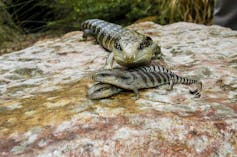 Blue-tongued lizard with her newborn young.
National Parks and Wildlife Service, South Australia
Blue-tongued lizard with her newborn young.
National Parks and Wildlife Service, South Australia
Other placental species include some reptiles such as the blue-tongued lizard, and many sharks including the Australian sharpnose. Even marsupials have a placenta, although it typically only supports young for a few days.
Marsupial mothers
Outside the womb, the queens of maternal care are marsupials such as kangaroos, koalas and Tasmanian devils. Marsupial mothers provide food and protection from predators through a prolonged period of lactation inside the pouch.
In marsupials, pregnancy is relatively short but young spend a long time in the pouch afterwards. For example, tammar wallabies’ pregnancy can be as short as four weeks, but mothers can provide milk to their young in the pouch for almost a year. During this time the babies increase in weight 2,000-fold. In comparison, human infants increase in weight threefold during their first year of life.
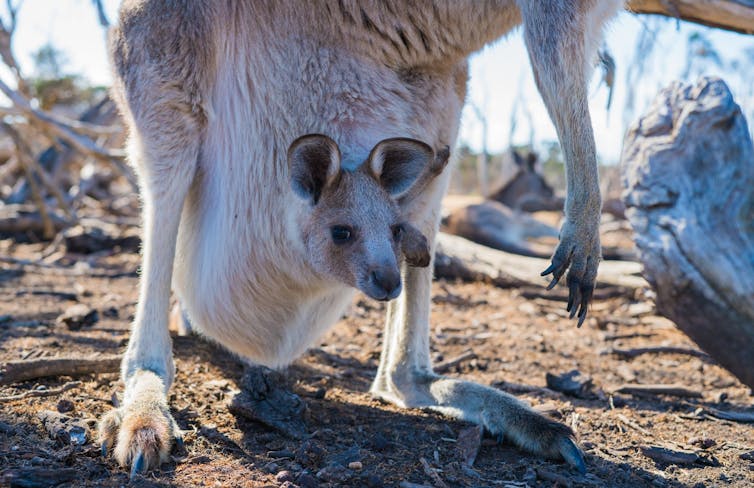 A kangaroo mother, looking after her joey in the pouch.
Ethan Brooke/www.pexels.com
A kangaroo mother, looking after her joey in the pouch.
Ethan Brooke/www.pexels.com
Egg-layers
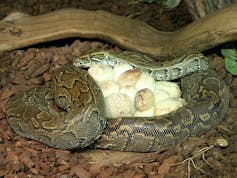 An African rock python, looking after her eggs. Python mothers will coil around their eggs while they incubate, and can even shiver to keep the eggs warm.
J. Lanki/wikimedia
An African rock python, looking after her eggs. Python mothers will coil around their eggs while they incubate, and can even shiver to keep the eggs warm.
J. Lanki/wikimedia
In contrast to animals that develop a placenta, egg-laying animals typically lay nutrient-rich eggs to support development. Parents of some species consider their job done after the eggs are laid, but others continue to care for their young by protecting the eggs and providing food once the babies hatch.
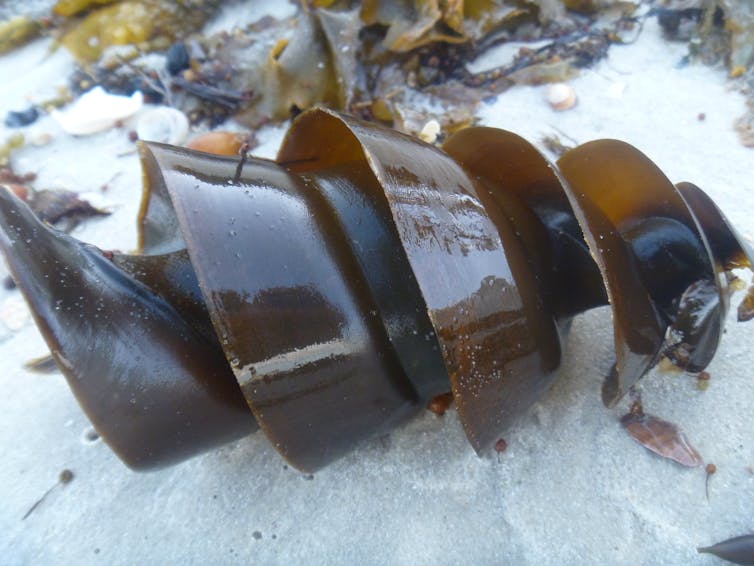 A Port Jackson Shark egg. After laying eggs, mothers carry them in their mouth and screw them into a secure rock crevice, hoping they will be protected for their 10-12 months of development.
Kate Bunker/flickr
A Port Jackson Shark egg. After laying eggs, mothers carry them in their mouth and screw them into a secure rock crevice, hoping they will be protected for their 10-12 months of development.
Kate Bunker/flickr
Some egg-laying sharks continue to provide care after birth. Port Jackson sharks carry their eggs in their mouths until they find a protected rock crevice to hide them in.
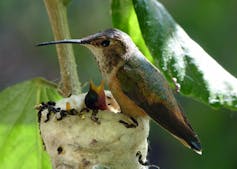 Hummingbird mothers look after their young without any paternal support.
Mike's Birds
Hummingbird mothers look after their young without any paternal support.
Mike's Birds
In birds, mothers provide warmth and protection while incubating their eggs. In some bird species such as hummingbirds, only the mother provides care after birth. However, in other cases, such as penguins, it’s a team effort with mothers and fathers providing food and protection to their offspring.
For some, it takes a village
For some animals, motherhood extends beyond looking after your own children. Like humans, orcas (killer whales) forgo the potential to reproduce later in life by going through menopause.
Menopause may prevent them from raising any more children, but it allows them to divert their efforts to raising the next generation by looking after their grandchildren.
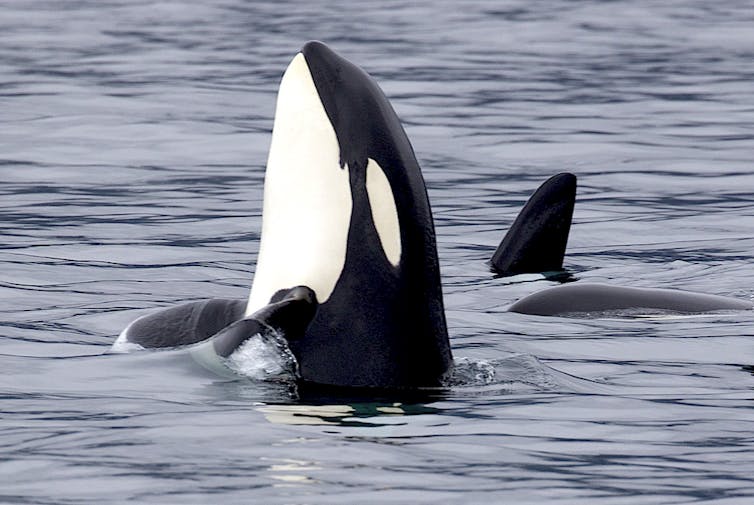 Orcas and a few of their close relatives (including beluga whales and narwhals) are one of the few non-human mammals that forgo reproduction later in life and enter menopause. This allows mothers to continue to support the next generation by looking after their grandchildren.
Gregory 'Slobirdr' Smith/flickr
Orcas and a few of their close relatives (including beluga whales and narwhals) are one of the few non-human mammals that forgo reproduction later in life and enter menopause. This allows mothers to continue to support the next generation by looking after their grandchildren.
Gregory 'Slobirdr' Smith/flickr
Many animals need even more support, so some species form societies where the whole community will care for the young, rather than just the parents. Meerkats live in groups of up to 30 individuals where parental duties are shared.
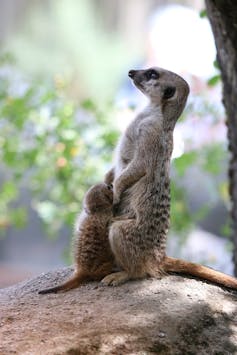 Meerkat mother keeping an eye out for predators with one of her pups.
Theo Stikkelman
Meerkat mother keeping an eye out for predators with one of her pups.
Theo Stikkelman
Younger females will “babysit” the pups while the rest of the mob forage for food, sometimes having to put their own lives in danger to protect the younger members of the group.
Within elephant herds, the mothers provide milk for their babies but other members of the herd (known as doulas, they can be either male or female) provide encouragement and physical support to both the mother and the growing calves. This same behaviour is seen in dolphins, as well as in several primates including chimpanzees and gorillas.
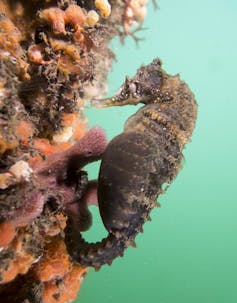 Pregnant male Hippocampus whitei. Seahorse fathers experience male pregnancy, providing nutrition, gas exchange and protection to developing embryos within his pouch.
Marine Explorer
Pregnant male Hippocampus whitei. Seahorse fathers experience male pregnancy, providing nutrition, gas exchange and protection to developing embryos within his pouch.
Marine Explorer
In a few species, it is the father that provides the most care for offspring. For example, seahorses exhibit male pregnancy, providing nutrition and protection from predators while inside his pouch. For a seahorse mother, her care responsibilities end once she has deposited her eggs into the male’s pouch.
If we can learn anything from the animal kingdom, it’s that motherhood comes in many forms.
Authors: Oliver Griffith, Lecturer, Macquarie University

















