

How can the world help India — and where does that help need to go?
- Written by Dileep Mavalankar, Vice President western region, Public Health Foundation of India
India is in the grip of an unprecedented second wave of COVID-19.
Official data suggests new cases have crossed 400,000 per day, and the daily death count is around 4,200. But the actual numbers may be significantly higher.
We know the hospital system is stretched beyond its limits and there are dire shortages in the country’s expanded vaccine drive.
Clearly, India is in need of help from beyond its borders. What can other countries do?
Help already pledged
In this moment of crisis, the international community has already stepped in to provide some help.
Several countries including the United States, United Kingdom, United Arab Emirates, Russia, Germany, and France have already sent aid such as oxygen and related equipment, ventilators, medicines and ICU equipment. The US has also said it will provide vaccine help, and critical drugs.
Australia has announced it will send ventilators, surgical masks and other personal protective equipment.
How should this help be used?
This aid is all critical. But given the size of India’s population — almost 1.4 billion — more will be needed and even this will not be enough.
Given this, we need to make best use of the incoming aid. India needs to conduct a quick national and state-level needs assessment exercise. Where is help most needed? And where can it be most useful?
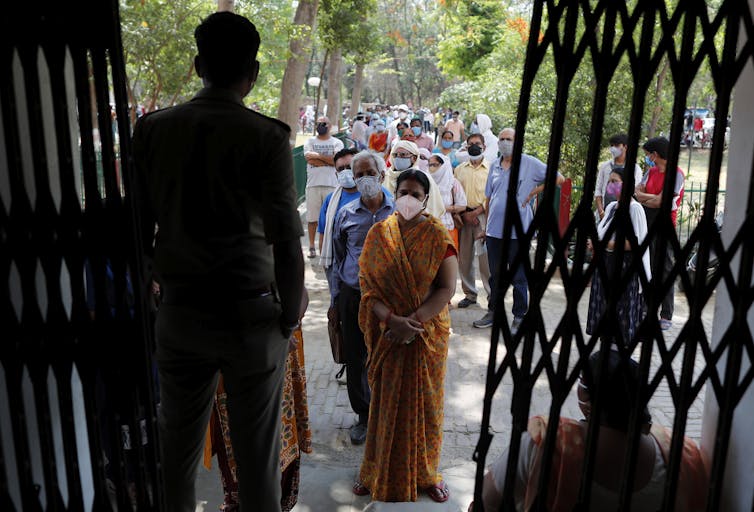 India’s vaccine program has begun but has been hit by shortages.
Rajesh Kumar Singh/AP/AAP
India’s vaccine program has begun but has been hit by shortages.
Rajesh Kumar Singh/AP/AAP
This should include an assessment of capacities for care and utilisation by each major city and rural area. For instance, there’s a need to evaluate diagnostic and testing capacities and their distribution across the country. An important measure missing at this point is high capacity testing systems which can help increase testing.
The review would also help answer: what are the strengths of the private and NGO sectors and how can they be harnessed? Where exactly are the most vulnerable, and how best can we reach them? Such a review would also help in ensuring that sophisticated machines such as ventilators are not sent to places where they cannot be operated or maintained.
At the same time, there’s a need to look for available internal funds and services that can strengthen India’s efforts.
The importance of vaccines
Given the emerging shortage of vaccines, they will, of course, be the most helpful gift in the long run. Many countries have booked more than they need. Such excess vaccine doses can be offered to India, as it will need millions of doses of imported vaccine to cover its population rapidly.
Besides the very visible gaps in emergency and critical care — such as oxygen and ventilators — technical expertise in epidemiology, biostatistics, data sciences and modelling as well as diagnostic technology would be very useful.
Read more: COVID crisis in India: why its public health strategy failed
We need help in conducting expert analysis of the situation, prediction modelling by each state and city, and assistance on how to improve systems to record and analyse the huge amount of data that is streaming in.
Sharing knowledge and collaboration in areas such as understanding mutations via gene sequencing, identification of variants of concern, and studying their virulence and transmissibility will also help.
Such efforts are intangible and would fall in the realm of “knowledge aid”, and hence, governments may not be keen to prioritise this. But foreign support could also come in the form of specific funds and grants.
Help must come with no strings attached
In this process, the countries offering the support should not put any conditions or delay the process. Immediate assistance is needed as the peak of the current wave seems to be only a few weeks away.
This support should reach where the most vulnerable get COVID services: public hospitals, healthcare centres run by non-government organisations, and community COVID care centers. The technical help in epidemiology and data sciences should be given to state health departments and major research centres located in cities.
Most importantly, foreign support should strengthen the health system and not be a burden on it.
Only if we are in it together, can we all hope to defeat the virus.
Authors: Dileep Mavalankar, Vice President western region, Public Health Foundation of India
Read more https://theconversation.com/how-can-the-world-help-india-and-where-does-that-help-need-to-go-160174

















