

Two experts on how much the $1.1 billion for women's safety can achieve
- Written by Kate Fitz-Gibbon, Director, Monash Gender and Family Violence Prevention Centre; Associate Professor of Criminology, Faculty of Arts, Monash University
One of the headline figures in Tuesday’s federal budget was a A$1.1 billion dollar investment in women’s safety.
This came as part of a special women’s budget statement, which pitched the budget as helping provide women with “respect, dignity, choice, equality of opportunity and justice”.
It also comes amid a national crisis in domestic violence. On average, one woman is killed every week in Australia by a male current or former partner.
So does the budget deliver on its promise to prioritise women’s safety and equality at home and at work? Does it do enough?
How does this compare with other investments?
By way of comparison, the federal government announced a $150 million package for domestic and family violence support as part of the COVID response in March last year. The headline figure on Tuesday night is a marked increase on this.
The budget papers note violence against women is estimated to cost Australia $26 billion annually. In part, this reflects the major health impacts of violence against women, with victim survivors at an increased risk of chronic illness, pain, and reproductive health problems.
 The budget featured a separate women’s statement this year.
Mick Tsikas/AAP
The budget featured a separate women’s statement this year.
Mick Tsikas/AAP
When compared to state and territory level contributions, it is also worth noting that since the 2015 Victorian Royal Commission into Family Violence, the state government has committed more than $3 billion to reform responses to and the prevention of family violence.
The comparison is useful to demonstrate what level of funding may be needed to support whole-of-system change.
The promising news
There are some noteworthy new initiatives included in the budget papers.
The government has announced $31.6 million over five years for a new Aboriginal and Torres Strait Islander personal safety survey. This is an important commitment and a first step towards truly understanding the prevalence of domestic, family and sexual violence in Indigenous communities. We cannot address what we do not know.
The survey must capture data in a culturally safe and sensitive way. It must lead to meaningful knowledge and community-controlled solutions. These must be adequately funded by governments and actually meet the needs of local communities.
The budget also funds the establishment of a new national women’s alliance for women with disability, to start work in June this year.
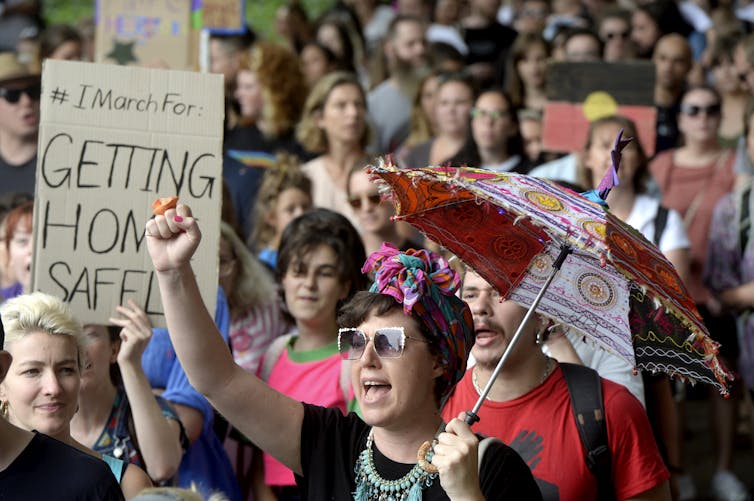 There has been growing pressure on the federal government to do more to prevent violence against women.
Jeremy Piper/AAP
There has been growing pressure on the federal government to do more to prevent violence against women.
Jeremy Piper/AAP
Women with disability are at greater risk of family, domestic and sexual violence and experience heightened barriers to reporting and seeking help. Approximately 20% of Australian women live with disability. Further, about two in five workers with disability in Australia report they have been sexually harassed in the past five years.
The alliance is a significant acknowledgement of the need to ensure the voices of women with disability are heard and inform the development of policy and practice.
Other aspects of the budget include $164.8 million in financial support for women who escape domestic violence and an extra $12.6 million for crisis accommodation. While this is a start, we note peak bodies have already signalled concerns around the inadequacy of funds for safe and affordable housing.
The disappointing news
The budget reflects a long-held tradition of failing to meaningfully invest in some critical areas. These include children as victims of domestic and family violence in their own right, working with men to change behaviours and working with First Nations communities and community leaders.
Children continue to be seen as an extension of their parents’ needs. Without child-centred responses to domestic and family violence, intergenerational transmission of this national public health issue will continue.
Read more: How intimate partner violence affects children’s health
Similarly, $35 million for primary prevention — with most focused on changing public attitudes and only partly focused on education for children and young people — is an under-investment in strategies that have the capacity to help reduce violence.
Further, a mere $9 million for perpetrator-focused responses is also a notable under-investment. While we acknowledge some of this work is funded by the states, more federal investment is needed to support a wide range of evidence-based interventions.
Lastly, we note the $26 million investment in Family Violence Prevention Legal Services to improve support services for First Nations women. This fails acknowledge the need for a national, culturally sensitive approach to domestic and family violence that addresses the lasting effects of colonisation on First Nations women, men and children.
Our verdict: is it enough?
The women’s budget statement describes the government’s commitment to reducing and preventing all forms of domestic, family and sexual violence as “steadfast”.
Our assessment is the 2021 budget is an improvement on previous years, but it does not yet reflect the level of investment so desperately needed to address, interrupt and ultimately prevent what is a national crisis.
Tackling this national emergency will require transformational leadership and unprecedented funding. This budget is a step forward for this government, but it falls short of promising the change we need.
While we recognise funding is only part of the picture, it is nevertheless an essential part. The budget was an opportunity for the Morrison government to demonstrate — in measurable ways — its commitment to do what’s required to ensure women’s equality at home, in public, at work and online.
Authors: Kate Fitz-Gibbon, Director, Monash Gender and Family Violence Prevention Centre; Associate Professor of Criminology, Faculty of Arts, Monash University

















