

climate change is a clear and present danger to Australia's security
- Written by: Matt McDonald, Associate Professor of International Relations, The University of Queensland
The Senate Committee on Foreign Affairs, Defence and Trade yesterday presented its report on the national security implications of climate change.
The report makes several findings and recommendations, noting at the outset that climate change has a range of important security implications, both domestically and internationally.
Tellingly, none of the expert submissions questioned the rationale for this inquiry, nor the claim that climate change challenges Australian national security.
Read more: US military strategists warn that climate is a 'catalyst for conflict'
The report concludes that:
the consensus from the evidence (is) that climate change is exacerbating threats and risks to Australia’s national security.
Significantly, it also notes that climate change threatens both state and human security in the Australian context. Here are some of the key security implications.
Sea-level rises and natural disasters are key challenges
The report emphasises the risks posed by rising sea levels and an increase in the frequency and intensity of environmental stress (droughts and floods, for example) and natural disasters such as cyclones. In turn, it notes that these could trigger population movements, with people displaced by extreme weather events or rising seas.
This, the report argues, would have significant implications for the Australian Defence Force (ADF). Humanitarian assistance and disaster relief missions involving the ADF have increased significantly in Australia and our region in recent years. The report predicts that the ADF will face even more pressure to carry out this type of mission in the future.
In its submission, the Department of Defence pointed out that the ADF was not established to provide these roles. The report recommends the creation of a senior leadership position within Defence to plan and manage disaster relief missions both here and abroad.
Australia, and its backyard, are particularly vulnerable
The report notes that Australia and its region are particularly vulnerable to the impacts of climate change.
Australia’s population is largely clustered in coastal areas, and this is also true of the Asian region generally and the Pacific specifically. Pacific island nations – as low-lying and with limited resources for implementing adaptive measures – are acutely vulnerable to sea-level rises. In the Asian region 40 million people were displaced by natural disasters in 2010-11 alone.
The report argues that Australia’s obligation to its neighbours in the region, acknowledged in recent statements on the Pacific, will create significant pressure on Australia and its defence force to manage the implications of climate change. It recommends sending even more aid to the Pacific region to help build climate resilience.
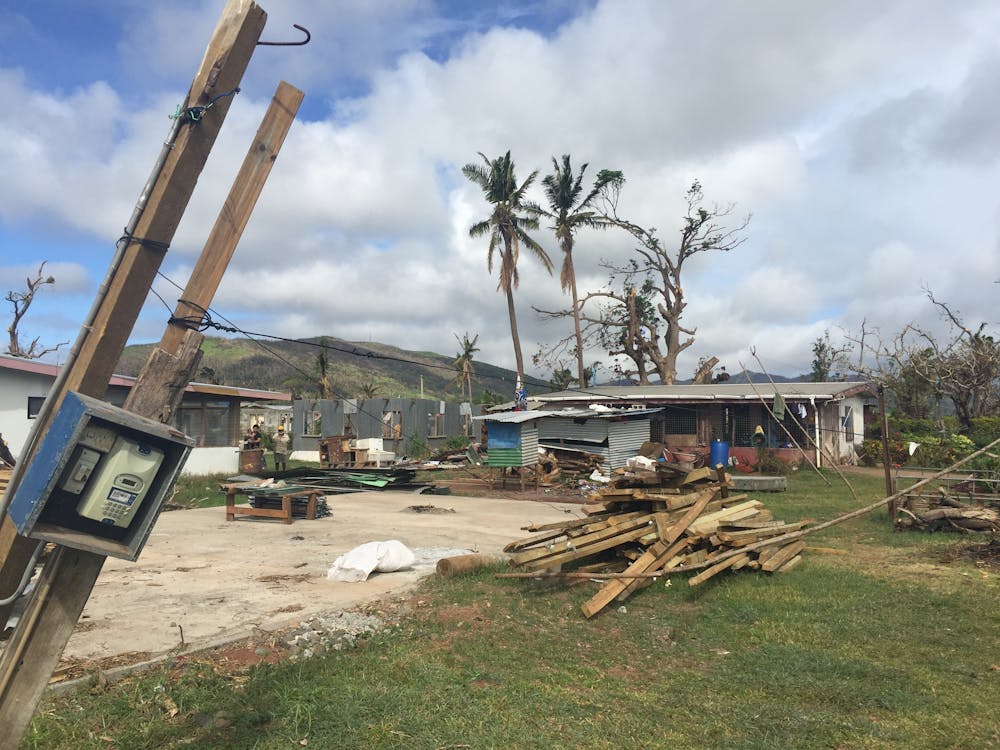 Fiji, which was hit by Cyclone Winston in 2016, is one of our vulnerable Pacific neighbours.
Pashida Yosufzai/AAP
Fiji, which was hit by Cyclone Winston in 2016, is one of our vulnerable Pacific neighbours.
Pashida Yosufzai/AAP
Defence needs to plan ahead
While the report acknowledges Defence efforts, a key finding is the urgent need for Defence to plan for a climate-affected world.
Future deployments associated with disaster relief and population movement, for example, will require urgent Defence planning to ensure personnel have the right training, resources and equipment. Australia’s forces will need to be trained and equipped for the likely ever-increasing number of humanitarian assistance and disaster relief missions in particular.
The report notes that Defence acquisition will need to account for temperature rises in future decades. This includes ensuring that equipment is fit for purpose in the long term. It will need to be able to withstand higher temperatures and potentially to run on different types of fuel.
The committee also recommends that Defence establish its own emissions reduction targets regarding energy use.
While more mundane, the management of existing infrastructure and real estate in the context of climate change, already the subject of Defence assessments, is also crucial. Defence is Australia’s largest land owner, and much of its infrastructure and resources will be exposed to higher temperatures and sea levels. The report recommends that Defence release existing risk assessments of assets’ exposure to climate change.
Read more: Defence white paper shows Australian forces must safeguard nature too
The issue cuts right across the government
While many of the recommendations are specifically for the Department of Defence, a core theme of the report is the need for a “whole of government” response. Besides adapting to climate change, the government needs to take action to limit the extent of the problem in the first place. This means that all departments, all levels of government, and society as a whole need to work together to reduce greenhouse gas emissions. The need to commit to mitigation efforts is a surprising, but welcome, finding of the consensus report.
As the report points out, to deal with future disruption both here and abroad, Australia will need to build resilient societies that can adapt to change. This poses challenges to urban planning, aid programs and health services as much as to Defence.
The report makes several recommendations aimed at fostering this type of across-the-board response from the government. Among these are the development of a Climate Security White Paper and the creation of a Climate Security role within the Home Affairs portfolio to oversee domestic responses to climate change. In both cases, these are responses to suggestions in expert submissions that existing measures and responses were partial and uncoordinated.
What does all this mean?
Potentially, not much. Recommendations of Senate inquiries are just that, and governments have the right to politely ignore or dismiss them. This is more likely to happen to reports proposed by the opposition or, as in this case, by the Greens.
When the inquiry was announced in mid-2017, the government described it as unnecessary. In its response to the report, Coalition senators generally indicated that they felt existing arrangements were sufficient.
Read more: Climate change and security: a wake-up call for Australia
It is nevertheless telling that Australia’s Defence establishment – on the face of it a bastion of conservatism – is worried about climate change. In my conversations with Defence officials, two things are apparent.
First, they are increasingly aware of the need to plan ahead to meet the challenges of climate change, including many of those noted above. This reflects the fact that Defence is an area in which long-term planning and threat assessment have always been central.
Second, they are also acutely aware of the toxic politics of climate change in Australia. Given its recent history, even those in Defence who are most convinced of the need to act are concerned about putting their heads above the parapet, so to speak.
Viewed in this light, it may be that these recommendations – in a consensus report, arising from a Senate inquiry and based on expert advice – provide just the basis for mainstreaming climate consciousness into defence and security planning. In the process, it is possible it’s just this sort of intervention that encourages changes in public debate and broader climate policy orientations. In Australia’s rancorous history of climate politics, stranger things have happened.
Authors: Matt McDonald, Associate Professor of International Relations, The University of Queensland


















