

a Cold War-era uranium mine that’s spewed acid into the environment for decades
- Written by Gavin Mudd, Associate Professor of Environmental Engineering, RMIT University
Buried in last week’s budget was money for rehabilitating the Rum Jungle uranium mine near Darwin. The exact sum was not disclosed.
Rum Jungle used to be a household name. It was Australia’s first large-scale uranium mine and supplied the US and British nuclear weapons programs during the Cold War.
Today, the mine is better known for extensively polluting the Finniss River after it closed in 1971. Despite a major rehabilitation project by the Commonwealth in the 1980s, the damage to the local environment is ongoing.
I first visited Rum Jungle in 2004, and it was a colourful mess, to say the least. Over later years, I saw it worsen. Instead of a river bed, there were salt crusts containing heavy metals and radioactive material. Pools of water were rich reds and aqua greens — hallmarks of water pollution. Healthy aquatic species were nowhere to be found, like an ecological desert.
The government’s second rehabilitation attempt is significant, as it recognises mine rehabilitation isn’t always successful, even if it appears so at first.
Rum Jungle serves as a warning: rehabilitation shouldn’t be an afterthought, but carefully planned, invested in and monitored for many, many years. Otherwise, as we’ve seen, it’ll be left up to future taxpayers to fix.
The quick and dirty history
Rum Jungle produced uranium from 1954 to 1971, roughly one-third of which was exported for nuclear weapons. The rest was stockpiled, and then eventually sold in 1994 to the US.
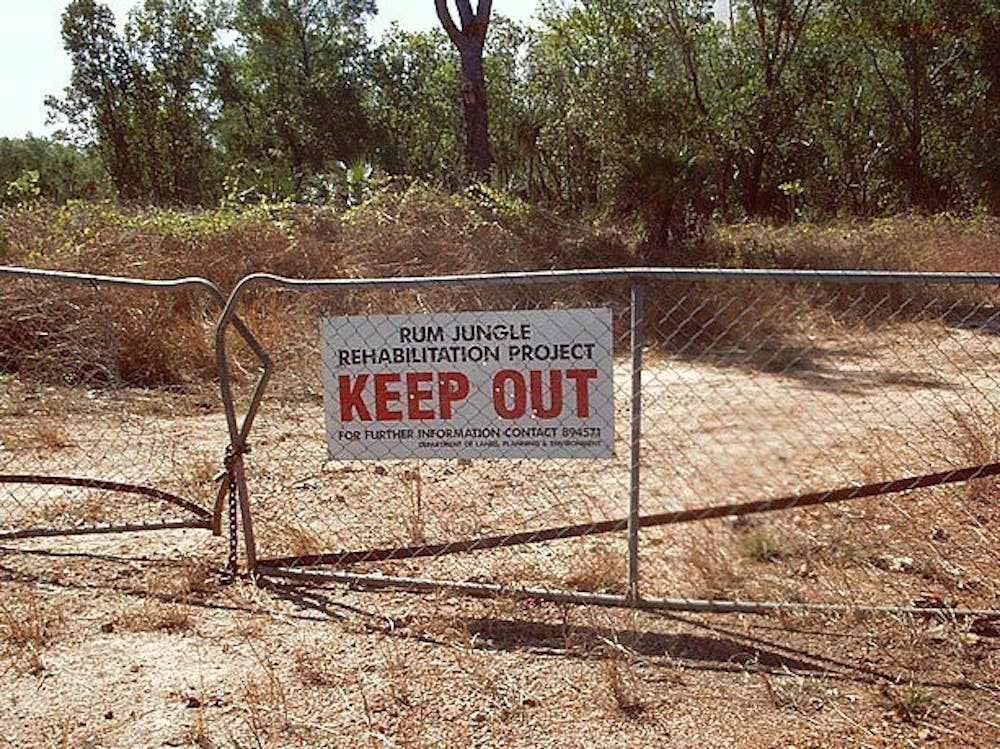 Rehabilitation of Rum Jungle began in the 1980s.
Mick Stanic/Flickr, CC BY-NC-SA
Rehabilitation of Rum Jungle began in the 1980s.
Mick Stanic/Flickr, CC BY-NC-SA
The mine was owned by the federal government, but was operated under contract by a former subsidiary of Rio Tinto. Back then, there were no meaningful environmental regulations in place for mining, especially for a military project.
The waste rock and tailings (processed ore) at Rum Jungle contains significant amounts of iron sulfide, called “pyrite”. When mining exposes the pyrite to water and oxygen, a chemical reaction occurs generating so-called “acidic mine drainage”. This drainage is rich in acid, salts, heavy metals and radioactive material (radionuclides), such as copper, zinc and uranium.
Acid drainage seeping from waste rock, plus acidic liquid waste from the process plant, caused fish and macroinvertebrates (bugs, worms, crustaceans) to die out, and riverbank vegetation to decline. By the time the mine closed in 1971, the region was a well-known ecological wasteland.
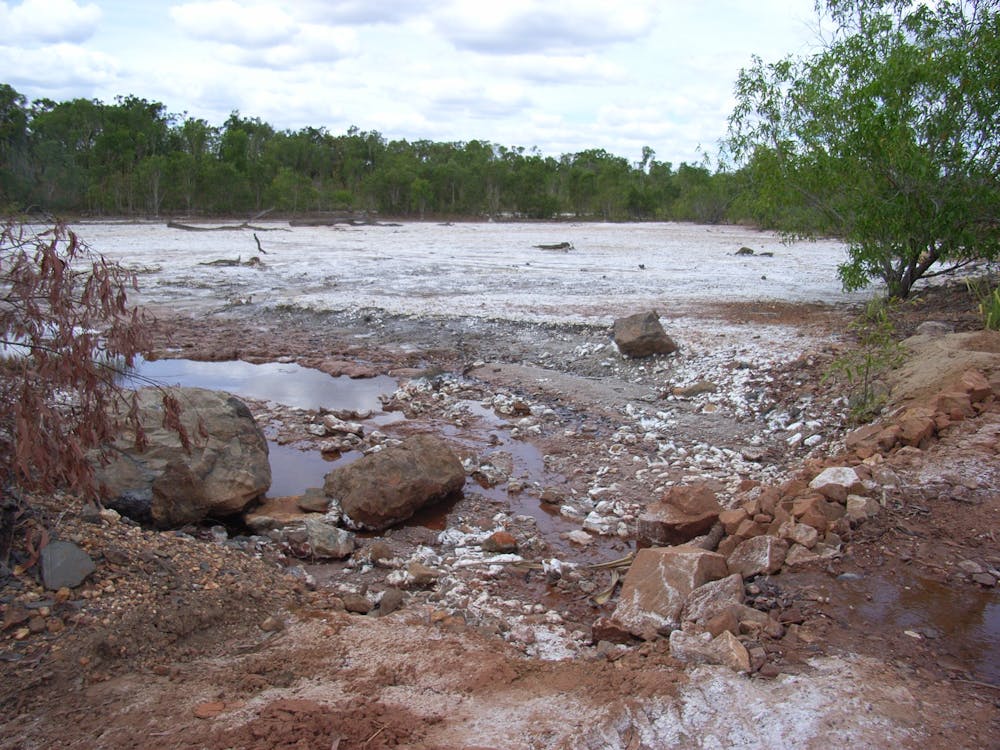 Once an ecosystem, now a wasteland.
Gavin Mudd, Author provided
Once an ecosystem, now a wasteland.
Gavin Mudd, Author provided
When mines close, the modern approach is to rehabilitate them to an acceptable condition, with the aim of minimal ongoing environmental damage. But after working in environmental engineering across Australia for 26 years, I’ve seen few mines completely rehabilitated — let alone successfully.
Many Australian mines have major problems with acid mine drainage. This includes legacy mines from historical, unregulated times (Mount Morgan, Captains Flat, Mount Lyell) and modern mines built under stricter environmental requirements (Mount Todd, Redbank, McArthur River).
This is why Rum Jungle is so important: it was one of the very few mines once thought to have been rehabilitated successfully.
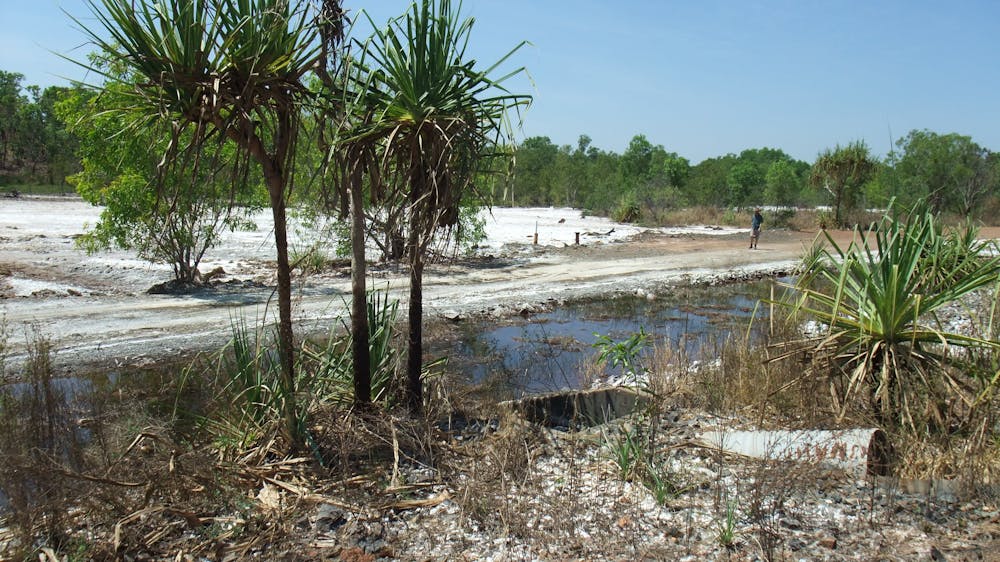 Salts litter the bed of the Finniss River.
Gavin Mudd, Author provided
Salts litter the bed of the Finniss River.
Gavin Mudd, Author provided
So what went wrong?
From 1983 to 1986, the government spent some A$18.6 million (about $55.5 million in 2020 value) to reduce acid drainage and restore the Finniss River ecology. Specially engineered soil covers were placed over the waste rock to reduce water and oxygen getting into the pyrite.
The engineering project was widely promoted as successful through conferences and academic studies, with water quality monitoring showing that the metals polluting the Finniss had substantially subsided. But this lasted only for a decade.
Read more: Expensive, dirty and dangerous: why we must fight miners' push to fast-track uranium mines
By the late 1990s, it became clear the engineered soil covers weren’t working effectively anymore.
First, the design was insufficient to reduce infiltration of water during the wet season (thicker covers should have been used). Second, the covers weren’t built to design in parts (they were thinner and with the wrong type of soils).
The first reason is understandable, we’d never done this before. But the second is not acceptable, as the thinner covers and wrong soils made it easier for water and oxygen to get into the waste rock and generate more polluting acid mine drainage.
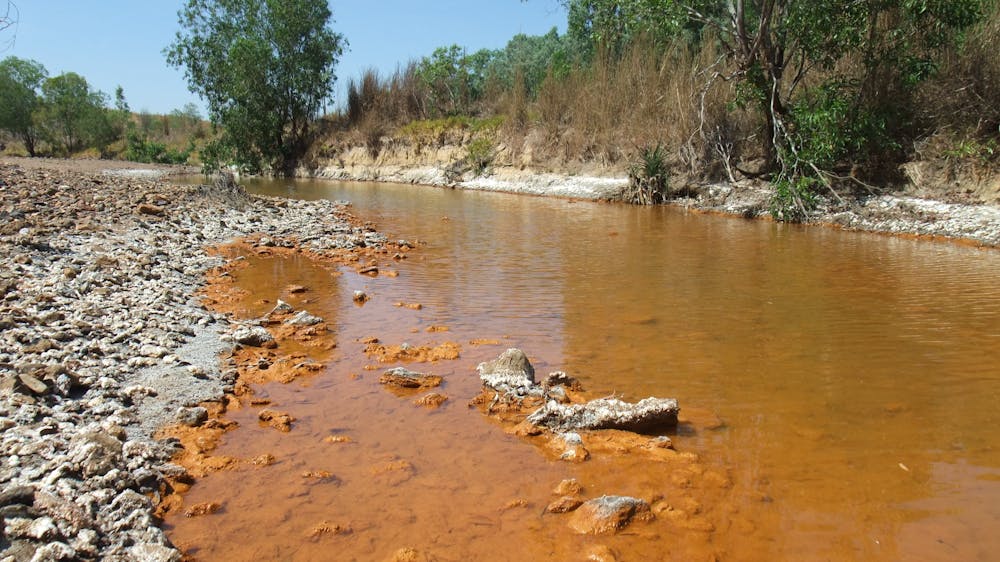 The iron-tainted red hues of the Finniss River near the waste rock dumps leaking acid mine drainage.
Gavin Mudd, Author provided
The iron-tainted red hues of the Finniss River near the waste rock dumps leaking acid mine drainage.
Gavin Mudd, Author provided
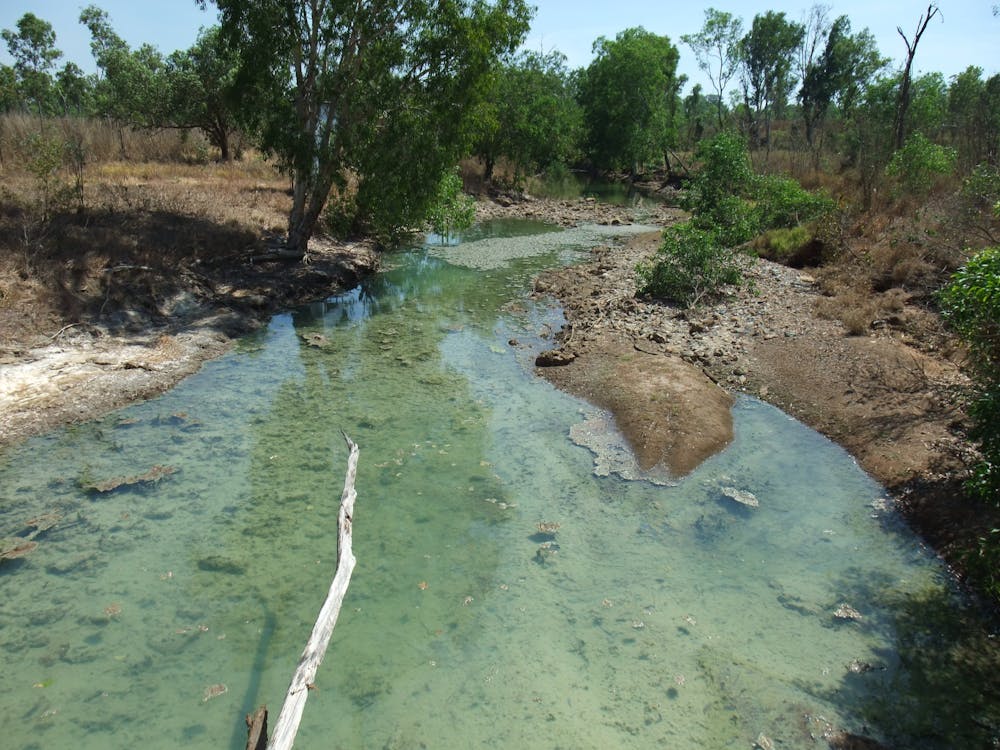 The copper-tainted green hues of the Finniss River near the waste rock dumps leaking acid mine drainage.
Gavin Mudd, Author provided
The copper-tainted green hues of the Finniss River near the waste rock dumps leaking acid mine drainage.
Gavin Mudd, Author provided
The stakes are higher
There are literally thousands of recent and still-operating mines around Australia, where acid mine drainage remains a minor or extreme risk. Other, now closed, acid drainage sites have taken decades to bring under control, such as Brukunga in South Australia, Captain’s Flat in NSW, and Agricola in Queensland.
We got it wrong with Rum Jungle, which generated less than 20 million tonnes of mine waste. Modern mines, such as Mount Whaleback in the Pilbara, now involve billions of tonnes — and we have dozens of them. Getting even a small part of modern mine rehabilitation wrong could, at worst, mean billions of tonnes of mine waste polluting for centuries.
 The federal budget did not disclose how much rehabilitation of Rum Jungle would cost taxpayers.
AAP Image/Darren England
The federal budget did not disclose how much rehabilitation of Rum Jungle would cost taxpayers.
AAP Image/Darren England
So what’s the alternative? Let’s take the former Woodcutters lead-zinc mine, which operated from 1985 to 1999, as an example.
Given its acid drainage risks, the mine’s rehabilitation involved placing reactive waste into the open pit, rather than using soil covers. “Backfilling” such wastes into pits makes good sense, as the pyrite is deeper and not exposed to oxygen, substantially reducing acid drainage risks.
Backfilling isn’t commonly used because it’s widely perceived in the industry as expensive. Clearly, we need to better assess rehabilitation costs and benefits to justify long-term options, steering clear of short-term, lowest-cost approaches.
The Woodcutters experience shows such thinking can be done to improve the chances for successfully restoring the environment.
Getting it right
The federal government funded major environmental studies of the Rum Jungle mine from 2009, including an environmental impact statement in 2020, before the commitment in this year’s federal budget.
Read more: It's not worth wiping out a species for the Yeelirrie uranium mine
The plan this time includes backfilling waste rock into the open pits, and engineering much more sophisticated soil covers. It will need to be monitored for decades.
And the cost of it? Well, that was kept confidential in the budget due to sensitive commercial negotiations.
But based on my experiences, I reckon they’d be lucky to get any change from half a billion dollars. Let’s hope we get it right this time.
Authors: Gavin Mudd, Associate Professor of Environmental Engineering, RMIT University

















