

they could make for a greener, more global contest
- Written by Jess Carniel, Senior Lecturer in Humanities, University of Southern Queensland
Last year, the Eurovision Song Contest was cancelled for the first time in its then 64-year history. This year’s Eurovision is a socially distanced affair, with frequent COVID testing of participants.
The Ahoy Arena in Rotterdam, where the contest is being held, has a capacity of 15,000 but the audience has been capped at 3,500 for each show. Interestingly, it does not look as socially distanced as expected. Shots of the crowd in the first semi-final on Tuesday (Wednesday in Australia), showed people seated side by side, with a few gaps between groups.
As a precaution, each participating country shot a “live-on-tape” performance to be used as a backup if their delegation could not travel to Rotterdam. Australia’s act Montaigne (Jess Cerro) filmed a performance of her song Technicolour in Sydney in March. SBS decided not to send a team to the contest due to travel concerns in the pandemic.
It was a slick production with an excellent vocal performance, but unfortunately, Montaigne did not make it through to the grand final. Some suggest the live-on-tape performance hindered Australia’s chances. Montaigne herself seemed to acknowledge this in a tweet where she said, “we were at a severe disadvantage”.
The performance was actually cut seamlessly into the live production; you could hear the crowd cheering while viewing Montaigne on a large screen in the arena. But while her song Techicolour had its fans, its hyperpop styling also divided casual viewers.
Read more: Eurovision shock: is ironic appreciation now unnecessary as slick singing styles reign?
All voting is split 50/50 between the jury and public. The jury voters had watched the first semi-finalists and voted the day before on a private stream. The public voted on the broadcast show. As juries watch the whole production on screen there is little difference in how they experience an in-arena performance and a live-on-tape performance anyway.
But it was always going to be a tough semi-final. Croatia had been tipped to make the qualifying ten but was also voted out.
In essence, a TV show
Thirty-nine countries are participating this year. No one has yet dropped out because of COVID-19, but some – notably Armenia and Belarus – are absent for other reasons, including political ones.
Montaigne and all other delegations filmed their live-on-tape performances in March under the watchful eye of representatives from the host broadcasters, the European Broadcasting Union, and independent voting observers. They were given one hour to film three attempts, with the best of the three to be used if necessary.
So far, Australia is the only participant to have used a taped performance. This is the first time Australia hasn’t qualified since entering the contest in 2015 (when it went straight into the grand final as a special guest). Still, Montaigne’s non-qualification should not be interpreted as an indictment of the live-on-tape model.
Although we are accustomed to seeing a large audience cheering and waving flags, this is actually a recent development at Eurovision. Before 1998, it was staged in smaller venues. An audience was present, but seated rather sedately. In the early 2000s especially, Eurovision became synonymous with larger crowds in arena stadiums, giving more of a live concert feel.
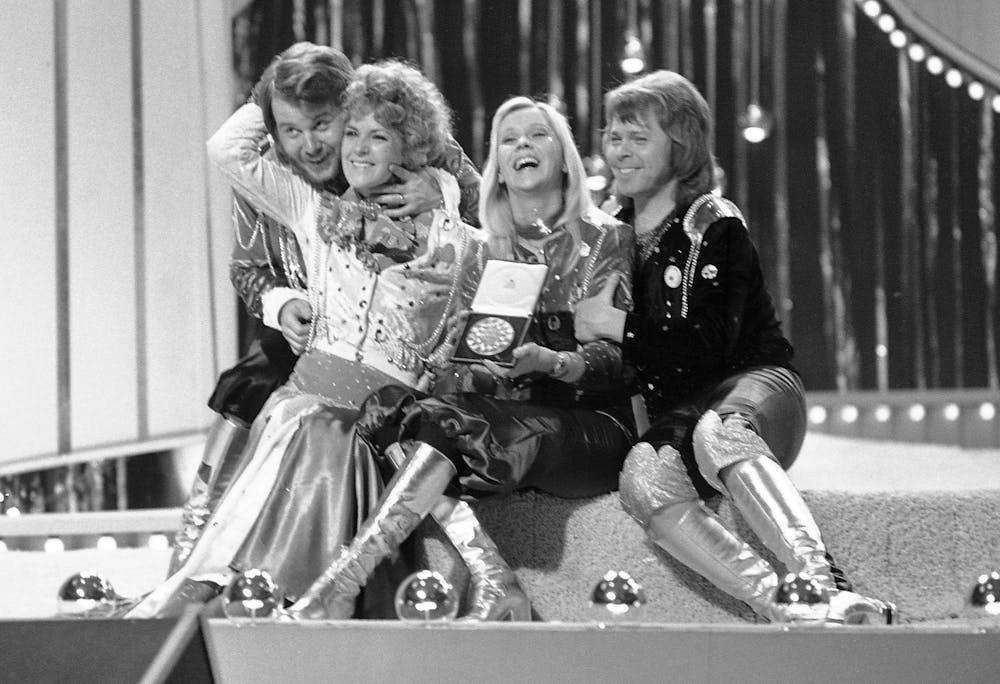 Eurovision was once performed in smaller venues. When ABBA won in 1974, the concert was held at the Brighton Dome with a capacity of 2,100.
AP Photo/Robert Dear
Eurovision was once performed in smaller venues. When ABBA won in 1974, the concert was held at the Brighton Dome with a capacity of 2,100.
AP Photo/Robert Dear
Attending the contest is a pilgrimage for fans. Still, it is in essence a television show — albeit one filmed in front of a live studio audience. The staging of several performances this year – most notably Ireland and Greece – reminded us of this through their heavy use of screen overlays of animated graphics (Ireland) and green screen (Greece).
Lesley Roy’s performance for Ireland involved intricate camera perspectives through small shadow boxes on stage as well as a screen overlay edited into the broadcast.
Greece’s Stefania performed in front of a green screen backdrop alongside backup dancers partially clad in green clothing. For the in-arena audience, the effect was no doubt strange and almost comical. For those at home, Stefania appeared on a purple stage, dancing alongside disembodied pants and shirts.
Such performances are designed with the television audience in mind. Even without these staging choices, each act is carefully choreographed to maximise the broadcast effect. This is most frequently seen in direct-to-camera singing.
The final 2021 production choices also illustrate new ways to understand a live broadcast show in a time of pandemic. The artists’ green room, where they gather during the event, was more prominent this year. While the crowd’s cheers were heard (amplified by a “cheer” function on the Eurovision app for those watching at home), they were at a distance from the performers.
Indeed to the at-home viewer watching the first semi-final, there was very little beyond the physical stage itself to distinguish between the in-arena performances and Montaigne’s live-on-tape submission.
An expensive endeavour
Filming live-on-tape suggests how Eurovision might be held in the future, making it more inclusive and environmentally friendly. Upon logging into the virtual press room, for instance, journalists this year were informed of the carbon emissions they saved by not travelling to the contest.
And the virtual Eurovision Village – usually a physical public space in the host city, offering extra performances and exhibitions – means Eurofans from around the world can be part of the on-site activities online.
Most importantly, participation is an expensive endeavour. It involves the cost not just of the production, but travel and accommodation for delegations, usually stationed in the host city for two to three weeks. Some smaller nations, such as Bulgaria and Montenegro, participate only intermittently for economic reasons.
Maintaining some sort of flexibility between staged and taped performances might enable more countries to participate more regularly in Eurovision. This might even allow the contest to become a more global event.
Authors: Jess Carniel, Senior Lecturer in Humanities, University of Southern Queensland

















