

International Energy Agency warns against new fossil fuel projects. Guess what Australia did next?
- Written by Samantha Hepburn, Director of the Centre for Energy and Natural Resources Law, Deakin Law School, Deakin University
Even if every country meets its current climate targets, Earth’s temperature will still rise by a dangerous 2.1℃ this century, according to sobering findings from a new International Energy Agency report.
The IEA found the route to net-zero greenhouse gas emissions by 2050 was “narrow and extremely challenging”, and electricity grids in developed economies such as Australia must be zero emissions by 2053. The IEA was abundantly clear: no new fossil fuel projects should be approved.
The report couldn’t come at a worse time for the Morrison government. This week, it announced A$600 million for a major new gas-fired power plant at Kurri Kurri in New South Wales, claiming it was needed to shore up electricity supplies.
The IEA’s findings cast serious doubt on this decision, and put even more pressure on Australia ahead of crucial international climate talks in Glasgow in November. So let’s take a look at the report in more detail, and see how Australia measures up.
What the report said
The IEA report sets out a comprehensive roadmap to achieve net-zero emissions by 2050. The good news is this is still achievable. But it’ll take a lot money and enormous effort.
There must be what the report describes as a “total transformation of the energy systems that underpin our economies”. Put simply, the world’s energy economy must be grounded in solar and wind — not coal, gas and oil.
The report works from a basic principle: even if the climate pledges countries have made under the Paris agreement are fully achieved, there will still be 22 billion tonnes of global carbon dioxide emissions in 2050.
This is well short of net zero.
So the IEA set out more than 400 milestones to achieve the global energy transformation. And these absolutely must be complied with if we’re to stop catastrophic global warming and limit temperature rise to 1.5℃.
The milestones include:
Massive investment in electricity networks
Enormous amounts of money are needed to shift away from fossil fuels and meet the global electricity demand doubling over the next 30 years. Existing networks took 130 years to build — we need to build the same again in about one-sixth the time. This includes investing in hydrogen and bio-energy (energy made from organic material), which the report calls a “pillar of decarbonisation”.
Read more: The 1.5℃ global warming limit is not impossible – but without political action it soon will be
Transport
Electric vehicles need to rapidly expand to 65% of the global fleet by 2030, and 100% by 2050. This will require an enormous increase in public electric vehicle charging units and hydrogen refuelling units. To facilitate this shift, petrol and diesel will be phased out. Many countries around the world, including the United Kingdom and Japan, have already introduced a ban on new fossil fuel cars by 2030.
Building and industry
We need to urgently retrofit homes and buildings to make them more energy efficient. Steel, cement and chemical industries, primary emitters, must shift to carbon capture and sequestration and hydrogen.
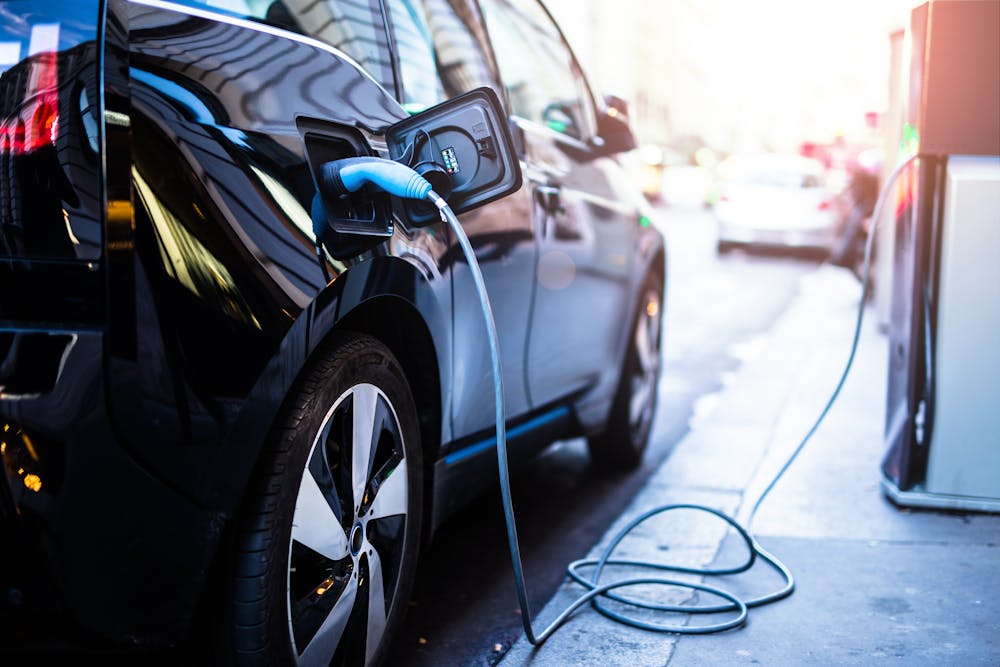 Petrol and diesel will need to be phased out by 2030, according to the International Energy Agency.
Shutterstock
Petrol and diesel will need to be phased out by 2030, according to the International Energy Agency.
Shutterstock
But the biggest take-home message for Australia is there must be no new development in fossil fuel beyond 2021.
No new fossil fuel development
The report states:
Beyond projects already committed as of 2021, there are no new oil and gas fields approved for development in our pathway, and no new coal mines or mine extensions are required.
Global demand for oil peaked in 2019, and has declined since then, largely due to COVID-19 lockdowns. Under the roadmap, this decline will continue and reach 75% by 2050. Any growth in demand during this period will be met by growing emergent markets in renewables, green hydrogen and bio-energy.
And of course, the report states no new coal plants should be financially supported unless equipped with carbon capture and sequestration. Inefficient coal plants must be phased out by 2030.
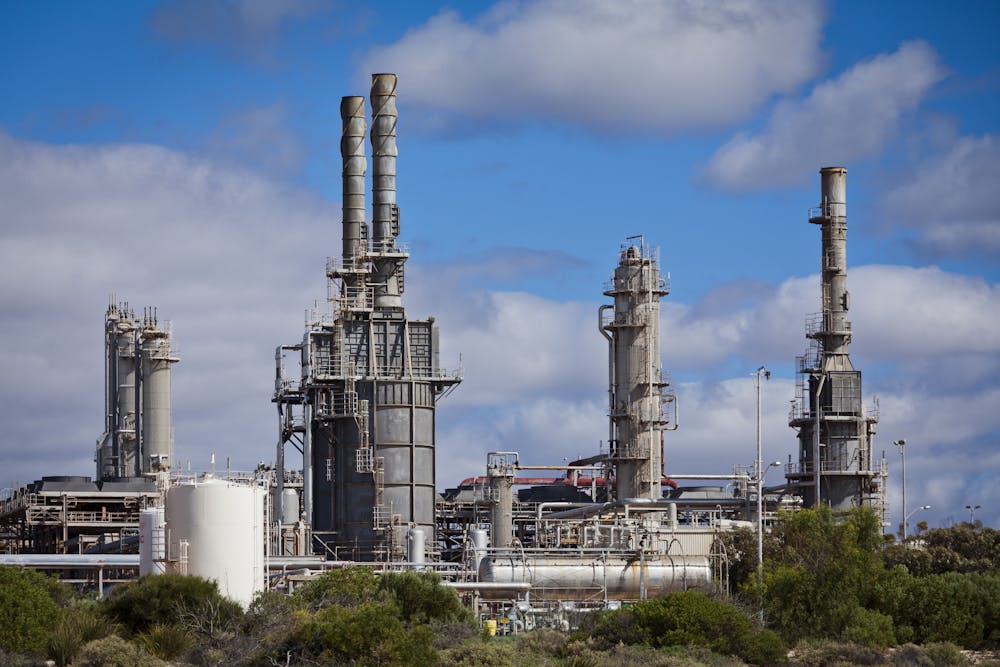 The federal government just announced over a half billion dollars for a new gas-fired power plant in NSW.
Shutterstock
The federal government just announced over a half billion dollars for a new gas-fired power plant in NSW.
Shutterstock
If the roadmap is followed, renewable energy will overtake coal by 2026, and oil and gas by 2030.
For this to happen, annual additions of 630 gigawatts of solar and 390 gigawatts of wind power will be required by 2030. This means the world needs to install the equivalent of “the world’s largest solar park roughly every day”, according to the report.
Australia, are you listening?
Australia’s gas-fired recovery plans are directly inconsistent with the IEA roadmap. The government has argued expanding fossil fuel supply is critical for energy security.
Not only did the federal government just announce over a half a billion dollars for a new gas-fired power plant in NSW, it’s also spending a further $173 million to develop the Beetaloo basin in the Northern Territory, another gas reserve.
Read more: Paying Australia’s coal-fired power stations to stay open longer is bad for consumers and the planet
Experts, advisers and Energy Security Board chair Kerry Schott have all disagreed with these moves. They argue, in line with the IEA report, that cheaper, cleaner alternatives to gas generation, such as wind and solar, can easily provide the dispatchable power required.
The government’s stubborn fossil fuel funding will make it more difficult than it already is to stop global warming beyond 1.5℃.
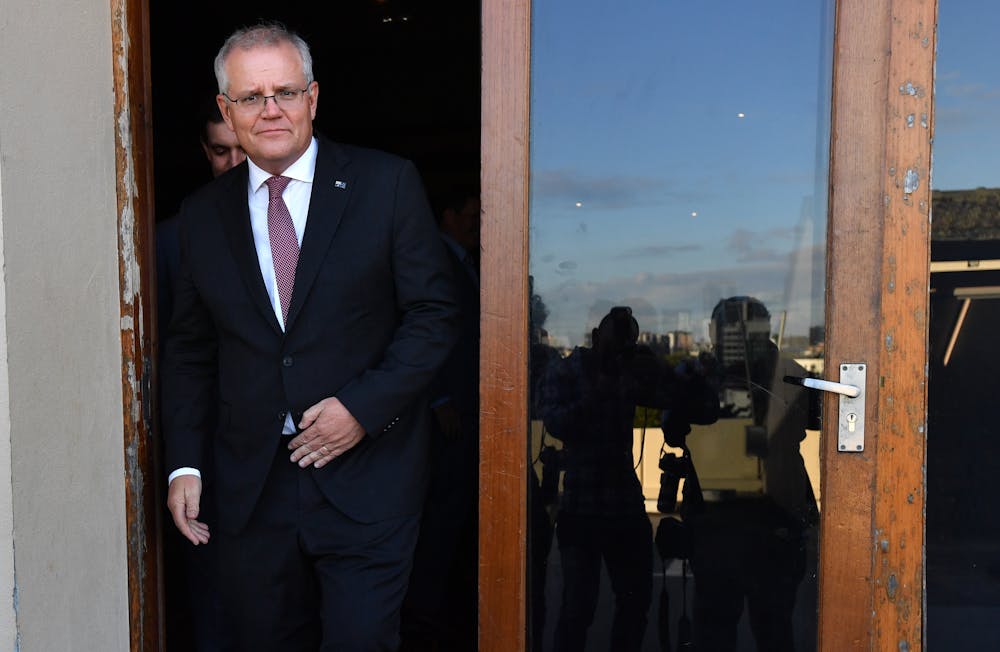 The government’s stubborn fossil fuel funding will make it more difficult than it already is to stop global warming beyond 1.5℃.
AP Image/Darren England
The government’s stubborn fossil fuel funding will make it more difficult than it already is to stop global warming beyond 1.5℃.
AP Image/Darren England
Australia must immediately stop investing in new fossil fuel projects. While this may be a difficult transition to accept given the enormous scope of gas reserves in Australia, there’s no point spending vast amounts of money on new infrastructure to extract a resource that will be commercially unviable in a decade.
Australia is ignoring the economic and environmental imperatives of transitioning to a low carbon framework. This is reckless, and unfair to other countries. We have the resource capacity and economic strength to transition our energy sector, unlike many developing countries. But we choose not to.
A national embarrassment
John Kerry, the US special presidential envoy for climate, says the next round of international climate talks in Scotland is the “last best chance the world has” to avoid a climate crisis.
But Australia’s investment in new gas development stands in stark contrast to the increasingly ambitious energy commitments of other developed countries. We shouldn’t come empty-handed, with no new targets, to yet another international climate summit.
US President Joe Biden has vowed to cut greenhouse gas emissions by 50-52% compared with 2005 levels. He has banned new oil and gas leases on federal land, removed fossil fuel subsidies and plans to double wind capacity by 2030.
Likewise, the European Commission seeks to stop funding oil and gas projects. Denmark recently implemented a ban on future gas extraction in the North Sea. And Spain has done the same.
Australia is ignoring its global responsibilities. As a result, we’ll be hit hard by the so-called “Carbon Border Adjustment” policies from the US and European Union, which tax imported goods according to their carbon footprint.
Ultimately, our actions will leave us economically and environmentally isolated in a rapidly emerging new energy world order.
Read more: The EU is considering carbon tariffs on Australian exports. Is that legal?
Authors: Samantha Hepburn, Director of the Centre for Energy and Natural Resources Law, Deakin Law School, Deakin University

















