

1 in 4 Australian year 8s have teachers unqualified in maths — this hits disadvantaged schools even harder
- Written by Sue Thomson, Deputy CEO (Research), Australian Council for Educational Research
Almost one in four (23%) Australian year 8 students were being taught maths in 2018 by teachers whose major qualification was in a field other than maths, new analysis reveals.
Internationally, on average, just one in ten year 8 equivalent students are taught maths by such teachers.
The analysis of Australia’s participation in the 2019 Trends in International Mathematics and Science Study (TIMSS) — an international assessment — was released today by the Australian Council for Educational Research (ACER).
The above figures have remained much the same since the 2015 TIMSS data collection.
When qualified teachers are assigned to teach subjects and year levels they have not studied at a tertiary level, this is known as out-of-field teaching. TIMSS also shows a large achievement difference between students taught by expert teachers and students taught by out-of-field teachers.
However, socioeconomic status has a large impact on student achievement, and TIMSS also shows more disadvantaged students are being taught by non-expert teachers.So, there may be a cumulative effect — with both teacher expertise and disadvantage playing a role in results.
Students with expert maths teachers score higher
TIMSS summarises achievement on the test on a scale with a mean of 500 and standard deviation of 100. In TIMSS 2019, Australian students achieved an overall average of 516 points in maths.
Read more: Australia lifts to be among top ten countries in maths and science
Students with expert teachers in maths, with specialist teacher training, scored significantly higher in maths in the TIMSS test than any other group.
Those taught by teachers with strong subject matter knowledge and pedagogical training in subjects other than maths scored next highest.
They all performed at a higher level than students taught by teachers with neither the subject-matter knowledge nor the pedagogical knowledge in maths.
 Percentages of Australian students (Year 8) by the type of major of mathematics teachers and corresponding average mathematics scores.
Data: ACER, CC BY
Percentages of Australian students (Year 8) by the type of major of mathematics teachers and corresponding average mathematics scores.
Data: ACER, CC BY
–
It’s important to note, however, the scores of students in this point-of-time assessment are not the simple result of the one teacher surveyed for TIMSS. They are a cumulative result of eight years of schooling.
One of the largest effects on student achievement is socioeconomic advantage and disadvantage.
Disadvantaged students bearing the brunt
Overall, 46% of year 8 students were taught maths by teachers with a major in both maths and maths education, while 23% were taught by out-of-field teachers.
However, while there is a general shortage of qualified maths teachers, it affects some students more than others.
Principals of the schools selected for TIMSS also reported on the socioeconomic composition of their schools. They were asked to indicate the percentages of students who came from economically affluent homes and from economically disadvantaged homes.
These responses were used to create three categories of school socioeconomic composition: more affluent, more disadvantaged and neither.
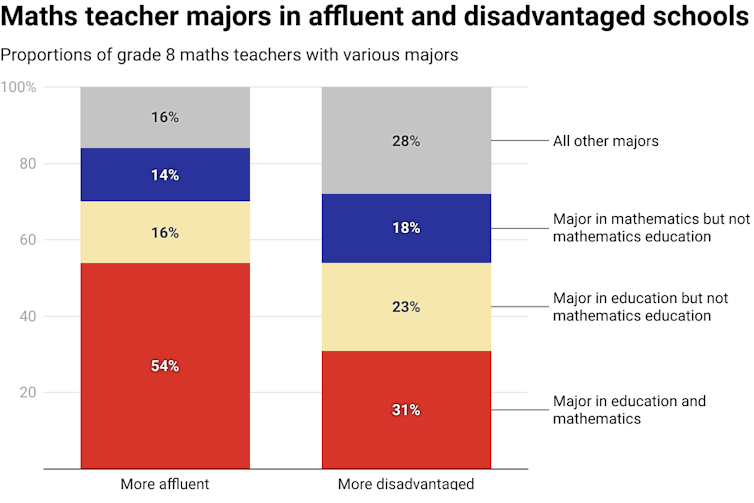
The TIMSS data show disadvantaged students are bearing the brunt of maths teacher shortages.
In more affluent schools, out-of-field teachers taught just 16% of students. More qualified maths teachers taught 54% of these students.
In contrast, in more disadvantaged schools, out-of-field teachers taught 28% of students. More qualified maths teachers taught just 31% of students.
 Data: ACER, CC BY
The average maths score for more affluent schools was 558 points, compared to 474 points for more disadvantaged schools.
A proportion of the achievement gap between students taught by out-of-field teachers and those taught by more qualified maths teachers must therefore be related to disadvantage.
Read more:
Australian schools are becoming more segregated. This threatens student outcomes
Many students in the disadvantaged secondary schools also would have attended disadvantaged primary schools, so may have had many years of more poorly resourced teaching.
Out-of-field teachers in Australia
According to the National School Improvement Tool (among many other documents on effective teachers and schools), highly effective schools have “teachers … [who] are experts in the fields in which they teach, [and] have high levels of confidence in teaching in those fields”.
Yet analysis from the Australian Mathematical Sciences Institute (AMSI) has warned that 76% of students will be taught by an out-of-field maths teacher at least once, and 35% of students twice, in the first four years of high school. Worryingly, 8% will be taught by out-of-field teachers for all four years.
Many out-of-field teachers have been teaching in that subject area for several years. Analysis of the 2013 Staff in Australia’s Schools survey showed out-of-field maths teachers had been teaching the subject to years 7-10 for an average total of 7.4 years.
While TIMSS data on years of teaching were not specific to maths teaching, it did show out-of-field teachers tended to have fewer years of teaching overall under their belt. Out-of-field teachers had 10.9 years on average compared to 16.3 years for the most qualified maths teachers.
How can we support out-of-field teachers?
The AMSI analysis suggests Australia will not be able to train enough new maths teachers in the short to medium term. So we need other alternatives.
One of these is to support out-of-field teachers by providing targeted forms of professional development. To do this requires an understanding of where weaknesses lie.
Some teachers might have the maths skills required but not enough understanding of maths teaching methods and practices. Other teachers might have the pedagogical background but weaker maths skills. Each group requires different professional development opportunities.
Read more:
Fixing the shortage of specialist science and maths teachers will be hard, not impossible
The TIMSS data show three-quarters of Australia’s out-of-field teachers reported needing professional development in maths content, compared to around half of the more qualified teachers.
And around 70% of all teachers said they need professional development in maths pedagogy and instruction, as well as assessment.
Initiatives like the federal government’s $9.5 million investment in high-quality mathematics and numeracy professional learning and resources is an important step in supporting out-of-field and in-field maths teachers alike to improve mathematics education, but it must be targeted.
Data: ACER, CC BY
The average maths score for more affluent schools was 558 points, compared to 474 points for more disadvantaged schools.
A proportion of the achievement gap between students taught by out-of-field teachers and those taught by more qualified maths teachers must therefore be related to disadvantage.
Read more:
Australian schools are becoming more segregated. This threatens student outcomes
Many students in the disadvantaged secondary schools also would have attended disadvantaged primary schools, so may have had many years of more poorly resourced teaching.
Out-of-field teachers in Australia
According to the National School Improvement Tool (among many other documents on effective teachers and schools), highly effective schools have “teachers … [who] are experts in the fields in which they teach, [and] have high levels of confidence in teaching in those fields”.
Yet analysis from the Australian Mathematical Sciences Institute (AMSI) has warned that 76% of students will be taught by an out-of-field maths teacher at least once, and 35% of students twice, in the first four years of high school. Worryingly, 8% will be taught by out-of-field teachers for all four years.
Many out-of-field teachers have been teaching in that subject area for several years. Analysis of the 2013 Staff in Australia’s Schools survey showed out-of-field maths teachers had been teaching the subject to years 7-10 for an average total of 7.4 years.
While TIMSS data on years of teaching were not specific to maths teaching, it did show out-of-field teachers tended to have fewer years of teaching overall under their belt. Out-of-field teachers had 10.9 years on average compared to 16.3 years for the most qualified maths teachers.
How can we support out-of-field teachers?
The AMSI analysis suggests Australia will not be able to train enough new maths teachers in the short to medium term. So we need other alternatives.
One of these is to support out-of-field teachers by providing targeted forms of professional development. To do this requires an understanding of where weaknesses lie.
Some teachers might have the maths skills required but not enough understanding of maths teaching methods and practices. Other teachers might have the pedagogical background but weaker maths skills. Each group requires different professional development opportunities.
Read more:
Fixing the shortage of specialist science and maths teachers will be hard, not impossible
The TIMSS data show three-quarters of Australia’s out-of-field teachers reported needing professional development in maths content, compared to around half of the more qualified teachers.
And around 70% of all teachers said they need professional development in maths pedagogy and instruction, as well as assessment.
Initiatives like the federal government’s $9.5 million investment in high-quality mathematics and numeracy professional learning and resources is an important step in supporting out-of-field and in-field maths teachers alike to improve mathematics education, but it must be targeted.
Authors: Sue Thomson, Deputy CEO (Research), Australian Council for Educational Research

















