some hard punches, but no delivery on the bigger picture
- Written by Paul Alexander, Adjunct Reseach Fellow (Supply Chains), Curtin University
The report of the Senate committee inquiry into the ousting of Australia Post boss Christine Holgate over Cartier watches, published yesterday, pulls no punches. Some of its 25 recommendations are blistering (with the inquiry’s Coalition members dissenting).
There has been intense interest in the events involving the Morrison government pushing Holgate out of her job over rewarding four senior managers with luxury watches, worth about $20,000, for securing a deal the report says was worth more than $200 million in revenue.
The saga has touched on issues of corporate rewards, the role of public service providers, the relationship between boards and senior executives, and workplace bullying. The report castigates Australia Post’s board and its owner (the federal government) over their understanding and respect for the organisations’s charter and proper governance.
But beyond the politics of the Holgate affair, perhaps the most strategically important parts of the report are those that touch on the reason Holgate gifted those executives those watches in the first place.
Australia Post has long been caught between its role as a publicly owned corporation expected to compete with private corporations and as a community service provider delivering letters, a business in terminal decline.
The sections of the report dealing with this, and the organisation’s future, should be the most interesting. But they are also the least satisfying, since they fail to really address the fundamental issues and offer a way forward.
Read more: Morrison should apologise to Christine Holgate and Australia Post chair should resign: Senate report
Letter delivery exemptions
An example of where the report falls short is its discussion of the relaxation of Australia Post’s community service obligations for letter delivery.
The government granted a temporary exemption in April 2020 so it could put more resources into parcel deliveries. The main effect of this was letters being delivered every second day in metropolitan areas, rather than every day, and having more time to deliver interstate mail.
That exemption runs out on June 30. The report recommends it not be extended, noting “some evidence” the government and Australia Post are “actively looking for ways to entrench lower community service obligations” and that performance standards might be lowered “without adequate consultation and appropriate parliamentary oversight”.
Its point about consultation and oversight is fair enough. Nonetheless, opposing any extension is still arguably the least helpful of all its recommendations.
Daily letter delivery is already a loss-making business for Australia Post. Reduced letter service levels are an appropriate corporate response. It has been struggling with this for years. The crisis of 2020, and the huge surge in parcel delivery, simply acted as a catalyst for changes long overdue.
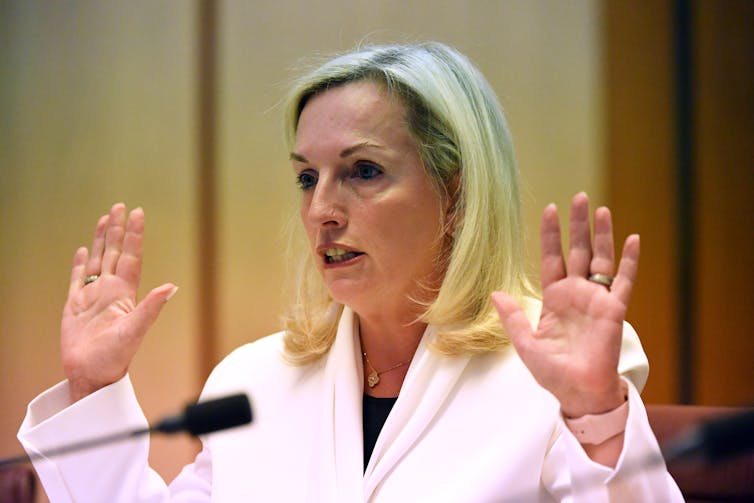 Former Australia Post chief executive Christine Holgate appears before the Senate inquiry on April 13 2021.
Mick Tsikas/AAP
Former Australia Post chief executive Christine Holgate appears before the Senate inquiry on April 13 2021.
Mick Tsikas/AAP
Read more: COVID hands Australia Post opportunity to end daily delivery
Torn between mandates
Australia Post is torn between being two organisations. On the one hand it is a public service organisation, with performance standards set by the parliament. On the other hand, its mandate is to be an effective corporate player in a competitive market.
It competes with others not only for customers but staff. Indeed, Holgate’s recruitment by parcel delivery competitor Global Express, the former division of Toll Holdings now owned by private equity company Allegro Funds, demonstrates this.
Part of attracting and incentivising managerial talent in a competitive market is through large salaries and rewards, in this case luxury watches. Bonuses are an accepted part of remuneration across the industry. If Australia Post is to attract talent it can’t afford to not to play this game.
Privatisation fears
Implicit in the inquiry report is concern of a long-term plan for Australia Post to abandon its public service role, and perhaps even be privatised. This appears to be why it wants the review of Australia Post commissioned from management consultancy Boston Consulting Group (BCG) made public.
BCG handed its report to the government in February 2020. The government has not released it. The inquiry report describes it as “secret”. There’s a clear imputation the reason is it contains political dynamite.
It is quite likely the BCG report does discuss lower mail service levels and privatisation. Any thorough review should cover all possibilities. But it is hard to see there being a compelling case to privatise Australia Post, or bits of it. No one is going to want to buy a loss-making letter-delivery business, and there’s no point selling the parcel business since it subsidises letter deliveries.
Reasons for confidentiality
It is more likely BCG focused on projections of demand in the parcel and letter businesses. It is clear Australia Post is at a tipping point with its business model. The parcels market is rapidly growing and the traditional letters market will be essentially wiped out in the next decade.
Any commercial organisation faced with such large technology and market changes, providing both threats and opportunities, needs a detailed understanding of its best way forward.
Read more: Australia Post's worst nightmare: Christine Holgate to head delivery rival Global Express
A report on such things will contain commercially sensitive information that a business operating in a commercial environment does not want to share – though in this case the horse has effectively bolted because Holgate has been forced out and taken all of her knowledge of the market, including insights from the BCG report, to a competitor.
Given this, and that these are topics of intense interest, perhaps the government should release the BCG report. The fallout from this debacle could hardly get much worse.
Authors: Paul Alexander, Adjunct Reseach Fellow (Supply Chains), Curtin University