

We all have to walk across roads — why aren't pedestrians a focus of road safety?
- Written by Margaret Brown, Adjunct Research Fellow, UniSA Justice and Society, University of South Australia
In May 2021 a B-double truck mounted a kerb when turning a corner in Melbourne, injuring five pedestrians. In February 2020 a drunk driver drove onto a footpath in Sydney, killing four children and injuring three others as they walked to get ice-creams. These incidents are just two of many grim reminders that pedestrians are an especially vulnerable group of road users.
“Pedestrians” includes most of us as we walk along or across roads, even if it is just to get to our car. Children, young people, city residents, older people and people on low incomes are especially reliant on walking rather than driving.
Read more: Slaves to speed, we'd all benefit from 'slow cities'
Pedestrians, along with cyclists and motorcyclists, are most at risk of injury and death when involved in a collision on the roads. In a crash, pedestrians are four times more likely to be injured than those in a vehicle.
The road toll has decreased over recent decades largely because fewer people in cars are dying. Pedestrian deaths have decreased much more slowly. In the decade to 2019, road deaths of car occupants fell three times as fast as for vulnerable road users (pedestrians, cyclists and motorcyclists).
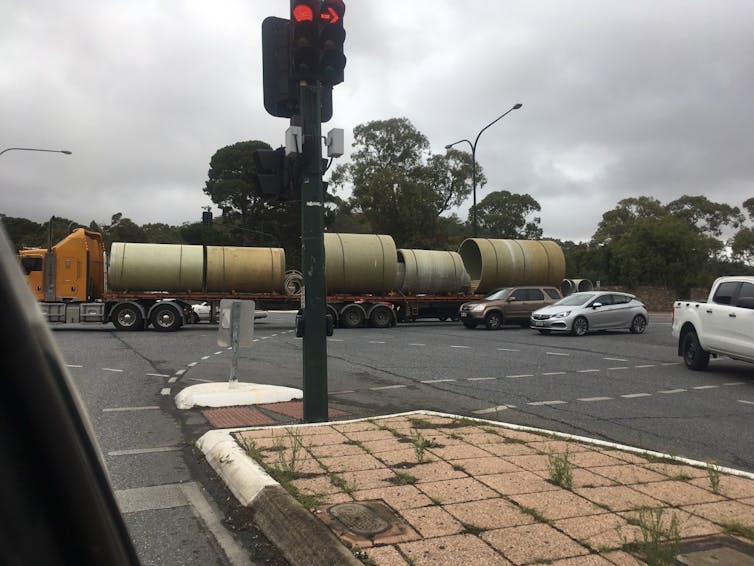 Many major intersections used by heavy vehicles have no pedestrian safety infrastructure.
Photo: Margaret Brown, Author provided (no reuse)
Many major intersections used by heavy vehicles have no pedestrian safety infrastructure.
Photo: Margaret Brown, Author provided (no reuse)
What are governments doing to protect pedestrians?
Australia has had many parliamentary inquiries and state and federal road safety strategies in recent years. A federal Office of Road Safety was created in 2019. However, the recommended road safety measures usually improve safety for people in vehicles or improve traffic flow. These measures do nothing for pedestrian safety.
Government reports and bodies have recently begun talking about the “safe system” approach. This approach is supposed to take a holistic view, sharing the responsibility for reducing risk by improving the safety of roads, vehicles and road rules, as well as driver behaviour. While some versions of this approach consider the safety of all road users, including pedestrians, this has not filtered through to government policies.
Some states have adopted climate change plans or strategies that promote walking and cycling. The South Australian Climate Change Action Plan 2021-2025, for instance, promises the state government will work towards a low-emissions transport system, improve public transport and encourage “active travel” – walking and cycling.
However, since the launch of the plan the state government has privatised trains and announced new roadworks to improve the flow of cars and freight vehicles. They are clearly paying little attention to the needs of pedestrians.
Read more: Cycling and walking are short-changed when it comes to transport funding in Australia
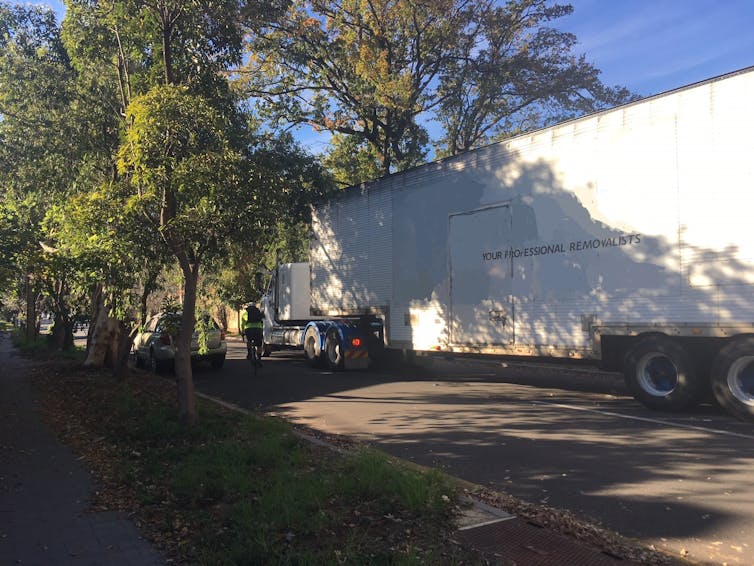 Truck and car traffic on roads without protective infrastructure deters people from walking and cycling.
Photo: Margaret Brown, Author provided (no reuse)
Truck and car traffic on roads without protective infrastructure deters people from walking and cycling.
Photo: Margaret Brown, Author provided (no reuse)
Safety affects everyone’s right to mobility
Australian governments neglect other perspectives such as the right to mobility for all. The International Covenant on Civil and Political Rights, signed by Australia, recognises the right to liberty of movement. The Convention on the Rights of Persons with Disabilities recognises the rights to access to transport and to personal mobility.
Our approach to road safety should, as Victoria Walks argues:
“[…] consider road safety as part of mobility for all people, whether they drive or not, and transport as part of the bigger liveability picture”.
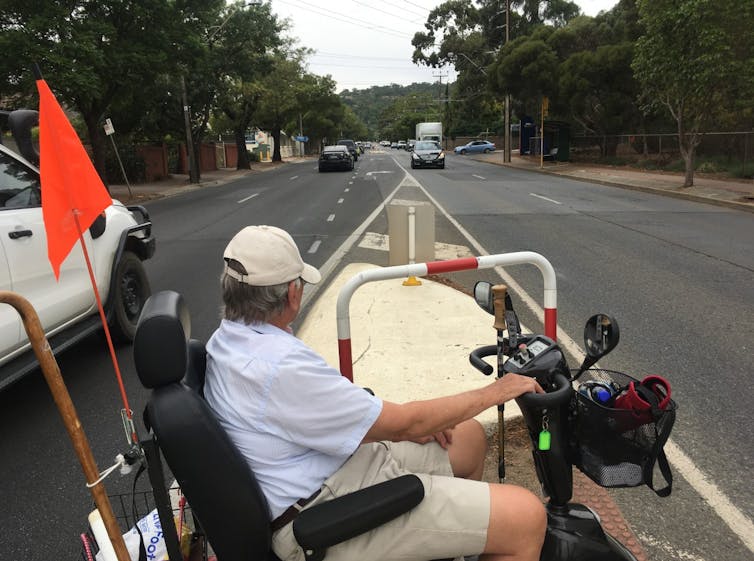 Road safety affects the right to mobility for all people, whether they drive a car or not.
Photo: Margaret Brown, Author provided (no reuse)
Road safety affects the right to mobility for all people, whether they drive a car or not.
Photo: Margaret Brown, Author provided (no reuse)
Another possible perspective is “liveable communities”. The concept of liveability promotes the critical factors of access to public transport, and walking and cycling infrastructure.
Read more: How do we create liveable cities? First, we must work out the key ingredients
So, how are Australian state and territory governments recognising our right to mobility and helping to build liveable communities for all?
In 2020, the Commonwealth Parliament’s Joint Select Committee on Road Safety received many submissions from organisations concerned with pedestrian safety. Its final report, released in October 2020, contains 22 recommendations. Yet none of these focus specifically on pedestrian safety, although “pedestrian awareness” is mentioned in relation to driver training.
How to make communities safer and more liveable
Recommendations in the Victoria Walks submission to the select committee covered topics such as:
- the design of crossings and intersections
- maintaining footpaths and walking routes
- banning e-scooters from footpaths
- reducing speed limits in residential areas
- increasing investment in public transport
- expanding the range of data collected on pedestrian injuries and fatalities.
The committee’s final recommendations reflected none of these points.
The Office of Road Safety is yet to release its National Road Safety Strategy. It says the strategy will consider “vulnerable road users” as a whole group. This approach fails to adequately consider the needs of pedestrians separately from motorcyclists and cyclists.
The previous National Road Safety Strategy 2011–2020 did include reducing “the number of serious casualties among pedestrians and cyclists” as one of its “major strategic challenges”. This suggests pedestrians are receiving even less attention now than they were a decade ago.
Some government publications recognise pedestrians as “vulnerable road users”. Yet almost no attention is paid to the most vulnerable pedestrians, namely older people, children and people with disability.
Governments are prioritising the flow of traffic, including of freight. They argue that’s good for jobs and economic growth.
There is little political will to discourage people from driving, to reduce speed limits, to prioritise walking (and cycling) infrastructure and to increase public transport funding. All of these measures contribute to mobility for all – including children, older people and people with disability. And that, in turn, will make our communities more liveable and sustainable.
I would like to acknowledge the work of my research assistant Kate Leeson and former colleague Peter Lumb.
Authors: Margaret Brown, Adjunct Research Fellow, UniSA Justice and Society, University of South Australia

















