

no magic reset of relations, but no hitting the snooze button, either
- Written by Matthew Sussex, Associate Professor, National Security College, Crawford School of Public Policy, Australian National University
Much speculation surrounded the lead up to the just concluded summit in Geneva between US President Joe Biden and his Russian counterpart, Vladimir Putin.
Coming after a NATO meeting where Biden reaffirmed his commitment to preserve Ukraine’s territorial integrity and sought to bolster the alliance against information warfare, it would have been fair to anticipate a relatively bellicose stance from the American leader.
By the same token, Putin had recently voiced some robust rhetoric that Russia would vigorously confront any threat to its sovereignty, alongside making a number of provocations, including massing troops on the border with Ukraine and lamenting the defeat of Donald Trump in the US presidential election.
All of this could have pointed to a feisty exchange between the two leaders.
In the end, the summit was a relatively calm affair. This was no doubt aided by the fact there were low expectations on both sides: they were merely hoping the hostile relationship could be ratcheted down a notch or two.
Red lines in the so-called grey zone
Despite the very low bar, it is likely both leaders marginally exceeded what they hoped to achieve.
The highlight was the announcement of a strategic dialogue between the two nations focused on arms control. That is comforting to an extent, but it was not a great stretch for either Putin or Biden to confirm that nuclear war was something each wished to avoid.
Arms control was already one of the few things Moscow and Washington could agree on — as witnessed by the New START nuclear weapons treaty extension that was concluded soon after Biden took office, at the height of tensions between the two leaders. So, there should be little enthusiasm this dialogue will break much new ground.
Instead, the key takeaway from the summit was that both the US and Russia remain determined to confront and compete with one another, albeit in a slightly more controlled way than the free-for-all of the Trump era.
A good indication of this was the identification by the US side of 16 components of critical infrastructure that it deemed off limits to Russian meddling. That was an interesting development in itself, since it thrust cybersecurity (which is key to the maintenance of critical infrastructure in an automated age) to the forefront on high-level, strategic interactions between adversaries.
But more to the point, it also signified a desire by the Biden administration to stabilise the relationship by identifying areas of the American society, economy and political system that it would not tolerate Russia attacking.
In other words, the US is seeking to draw red lines in the so-called grey zone.
Read more: Reagan and Gorbachev offer a script for Biden-Putin summit
Putin is a winner just showing up
The main question from this is whether Putin is at all interested in the type of strategic stability the US has offered.
One could make the argument the Russian state is at its most effective in its rivalry with the West in general (and the US in particular) when it acts unpredictably and seeks to exacerbate existing divisions within and between states. It has also used a variety of instruments, from repression to energy diplomacy, to successfully bolster its image as a great power, albeit a capricious one.
Read more: Belarus plane hijacking snarls Biden's hopes to repair strained US-Russia relationship
In fact, Putin is already the winner from the summit simply by virtue of the fact the Biden administration agreed to it. Images of the two leaders adopting a relaxed posture, seemingly at ease with one another, does much to salve Putin’s need for recognition and status.
Domestically, it helps him show Russians that he is still influential globally. And internationally, it supports the Kremlin narrative that Russia should be treated as a leading pillar of an emerging multi-polar order.
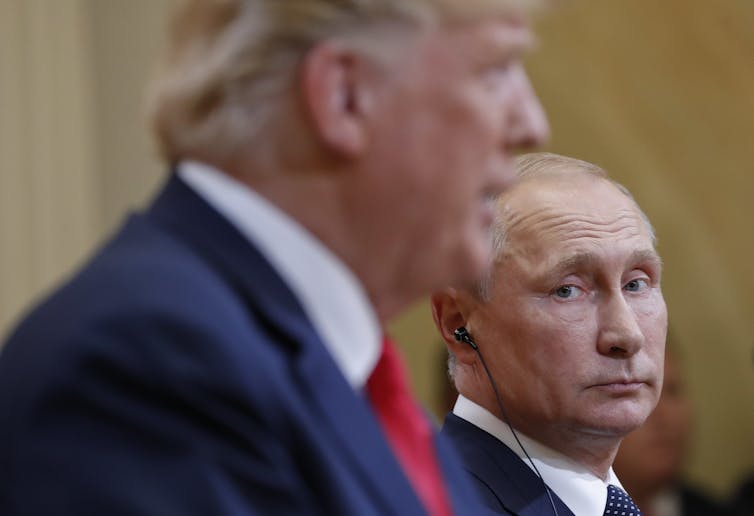 In an interview before the summit, Putin called Trump ‘colorful’ and said he felt he could work with Biden.
Pablo Martinez Monsivais/AP
In an interview before the summit, Putin called Trump ‘colorful’ and said he felt he could work with Biden.
Pablo Martinez Monsivais/AP
Where to from here?
It is true both leaders scored points against one another. Biden’s references to the treatment of Russian dissident Alexey Navalny and his condemnation of Russian influence operations were tailored for his domestic audience.
These messages focused attention on US core values, which sharply distinguished his presidency from the messy transactionalism of Trump’s. It sent the same message to America’s allies, in an attempt to reassure them the US was once again prepared to lead on such matters.
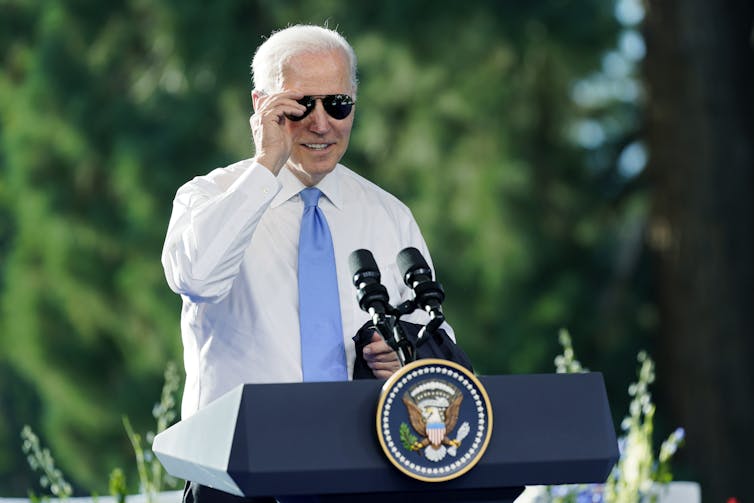 Biden said after the summit, ‘I did what I came to do.’
Patrick Semansky/AP
Biden said after the summit, ‘I did what I came to do.’
Patrick Semansky/AP
For his part, Putin engaged in some customary “whataboutism” when chiding the US as hypocritical in castigating others but not looking to its own deep internal problems. And given the opportunity in an NBC interview to deny he was a “killer”, as Biden had labelled him in March, Putin quite deliberately didn’t take it.
Ultimately, the Biden-Putin summit was certainly not a full “reset” of the relationship. Yet, neither was it an attempt to simply hit snooze on it, with Putin extracting concessions from Washington while Biden pauses US confrontation with Moscow to focus on the bigger challenge of a rising China.
Whether it is truly successful in returning some strategic stability to the relationship, though, will not be clear for some time. If Russia-US relations slide back into chaotic competition, at least Biden can say he tried.
And for his part, Putin will likely hint that he didn’t.
Authors: Matthew Sussex, Associate Professor, National Security College, Crawford School of Public Policy, Australian National University

















